creator cover Alex Bark
Alex Bark

Alex Bark 

I am Alexey and I love clarinet.

3subscribers

24posts

About

I'm a conservatory-trained clarinetist with a Bachelor's degree and 10 years of experience as a dedicated teacher. While my professional path has changed, my commitment to the clarinet remains stronger than ever!
Join me on my journey as I focus on advanced practice methods and new ways to elevate my playing. I'll be sharing the proven techniques and practical advice you need to sound your absolute best.
Let's achieve musical mastery together!

Tone development

Ideally, everything we do on the clarinet is work on tone. However, this is mostly true for players whose technique and sound are already well established. For those who are still searching for their sound or trying to improve it, it is important to dedicate separate time to tone development. This work should be done carefully and thoughtfully, using very simple material, sometimes just one or a few notes.
A short tone routine before regular practice can also be very helpful for experienced players who are returning after a long break. A new mouthpiece may also require this kind of focused practice, because a different mouthpiece often demands slightly different coordination between embouchure and air, depending on the register and dynamics. It is much easier to understand a new mouthpiece while playing simple exercises before moving on to repertoire.
In general, tone development can be described in the following way. First, we learn to play one note well, in a comfortable register and at a comfortable dynamic. Then we gradually expand this quality to other registers, higher and lower, and to different dynamics, softer and louder. After that, we learn to connect notes, first slowly and in small groups, and later faster and in longer phrases, always maintaining the same quality of sound.
It is especially important to practice crescendos, diminuendos, and wide intervals. These exercises develop flexibility, sensitivity, and coordination of the embouchure and the air more than almost anything else.
One long note
The first possible exercise is playing one long note. I like to use written C in the chalumeau register. The dynamic should be mezzo forte, not too loud and not too soft.

Developing articulation speed

When working on fast staccato, there are three main problems that need to be addressed:
  1. the speed of the tongue itself
  2. coordination between the tongue and the fingers
  3. endurance, or the ability of the tongue not to tire or become tense
Accordingly, we can distinguish three groups of exercises, one for each of these problems.
It is important to understand that fast and light staccato is based on legato articulation, not on staccato articulation. What I mean is that when we play a slow staccato passage, there are clear pauses between the notes. However, when a fast staccato passage is required, this approach does not work. On the contrary, a fast staccato passage should be treated as a legato passage, in which there are no pauses between the notes, and there is only a very brief and light touch of the tongue to create a minimal separation between sounds.
Developing tongue speed
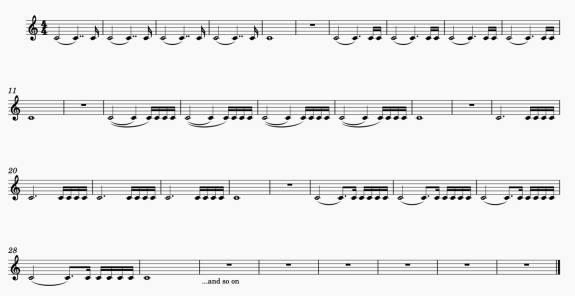
One of the best exercises is to play a long note and then add short, fast notes to it: first one, then two, then three, and so on, as in the example below.
It's important that the musical example above does not show the actual notes lengths. It should be understood as an approximate indication. The idea is to hold the long note long enough, first, to establish the exhalation, and second, to mentally prepare for the following short notes, which should be as fast and as light as possible.

Exercises for developing clean articulation

Correct articulation and good staccato are based on correct legato, or in other words, on a well-formed embouchure and breathing. For this reason, the first articulation exercises should not be understood as playing separate notes, but rather as playing one long sound that is interrupted by the tongue.
TICKLING TONGUING
  1. Begin by playing one long note. The sound should be stable and of good quality.
  2. When the sound becomes satisfactory, continue holding it and slowly begin to move the tip of the tongue toward the tip of the reed. It is very important that only the very tip of the tongue moves, and that it moves very slowly. Pay special attention to the fact that while the tongue is approaching the reed, the quality of the sound does not change. This indicates that your breathing, embouchure, and oral cavity are not changing their shape.
  3. When the tongue comes close enough to the tip of the reed, it will feel the vibration of the reed and a tickling sensation will appear. At the same time, the sound will change and become more muted or buzzing. At this moment, it is important not to change the air pressure in the mouth or the tension of the embouchure. You are still playing one long sound.
  4. Without stopping the sound and without changing breath pressure or embouchure, slowly and smoothly move the tip of the tongue away from the reed by a few millimeters, just enough for the sound to become normal again. It is important that the tongue moves away from the reed only by a very small distance.
  5. If necessary, take a breath and continue playing one stable, high-quality sound, slowly moving the tip of the tongue toward and away from the reed, alternating between the normal sound and the muted or buzzing sound.
Key points:

Air pressure remains constant, regardless of whether the tongue is touching the reed or not.

The shape and engagement of the lips remain constant, regardless of whether the tongue is touching the reed or not.

Only the tip of the tongue moves, and it moves very slowly. Slow movement helps control the tongue.

The tip of the tongue always stays close to the reed and does not move far away from it. In this way, the tongue helps direct the air toward the tip of the reed.

Until the moment when the tongue actually touches the reed, its movement should not cause any change in the sound.
TICKLING TONGUING WITH SOUND STOPPING
This is a variation of the previous exercise. You play one long sound. The movement of the tongue does not change the sound. The tongue movement is minimal and slow.
This time, however, when you touch the reed, feel the tickling sensation, and the sound becomes muted, you do something that causes the sound to stop completely.
Usually, this requires either slightly more pressure on the reed from the tongue, or a slightly larger area of the tongue touching the reed, or covering with the tongue the exact tip of the reed.

How to find optimal point of contact between the tongue and the reed

As I wrote above, I initially used "anchor tonguing" without much success. Later, I retrained myself to a method in which the very tip of the tongue touches the reed just below its tip, literally about one millimeter from the edge of the reed.
Although this approach was much better for me than "anchor tonguing", it still had some drawbacks. At times, I would miss the tip of the reed, and playing in the highest register became quite difficult. Eventually, I concluded that the most comfortable and reliable solution for me is when approximately five millimeters at the tip of the tongue touch approximately five millimeters at the tip of the reed, or at least when it feels that way.

Articulation

Teaching and learning articulation is quite difficult. There are many obstacles. We cannot see what is happening inside our own mouth or inside the student’s mouth. We are often not fully aware of how exactly our tongue moves inside the mouth, or which part of the tongue actually touches the reed.
Another difficulty is that tongue movements often cause changes in the embouchure or in the breathing, and ultimately in the sound. One more difficulty is that the length of the tongue can vary, as well as how much of the mouthpiece is taken into the mouth. It is easy to imagine that if a person has a very long tongue and plays on a mouthpiece with a long facing, it may be uncomfortable to use the classical approach of placing the tip of the tongue on the tip of the reed.
This means that the approach must be individual. At the same time, there are principles that apply to everyone. For example, the fact that the breath initiates the sound, while the tongue only helps to make the beginning of the sound more precise, or that articulation should not change the quality of the sound itself.
I personally had to relearn articulation after completing my formal conservatory education. I was using what is known as "anchor tonguing". This is a technique in which the tip of the tongue touches the lower teeth or the lower lip, while a part of the tongue closer to the middle touches the reed. I had a fairly "quick" tongue and a rather fast staccato. However, every attack was unclear, with extra noises, and playing isolated, clean, defined staccato notes was simply impossible.
Another problem, which I realized much later, was that the tip of my tongue was also pressing against the lower lip and was, in fact, supporting my embouchure. As a result, my embouchure had no chance to develop, because my tongue was partially taking over its function.
After finishing the conservatory, I began to experiment and discovered the approach described in "The Clarinetist’s Compendium" by Daniel Bonade, and it was the best thing I could have done for my articulation. In this approach, the very tip of the tongue touches the reed just below the reed tip. Staccato is treated as legato, with constant and even air pressure in the mouth, while the tip of the tongue moves forward and backward, touching the tip of the reed lightly, touching rather than striking it.

The integration of breath, embouchure, and oral cavity into a single system.

Earlier, I described different approaches to breathing, embouchure, and the oral cavity. If we try to apply all techniques at the same time, there is a high risk that the result will not be very good.
At this point, I will begin to slightly contradict myself. Earlier, I wrote that in the human/clarinet system, all parts are equally important, and that we cannot say that breathing is more important than the embouchure or the reed and mouthpiece. I truly believe this. However, adjusting all parts of the system at the same time is very difficult, so we need to choose the order in which we work on them or study them.
I suggest the following hierarchy: breathing - embouchure - oral cavity - followed by the mouthpiece and reed - the clarinet itself, and last - finger
technique. In other words, we should first develop good exhalation. I
deliberately avoid the word correct. Later, we add the embouchure to the
exhalation, and finally, if necessary, we fine-tune the sound using the oral
cavity.
Of course, all these elements are closely connected. For example, without a good embouchure, good breathing may produce a sound that is too straight and unprocessed. At the same time, without good breathing, even a good embouchure will produce a childish sound - weak and too soft, a sound that doesn't carry, a sound that doesn't sing. The development of a more intense exhalation stimulates the development of the embouchure, and vice versa. A stronger embouchure makes it possible to use more intense breathing.
So, what is a good exhalation?
Earlier, I wrote about breathing technique. Now I would like to
add a few thoughts about sensation and intention. Before that, however, I need
to make a short digression and speak about my student years.
When I was a student and listened to famous clarinetists, or when leading
clarinetists came to give masterclasses, I noticed how different their playing
was from mine and from that of many of my fellow students. This difference was mainly in how they shaped the musical line and how they connected individual notes into a single line, following a continuous line of breath. It felt as if they knew some secret that they were unwilling to share, because they spoke about things that we already knew.

Exercises for Shaping the Oral Cavity

As I mentioned earlier, we are often not very aware of what is happening inside our mouths. I like to use various exercises that help develop awareness and give greater control. These exercises can be done without the clarinet, or you can first do them without the instrument, memorize the sensations, and then immediately try the same sensations while playing the clarinet.
1. Exercise for the middle part of the tongue
Say the German "ich" several times in a whisper. The German "ich" sound can be approximated by combining two English sensations: the vowel quality of the "i" in the word "itch", and the soft, forward "h" sound found in words like "huge".
Pay attention to the hissing sound. Prolong it - you should clearly hear this hiss, similar to the sound a cat makes when hissing. Try to become aware of and remember the movement of the tongue.
Next, form an embouchure without the mouthpiece: the mouth is slightly open, the chin is flat, the corners of the lips are closed, the upper lip is lengthened and gently pressed downward, and a compact, round, or slightly oval opening is formed in the center of the lips. Without changing the position of the jaw or lips, whisper the German "ich" again and prolong the hissing sound. Repeat this several times and try to memorize the tongue movement.
Then, form the embouchure as described above and simply start exhaling through the small opening in the center of the lips. Exhale with enough intensity to clearly hear the hiss of air passing through the narrow opening. Now, without stopping the exhalation and without changing the embouchure, raise the middle part of the tongue, thinking of the German "ich". You should clearly hear the hiss become louder, and possibly even turn into a whistle. Repeat several times, memorizing the sensations.
Finally, try this exercise with the mouthpiece and clarinet. Place the mouthpiece in the mouth, form the embouchure, and begin exhaling without producing a sound. You should hear the hiss of air passing between the mouthpiece and the reed. This hiss should be low and intense. Without stopping the airflow and without changing the embouchure, raise the middle part of the tongue while thinking of "ich". You will hear the character of the hiss change - it will become louder and more focused. Then, without changing the tongue position and continuing to hiss, gently apply a bit of pressure to the reed by slightly firming the embouchure, making the opening smaller using the lips, the lower jaw, or, more realistically, a combination of both.

Subscription levels0
No subscription levels
Go up