Tone development
Ideally, everything we do on the clarinet is work on tone. However, this is mostly true for players whose technique and sound are already well established. For those who are still searching for their sound or trying to improve it, it is important to dedicate separate time to tone development. This work should be done carefully and thoughtfully, using very simple material, sometimes just one or a few notes.
A short tone routine before regular practice can also be very helpful for experienced players who are returning after a long break. A new mouthpiece may also require this kind of focused practice, because a different mouthpiece often demands slightly different coordination between embouchure and air, depending on the register and dynamics. It is much easier to understand a new mouthpiece while playing simple exercises before moving on to repertoire.
In general, tone development can be described in the following way. First, we learn to play one note well, in a comfortable register and at a comfortable dynamic. Then we gradually expand this quality to other registers, higher and lower, and to different dynamics, softer and louder. After that, we learn to connect notes, first slowly and in small groups, and later faster and in longer phrases, always maintaining the same quality of sound.
It is especially important to practice crescendos, diminuendos, and wide intervals. These exercises develop flexibility, sensitivity, and coordination of the embouchure and the air more than almost anything else.
One long note
The first possible exercise is playing one long note. I like to use written C in the chalumeau register. The dynamic should be mezzo forte, not too loud and not too soft.

What should we focus on while playing one “simple” note?
1. First, the sound must be stable. The volume should not change. This means that the embouchure is stable and the air is steady.
2. Second, once the sound is stable, we should listen carefully for additional noises inside the tone.
There are two main types of extra sounds:
a)The first is the sound of air noise moving through the mouthpiece and the clarinet.
b)The second is a kind of buzzing or ringing coming from the reed vibration.
Air noise is usually stronger when the embouchure is too open. Buzzing appears when there is too much pressure on the reed. Of course, extra noises can also be caused by a bad reed, but here we assume that the reed is at least acceptable.
By listening to air noise and buzzing, we can understand whether our embouchure is too relaxed or too tight. We can also decide what kind of sound we prefer. Some players like a sound with slightly more air and less brightness. Others prefer more core and focus, which can feel more brilliant. Ideally, we are looking for balance, a sound that is both warm and focused.
3. Third, we can begin listening to overtones inside the sound. For example, in written low C, the first overtone is G above it.

You can play low C and try to hear the G inside that sound. You can alternate between C and G to train your ear, and then return to C and try to hear G within it. This is not imagination. The overtone really exists inside the sound.
I believe that a strong fundamental note makes the sound feel deep and warm. A strong first overtone makes the sound project and carry better. The distance and balance between these elements create roundness and richness. This leads to a full and complex tone.
Several notes long tones
When one note becomes stable and controlled, we need to transfer this quality to other notes.
You can begin with one good long note. The first note in the pattern should be slightly longer than the others. Once the sound feels stable, add one or several additional notes. Play slowly and stay in one dynamic, usually mezzo forte. Make sure the volume does not change from note to note.
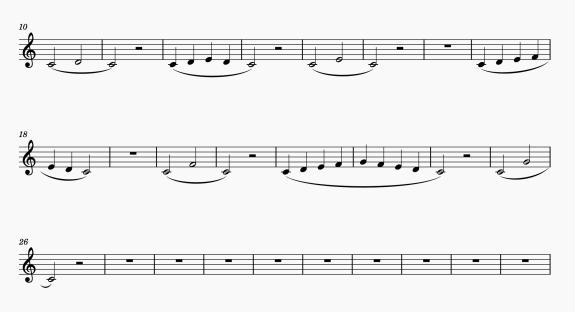
This is not a specific exercise but an example of how to expand one good sound to more notes, gradually increasing the number of notes or the distance between them. These exercises can be practiced in different registers and dynamics.
Crescendo and diminuendo on one note
A perfectly played crescendo and diminuendo is extremely difficult. The sound should appear from almost nothing, grow until it fills the room, and then disappear again, leaving a sense of resonance. This requires great control of the embouchure and air.
For beginners, it is helpful to start from mezzo forte. First, establish a good quality sound, then gradually make it softer or louder while keeping the tone stable.

More advanced players who are comfortable with very soft and very loud playing can practice starting from pianissimo, growing to fortissimo, and returning to pianissimo.

It is important to practice at least one note in each register: chalumeau, clarion, and altissimo.
Registers homogeneity
Homogeneity between registers is one of the most important goals.
In all exercises below, the main focus is that every note remains in the same dynamic. Start with mezzo forte. As control improves, practice the same exercises at fortissimo and pianissimo, while keeping both volume and tone color consistent.
Also, be careful to listen to the qualities in sound described in the "One long note" sections (aka primary tone, overtones, airiness, buzziness).
Intonation must also be carefully monitored.

Complex exercises
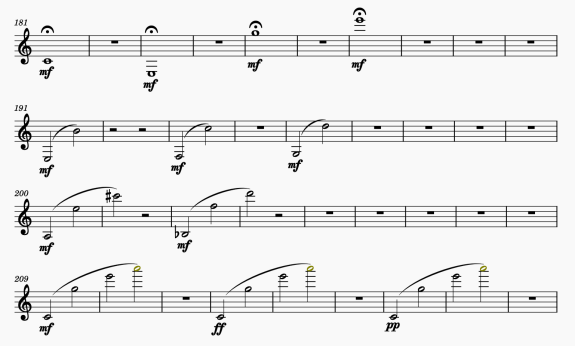
There is a wonderful exercise by David Weber that involves playing five chromatic notes up and down while performing a crescendo and diminuendo.
There are two versions of this exercise, which differ only in how the crescendo is distributed across the notes.

Another excellent exercise begins on low E at pianissimo. Gradually make a crescendo. When the sound is full and strong, move to B in the clarion register. Stay on that note for a moment and listen carefully. Then perform a smooth diminuendo.

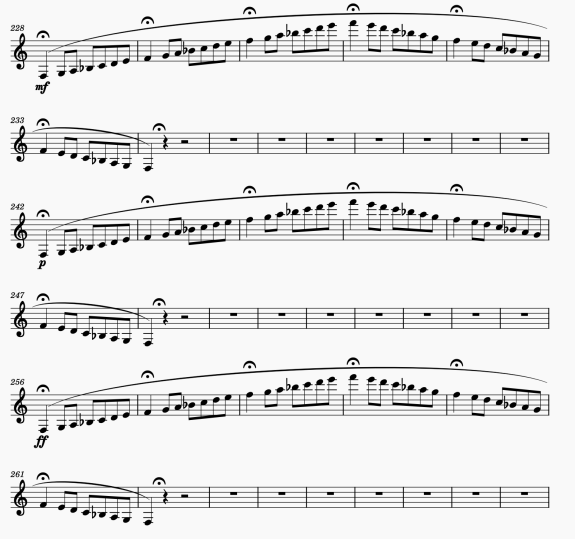
The next exercise may look like a scale or a technical exercise, but it is still a tone exercise. It should be played slowly and lyrically. Some notes have fermatas. These are notes where we stop in order to evaluate the sound in that register and to stabilize the tone to carry qualities through the next notes.
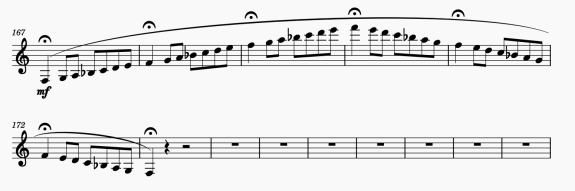
It is extremely important that all notes remain at the same dynamic level. Listen carefully and do not ignore small problems. Start at a comfortable dynamic. Later, try very soft and very loud playing, while maintaining beauty and resonance.
If the altissimo register is still unstable, the exercise can be limited to chalumeau and clarion registers.
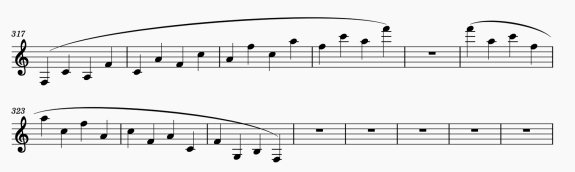
Another excellent exercise is playing broken chords slowly. Before playing each next note, try to hear it clearly in your mind. Only after you imagine the sound should you play it. This is very different from playing the same pattern quickly as a technical exercise.

Finally, we must remember that long tone practice is physically demanding for the embouchure. It may be better to practice tone development separately from repertoire, or to select only a few tone exercises before the main practice session.
Below is an approximate example of exercises that include all the elements: one long note, register consistency, and dynamic control. Usually, about 15 minutes is enough to play through these exercises, as long as you stay reasonable and do not aim for absolute perfection.