
Developing articulation speed
When working on fast staccato, there are three main problems that need to be addressed:
- the speed of the tongue itself
- coordination between the tongue and the fingers
- endurance, or the ability of the tongue not to tire or become tense
Accordingly, we can distinguish three groups of exercises, one for each of these problems.
It is important to understand that fast and light staccato is based on legato articulation, not on staccato articulation. What I mean is that when we play a slow staccato passage, there are clear pauses between the notes. However, when a fast staccato passage is required, this approach does not work. On the contrary, a fast staccato passage should be treated as a legato passage, in which there are no pauses between the notes, and there is only a very brief and light touch of the tongue to create a minimal separation between sounds.
Developing tongue speed
One of the best exercises is to play a long note and then add short, fast notes to it: first one, then two, then three, and so on, as in the example below.
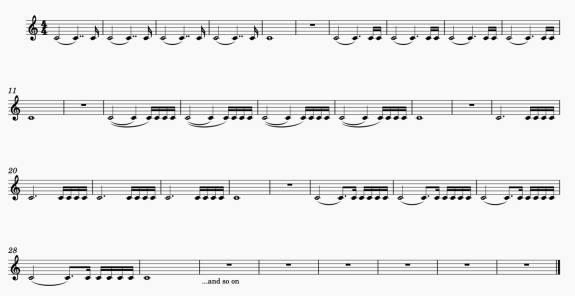
It's important that the musical example above does not show the actual notes lengths. It should be understood as an approximate indication. The idea is to hold the long note long enough, first, to establish the exhalation, and second, to mentally prepare for the following short notes, which should be as fast and as light as possible.
Remember that the tip of the tongue should always be as close as possible to the tip of the reed, and the tongue itself should be as relaxed as possible.
Play this exercise in different registers, starting with the most comfortable one and gradually moving to the lowest and the highest registers.
Developing tongue endurance
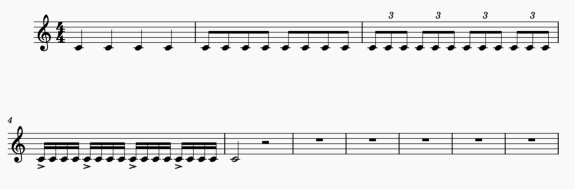
Play the exercise above using legato articulation. The notes should be as long and connected as possible, and the separation between notes should be almost not be heard.
The tongue only lightly and fleetingly brushes the reed. When playing sixteenth notes, you may start by playing one bar as written, but if you feel that the tongue is not yet tired, play two or more bars until the tongue becomes fatigued and begins to stumble. If the sixteenth notes feel easy, the tempo of the exercise should be increased.
Also, to make the task slightly easier when playing sixteenth notes, you can, and in fact should, play the first note of each group of four with a light accent, while playing the remaining three notes much more lightly.
Remember, the tip of the tongue should always remain as close as possible to the tip of the reed, and the tongue should be as relaxed as possible. This exercise should also be practiced in different registers, starting with the most comfortable and gradually moving to the lowest and highest registers.
Developing coordination between the tongue and the fingers

The musical example above does not show the actual notes lengths. It serves only as an approximate guide. The idea is that during the pauses, you can take a breath and mentally prepare for the following short notes, which should be as fast and as light as possible, with perfect coordination between the tongue and the fingers.
The following exercise should also be played with legato articulation. The notes should be maximally connected, with no pauses between them.
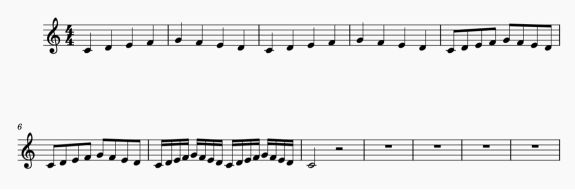
The next exercise is aimed at understanding how the tongue works in mixed articulation.

Mixed articulation, for example, two notes legato followed by two notes staccato, can cause difficulties at fast tempi. One reason may be that the tongue is not quick or light enough. Another reason may be that the transition from slurred notes to staccato notes requires special attention.
The point is that staccato notes at fast tempi are played with legato articulation; however, the last slurred note before the staccato must be played with a stopping tongue.
Let me explain this using the first bar above as an example. We play the note C, then we play the note D, and we must stop the sound of the note D by touching the reed with the tongue, without stopping the breath. In other words, we end the note D using the tongue. This movement prepares the tongue to play the following notes with legato articulation, as connected as possible and without pauses between the notes. I want to emphasize that this applies specifically to fast tempi. At slow tempi, staccato notes are also played with a stopping tongue, not with legato articulation.
In an exaggerated form, this can be represented as shown below.
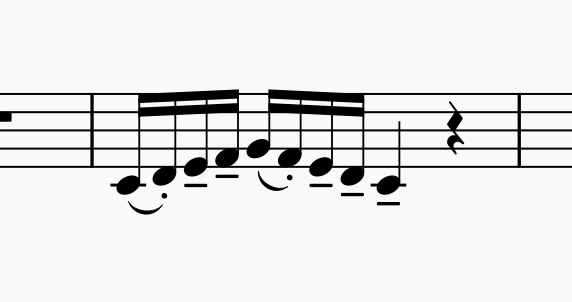
The dotted notes are notes whose sound is short because we stop their vibration with the tongue. This movement prepares the tongue for the following notes. The remaining notes are played tenuto, long and connected, but still with the tongue.
Once again, I would like to emphasize that for any type of articulation, it is important that the tongue remains relaxed, that its movement is minimal, and that the tongue always stays close to the reed.