
Natural resorption of herniated disc at the level of L5-S1. Formation of foraminal herniation at the level of L4-L5. Clinical observation.
Patient B, 57l, came for a consultation. Past medical history. First time severe pain in the lumbar region with irradiation to the left lower extremity occurred in 2017. He refrained from the proposed surgery. I was treated conservatively. The pain gradually regressed and the patient had no back problems for several years. He became ill again in 2025, but this time the pain from the lumbosacral region irradiated to the right lower extremity. MRI scans from 2017 and 2025 were presented for consultation.
Below is a series of scans from 2017
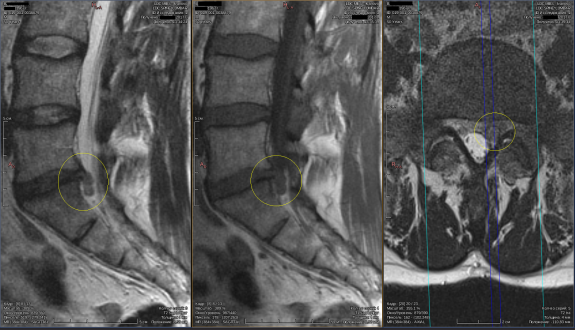
MRI of the lumbar spine dated 2017. Left-sided paramedian sequestered L5-S1 herniation is seen.

MRI of the lumbar spine dated 2017. Left-sided paramedian sequestered L5-S1 herniation is seen.
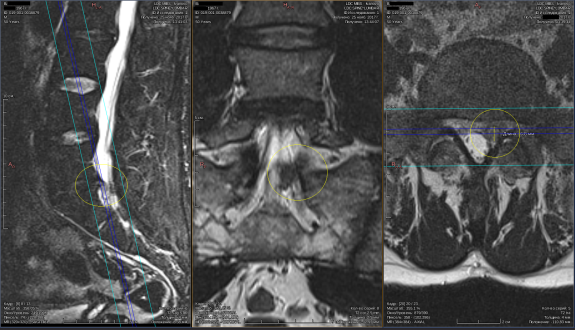
MRI of the lumbar spine dated 2017. Left-sided paramedian sequestered L5-S1 herniation is seen.
MRI scans from 2025 show resorption of the L5-S1 disc herniation over the past 8 years.

MRI of the lumbar spine from 2025. Resorption of sequestered herniated herniated disc of the L5-S1 intervertebral disc is seen.

MRI of the lumbar spine from 2025. Resorption of sequestered herniated herniated disc of the L5-S1 intervertebral disc is seen.
Further MRI scans show an ascending right foraminal herniation of the L4-L5 intervertebral disc, compressing the right L4 root, which is responsible for the patient's current pain syndrome.
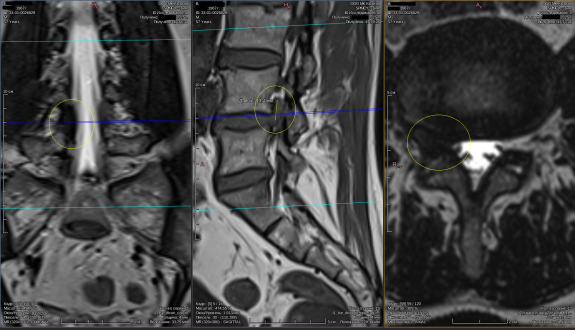
MRI of the lumbar spine from 2025. A right-sided foraminal ascending herniation of the L4-L5 intervertebral disc is seen.

MRI of the lumbar spine from 2025. A right-sided foraminal ascending herniation of the L4-L5 intervertebral disc is seen.
The
natural resorption of a herniated disc involves several mechanisms
and varies in timing, influenced by factors like the type and size of
the herniation1.
Scientific literature suggests that spontaneous regression of lumbar
disc herniation does occur, although not in all patients1.
natural resorption of a herniated disc involves several mechanisms
and varies in timing, influenced by factors like the type and size of
the herniation1.
Scientific literature suggests that spontaneous regression of lumbar
disc herniation does occur, although not in all patients1.
Pathophysiology of Natural Resorption
The mechanisms behind the spontaneous resorption of a herniated
disc include:
disc include:
Dehydration: The herniated nucleus pulposus
can shrink as it loses water, potentially allowing it to retract
back into the fibrous ring1.
can shrink as it loses water, potentially allowing it to retract
back into the fibrous ring1.
Mechanical Retraction: Herniations that
bulge without damaging the outer ring may retract1.
bulge without damaging the outer ring may retract1.
Inflammation and Neovascularization: Disc
herniation can trigger an inflammatory response and the growth of
new blood vessels in the epidural space. This leads to the enzymatic
degradation and phagocytosis of cartilage1.
Fragments of hyaline cartilage may experience swelling or loss of
proteoglycan1.
herniation can trigger an inflammatory response and the growth of
new blood vessels in the epidural space. This leads to the enzymatic
degradation and phagocytosis of cartilage1.
Fragments of hyaline cartilage may experience swelling or loss of
proteoglycan1.
Disc Composition: Resorption is more likely
when the herniated disc mainly consists of nucleus pulposus4.
Larger herniations may be resorbed more easily due to the greater
volume of nucleus pulposus exposed to circulation7.
when the herniated disc mainly consists of nucleus pulposus4.
Larger herniations may be resorbed more easily due to the greater
volume of nucleus pulposus exposed to circulation7.
Approximate Dates of Natural Resorption
The timing of resorption varies considerably:
Resorption can occur over a period of 1.5 to 48 months, with
the frequency of resorption ranging from 4.3% to 93.3%1.
the frequency of resorption ranging from 4.3% to 93.3%1.
Significant relief may be experienced within three to six
months as the herniated disc begins to reabsorb3.
months as the herniated disc begins to reabsorb3.
Long-term healing and tissue remodeling can continue for
several months to a year or more3.
several months to a year or more3.
One study reported that the timing of herniation regression
is at least 1 year1.
Another study found that resorption of sequestered disc herniations
occurred after an average of 9.3 months1.
is at least 1 year1.
Another study found that resorption of sequestered disc herniations
occurred after an average of 9.3 months1.
Different types of herniations regress at different rates.
Sequestrated herniations tend to regress after about 9 months, while
extrusion herniations take approximately 12 months. Protrusion
herniations may regress very slowly1.
Sequestrated herniations tend to regress after about 9 months, while
extrusion herniations take approximately 12 months. Protrusion
herniations may regress very slowly1.
The majority of massive lumbar disc herniations resolve at
variable points between 3 and 21 months7.
The average time for spontaneous resorption is around 9 months, with
giant disc herniations resorbing earlier than other types7.
variable points between 3 and 21 months7.
The average time for spontaneous resorption is around 9 months, with
giant disc herniations resorbing earlier than other types7.
In some instances, complete healing can take up to six
months5.
months5.
Healing Stages:
Reduced inflammation may occur within the
first week with treatment5.
first week with treatment5.
Tissue repair can take between 2 and 12
weeks, during which the nucleus of the disc either dries up or stops
pushing into the nerve canal5.
weeks, during which the nucleus of the disc either dries up or stops
pushing into the nerve canal5.
Remodeling occurs later in the healing
timeline as muscles strengthen and flexibility returns5.
timeline as muscles strengthen and flexibility returns5.
Scientific Publications
Relevant scientific publications on this topic include:
Resorption of Lumbar Disk Herniation: Mechanisms,
Clinical (2023)2
Clinical (2023)2
Characteristics and mechanisms of resorption in lumbar
disc (2022)4
disc (2022)4
Prediction and Mechanisms of Spontaneous Resorption in
Lumbar (2023)7
Lumbar (2023)7
"Resorption of lumbar disc herniations: a non-systematic
literature review"6
literature review"6
"Non-Surgical Approaches to the Management of Lumbar
Disc"8
Disc"8
"RESORPTION Of LUMbAR DISC HERNIATIONS"1
Citations:
Neurosurgeon
Sergey Tikhomirov
https://sites.google.com/view/doctor-tikhomirov-s-e/telemedicine
WatsApp +79016852305
Telegram/Viber: +79519191113