
Russian State Library
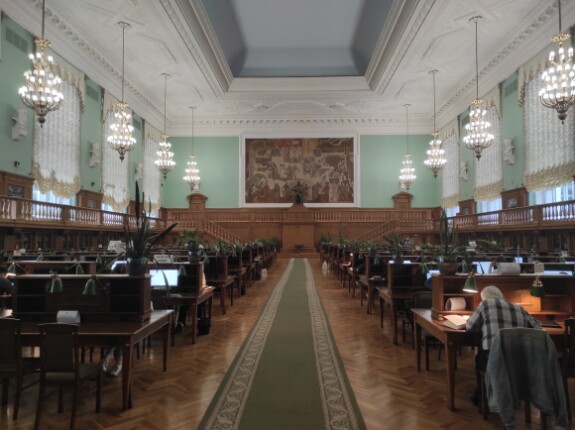
The biggest library in Russia and one of the biggest in the world. It was designed in late 1920s, soon after the birth of the new Soviet state, and fully finished in the 1950s. In includes 4 buildings and one 19-floor book repository. There are several reading halls, a cafe, and a whole bunch of book-filled nooks and crannies.
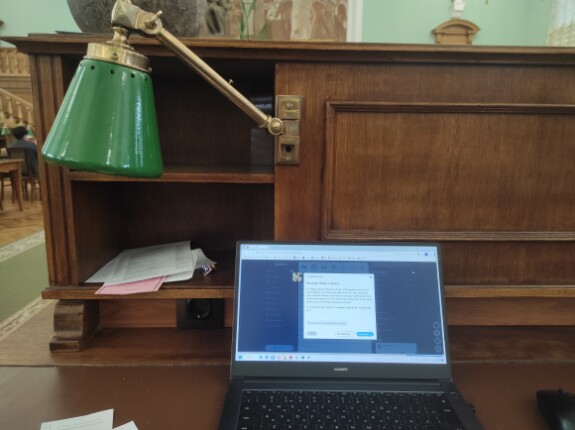
I'm writing this post sitting in the library's biggest reading hall - Reading Hall No. 3. It was opened in 1957 and still retains most of the original furniture and design (only there are now individual power sockets in every desk). Most of the tables are occupied by people with books and laptops. It's very quiet.
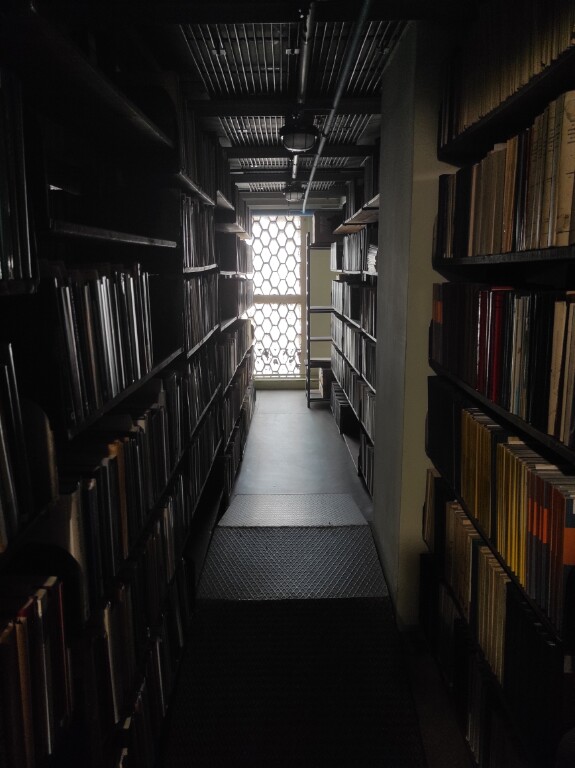
The book depository is a huge building that rises high above everything else in this historical area. It had 10 floors originally, each 5m high, but later it was divided into 19 smaller floors. We visited one of the floors. I was impressed to see that the windows are made out of Falconnier glass blocks (made specially for the library in Gus Khrustalny).
There are two automated delivery systems in the library: one delivers readers' orders into the depository (pneumatic tubes) and the other delivers books back to the reader (monorail). We had a chance to see both of them in action, very impressive! They also kept a bit of the old book delivery system that worked from 1953 until 2015. I saw it on pictures before, and it was great to see the granny in real life. :) There are a lot of "grannies" in the library, from the green lamps to rotary phones to wall clocks. The pneumatic tube system has been in place since 1975. People whose job is to preserve books are very likely to preserve everything else.


I loved this anecdote. In one of the reading halls, there's a big painting of Lenin (pictured below). Apparently it was put in place in mid-1950s to cover the bas-relief that was there originally. On the bas-relief there are Karl Marx, Friedrich Engels, Vladimir Lenin and Joseph Stalin. After Stalin's death in 1953 and debunking the cult of personality, images of him were quickly removed from everywhere. The library, being true preservers of history, kept theirs but covered it up. It just shows what kind of people librarians are. :)

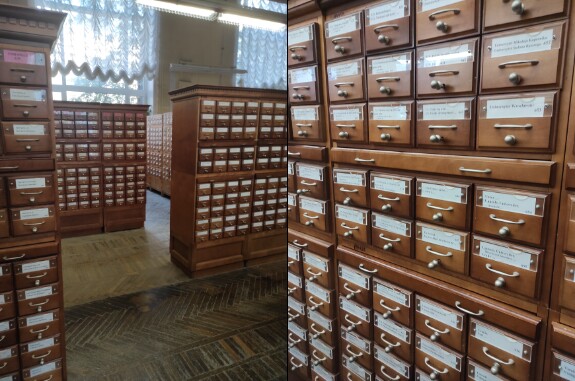
Although the library is working on running a full digital catalogue of all their 48 million items, if you want access to older editions you'll probably need to use the old paper card catalogue. The room gave me major nostalgy - I remember using this kind of catalogue in my local library when I was a kid. The sound of pulling out a narrow box, then the little built-in table, going through the cards one by one, writing down what you need on library cards. It was a whole process! Of course, the local library's catalogue was WAY smaller.

A few more shots of interiors. Although the building itself was designed in 1920s (during the era of avantgarde and art deco), the interiors were mostly done in 1950s when the main design style was neo classicism.

I enjoyed this tour immensely, so much so that I had to go back and get a library card so I can see more of it, sit in every reading hall and drink a cup of tea in the marble hall cafeteria. Also, the idea of 48 million books at the tip of my fingers makes me giddy. Thank you to my followers for the monetary support and making this real for me: K. T., H. W., T. B., m., @depetium, @transarkadydzyubin, S. R.

