
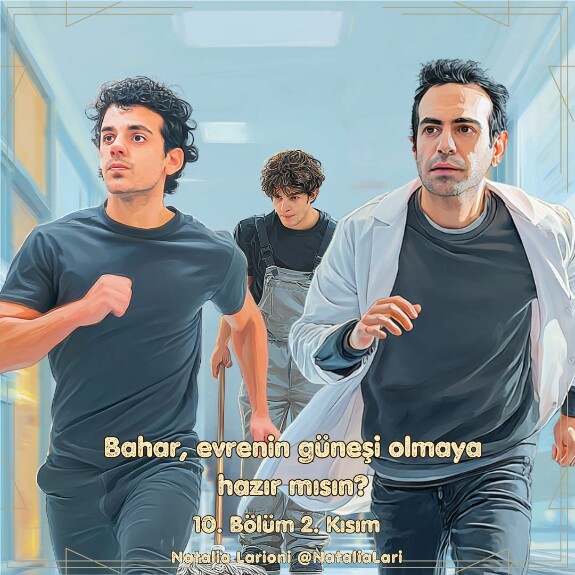
Bahar, Are You Ready to Be the Sun of the Universe?
Chapter 10. Part 2
She had never tried to hide behind anyone’s back before, but right now Bahar was grateful that Yusuf had taken the blow for her. She couldn’t tell whether it was good or bad, but she let him temporarily postpone the moment she would have to confess her pregnancy to Evren.
— What did you say? — Evren asked again, as if he couldn’t make sense of his own question to Yusuf.
— Bahar and Rengin helped me make up my mind, — his voice grew steadier with each phrase, as if, right then and there, Yusuf himself wanted to learn the truth. — We’ll do a test, so there’s no more guessing or— — he hesitated, and Bahar’s fingers tightened on his shoulder, — or we’ll find out that neither of you is my father, — Yusuf found the strength to say it aloud.
Bahar felt an urge to hug him — there was so much pain in his words.
— It had to happen sooner or later anyway, — he shrugged. — Better now, — he even smiled, not realizing that his lips were trembling.
— Now? — Serhat spoke up. — Evren and I have an emergency patient, do you even realize that… — he began.
Rengin turned pale, swayed slightly, pressed a hand to her stomach. Bahar kept her hand on Yusuf’s shoulder, silently supporting him, holding her breath for a moment. Doruk coughed, pulling everyone back to reality.
— I understand, — Yusuf nodded. — It’s always bad timing. Wrong time when I was born, wrong time when I showed up here. You never had time for me, — he said it evenly, as if he had already come to terms with it, but it was only an illusion.
Bahar felt his body trembling.
— You were always busy, — he shrugged again. — I’ve always been something you could postpone.
Yusuf spoke quietly but firmly. Bahar almost hugged him again; his words cut right through her, while the two men seemed paralyzed, unable to find words. Both remained silent.
— I’m not forcing anyone, — Yusuf placed the test tubes on the table. — Decide for yourselves, tell me when you’re ready. I’m not rushing anyone. Bahar, Rengin, — he turned to them, — I think that’s enough for today. Shall we go home? — he asked, glancing at them.
— A DNA test, — Serhat stepped back. — To destroy everything? — the words escaped him.
Yusuf turned to him slowly.
— To end it, — he looked intently at the man he had considered his father all these years.
Evren, slightly frowning, stared at the test tubes and said nothing.
— Do you even understand what that means? — Serhat unbuttoned his collar. — If I turn out to be… — he stopped mid-sentence, fell silent, then went on. — I have a daughter. I can’t.
— Serhat, — Evren turned to him, — it’s hard for everyone. If Yusuf turns out to be my son, — he swallowed hard, — I wasn’t there for him.
He stopped, and silence filled the room. Serhat was tense, like a drawn string. Bahar could barely breathe, struggling against a sudden wave of nausea. Rengin was clutching one hand to the monitor, the other still pressed to her belly. Evren moved his head, loosening his neck. Doruk just sighed — an unwilling witness who couldn’t walk away; now he too wanted to know how this would end.
— Three methods, — Evren broke the silence. — A swab — one week. Blood — one day. There’s also a rush test — a few hours, but it’s not reliable, — he said, looking at Yusuf. — I’d prefer the accurate one — the first or second, — Evren turned to Serhat. — Which one do we choose? — he wasn’t really asking; he was forcing a decision.
— That’s not something you decide like this, — Serhat avoided his gaze, uneasy, on the verge of a panic attack.
— We’ve already decided, Serhat. We’ll do the test. It’s worse to pretend everything’s fine when it’s not, — Evren said quietly. — It’s the only way to stop fighting over the past. We won’t postpone it again, will we, Serhat? — he added. — We’ve already postponed too much in life.
Serhat looked away, lacking the courage to meet his eyes, yet he nodded — agreed.
— Then let’s go to the lab, — Evren exhaled, forgetting for a moment about the patient — and about the fact that Bahar had unwittingly deceived him with those lemons.
Serhat turned pale, handed Doruk the patient’s chart, and followed Evren and Yusuf. He walked as if to the gallows. Doruk watched them go, motionless.
— Doruk, — Bahar called after him, — what about the patient? Do you need help?
Doruk turned toward her.
— No, I’ll handle it while the professor’s busy, — he said, waving the chart before leaving in the opposite direction.
Bahar and Rengin exhaled with relief — they no longer hid how exhausted this day had left them.
***
That day felt endlessly long. The air in the ultrasound room grew thick and heavy after the men left. Bahar smoothed her hair and stepped out first; Rengin followed. For a while, they just walked side by side in silence. Bahar suddenly felt dizzy and reached for the wall, trying to steady herself, stopping by the window.
Through the glass, the Bosphorus shimmered, car lights glowed, and the muffled hum of the city reached them. Bahar leaned against the wall and took a deep breath.
— You’re very pale, — Rengin whispered, glancing around. — Let’s sit down for a minute, — she suggested.
— I can’t, — Bahar admitted. — If I sit down now, I won’t get back up, — she tried to smile. — Just dizzy, — she swallowed hard. — Emotions.
— Have you even eaten today? — Rengin frowned slightly, trying to figure out which smell was bothering her this time.
Bahar just shook her head and tried to take a step, but it was unsteady, and Rengin caught her by the elbow.
— You haven’t eaten either, — Bahar sighed. — No one has. — A small, tired laugh escaped her. — We’re pregnant together again.
— At least not by the same man, — Rengin replied, her voice heavy with exhaustion.
— Huh, — Bahar’s face changed, but she said nothing.
— You heard him, — Rengin stared at the floor. — He’s not ready for a child. And I… — she faltered, — I don’t even know how to tell Parla.
Bahar blinked, chasing away the darkness before her eyes.
— My list’s longer, — she whispered. — Uraz, Umay, Siren, Mom, Çagla, Nevra, — she smiled again, but there wasn’t a trace of joy in it. — Feels like I should send out a press release, — she gave Rengin a sidelong glance. — So I really do have to tell them? — she asked. — No more checking if it’s a mistake? — she nudged her shoulder lightly. — You’ve already decided it’s life, Rengin.
Rengin looked at her, and they kept walking down the hallway, their steps blending with the hospital noise.
— I guess I have, since now I’m thinking about how to tell Parla, — she agreed quietly. — Though… — she looked at Bahar again, — he doesn’t want it, so why am I even thinking about keeping the baby? — she couldn’t make sense of herself.
— A woman makes that decision — to give birth or not, — Bahar whispered. — She relies only on herself. A man always has a choice — to be a father or not. He either stays or leaves.
— Beautiful words, — Rengin’s lips curved into a bitter smile. — But then the woman has to explain to everyone why she chose to go through with it. Bahar, — she stopped, — what if I haven’t decided yet? — fear trembled in her voice. — What if it’s not too late for me to just… end it? Serhat clearly isn’t ready, and I already have Parla. I raised my daughter alone once — do I really want to go through that again? I don’t know.
— You’re doubting, Rengin, — Bahar smiled softly. — That’s normal. But you know… — she squeezed her hand — your heart’s already decided. It’s your mind that’s still resisting.
— Serhat won’t be able to accept Yusuf if he turns out to be his son, — Rengin exhaled. — And you’re talking about another child.
— He’s still stuck on Esra, and that’s understandable. He’s spent his whole life fighting for hers, — Bahar closed her eyes for a second. — What’s going on between you two, anyway? — she asked carefully.
— He’s starting to leave the hospital again, — Rengin said. — Yesterday he even went home with me. But that’s no reason to have a baby, as if I’m trying to tie him down, make him take responsibility. Bahar, — Rengin’s eyes widened — if something happens, you’ll help me, won’t you?
Bahar frowned slightly. She understood perfectly what Rengin was asking.
— Let’s not rush, — Bahar said gently. — You need to talk to Serhat either way. Tell him whatever you decide.
They fell silent again. Slowly, they walked down the corridor, and amid the scent of antiseptic, the aroma of freshly brewed coffee began to seep through the air. They were so deep in thought they didn’t immediately notice the sound of approaching footsteps. Sert Kaya was walking toward them, tablet in hand. When he drew level, his eyes swept over them.
— Professor Rengin, still in the hospital this late? — his voice was polite, yet laced with metal. — I thought you’d already left your post, — he paused deliberately. — After your suspension, — he added.
— I’m still a doctor, Mr. Sert, — Rengin straightened and met his gaze.
— By the way, professor, — he said calmly, almost casually, — we have a problem.
— What kind of problem? — Rengin frowned slightly.
— Administrative, — Sert replied in an overly neutral tone, scrolling through his tablet.
— If it concerns the hospital, I have the right to know, — Rengin kept her voice even.
— The right? — he raised an eyebrow. — I’m sorry, but after your suspension, matters of that level are no longer your concern, — Sert Kaya spoke politely, without pressure, but that very politeness sent a chill down her spine. — Administrative affairs are now under my authority and the chief physician’s, — he turned off the tablet. — You’d better focus on medical practice. While you still can.
— As long as I have hands, I’ll keep treating people, — Rengin had gone pale, but didn’t look away.
— Noble, — Sert Kaya smiled faintly, but there was no warmth in it. — Only, nobility isn’t part of the chain of command.
He took a step closer, as if establishing hierarchy right there in the hallway. Bahar opened her mouth to speak, but Sert Kaya cut her off, turning toward her.
— And you, Dr. Bahar Özden — quite the opposite, overly active, — he paused, looking down at her. — Signing off on requests without notifying the administration — is that your habit? Or are there special circumstances we should be aware of?
— Every doctor has special circumstances — their patients, — Bahar met his gaze steadily.
— Excellent answer, — he almost smirked, — but not a structured one, — Sert tilted his head slightly.
— I had the right, — Bahar stood tall, though her vision was darkening and her legs trembled. — The case couldn’t wait.
Rengin stepped slightly back — the heavy scent of Sert Kaya’s cologne nearly took her breath away.
— A right is not an excuse, — Sert’s tone sharpened. — And you, Professor Rengin, approved that document without authorization.
— I had every right to, — Rengin stood just a step away from him, breathing shallowly so as not to inhale the scent of his cologne.
Sert took a small step toward her.
— You have no rights here anymore, — his cold, emotionless voice made her chest tighten. — There’s a structure now. Get used to it. Come, let’s deal with your little initiative, Dr. Bahar Özden, — he shot Bahar a hard look.
He didn’t ask for her consent — just turned and walked away, fully aware she’d follow. Bahar cast Rengin an apologetic glance and hurried after him.
Rengin stayed where she was. For a few seconds, she just stared in the direction they had gone. Then she exhaled slowly, releasing all the tension that had been building for hours. She turned and saw a narrow bench against the wall; she walked over and sat down, not from exhaustion, but because she needed to stop.
Folding her hands on her knees, she sat upright. The lamp light fell across her face, deepening the shade of her eyes. Rengin didn’t cry. She just sat, listening — to doors slamming somewhere, to nurses being called, to the distant rumble of gurney wheels. It was the familiar soundscape of the hospital, the world she had lived in for years.
— Structure, — she whispered. — Fine. Let there be structure. I’ll still be a doctor.
She wasn’t wearing her white coat now, but she still remembered who she was. The world didn’t rest on titles — it rested on people who knew how to stand, even when they were told to sit.
***
He couldn’t even sit down, though exhaustion was tightening his muscles like steel bands. Cem, dressed in his janitor’s uniform, was pushing a mop bucket down the hallway. He tried not to look at anyone — he was tired of seeing either contempt or pity on people’s faces. Lost in his thoughts, he didn’t notice when Sert Kaya slowed down beside him.
— Dr. Bahar Özden, you’re far too emotional, — Sert said, as if continuing an earlier conversation. — That’s what happens when empathy becomes excessive, — he nodded toward Cem.
Cem raised his head and met Bahar’s eyes. His jaw clenched, and he turned his glare on Sert Kaya. Sert looked down at him, chin slightly lifted.
— Remember, young man, — he almost patted Cem on the shoulder but stopped short, lowering his hand instead, — discipline gives a chance even to those who’ve fallen the lowest. Carry on. Don’t get distracted.
— Yes, Mr. Kaya, — Cem forced the words through his teeth, throwing Bahar a bitter look.
Sert walked ahead. Cem lowered his head and kept mopping.
— How are you? — Bahar asked softly.
— A new life, — Cem lifted his head. — Thanks for helping me get this job, — his voice dripped with sarcasm, close to breaking. — Now I’m closer to the hospital than anyone, — he leaned toward her slightly, — closer than you, even.
— Cem… — Bahar swayed, almost reaching for his arm, but he stepped back, denying her touch, forcing her to steady herself against the wall.
— What? Not what you pictured for my redemption? — a defiant smirk crossed his lips. — I’m fine, — he nodded. — Better here, — his eyes flicked toward Sert’s back. — At least he keeps his word.
— He’s using you, — Bahar said, breath uneven.
— At least he doesn’t pity me, — Cem muttered darkly. — Pity’s worse.
Bahar took a step toward him, but Cem slid the mop bucket between them with his foot, as if setting up a barrier.
— Don’t worry, Dr. Bahar Özden, I’ll manage, — he said sharply, plunging the mop into the water so hard it splashed, forcing Bahar to step back.
— Dr. Bahar Özden! — Sert Kaya’s commanding voice echoed down the corridor, urging her to follow.
Bahar glanced back as she walked away. Cem quickly wiped up the water, grabbed the bucket, and disappeared down the stairwell. Pulling out his phone, he turned on the screen, the glow lighting up his face.
“Everyone looks at me like I’m sick,” he typed quickly and sent it to Parla.
Her reply came almost instantly: “Don’t listen to them. Do what you can. It’ll pass.”
“Pass? When everyone around me looks at me and says — guilty?” Cem sent the message, shoved the phone into his pocket, and went down another floor.
He didn’t want to run into Bahar again — she shouldn’t have even been at the hospital on a Saturday… and yet she was.
And he — he had no choice. He had to keep working it off.
***
They chose a table right by the railing, where the sea breathed directly into their faces. Nearby, someone was sipping coffee and reading a newspaper — a typical Bosphorus evening, where people spoke slowly, as if time itself was in no rush. Soft light, piano notes, the clinking of dishes, the cries of seagulls.
İsmail and Nevra behaved with a restrained flirtation, while Reha and Gülçiçek looked like a couple with a long history — where every smile seemed to test the strength of what was left between them. The waiter left the table, setting down wine, oysters, and olives. The music flowed quietly, yet there was tension in the air.
— There was something electric in the air at Bahar’s house today, — Gülçiçek said, watching the waves. — Everyone was speaking louder than they needed to.
— In houses like that, there’s always a storm before the truce, — Reha smiled. — Or just after, when the wine’s already on the table, — he added, watching his wife, who sat beside him but seemed miles away.
— At the Özden house, — İsmail leaned back in his chair, — every day feels like an operating room, — he coughed lightly. — Even on weekends.
— You wouldn’t believe it, — Nevra laughed, squeezing his hand on the table. — Someone’s always treating someone there, even when nobody’s sick, — she adjusted her bracelet and looked into his eyes. — It’s beautiful here, almost like İzmir, remember? — she teased, and when he raised an eyebrow, she laughed again. — Oh right, you were there — without me.
— I’d have remembered you, — İsmail grinned, — if you’d been there with me. Which means we should go together.
Gülçiçek turned her gaze from the Bosphorus to Nevra and İsmail, then glanced at Reha. He immediately leaned closer to her.
— Your look says I should take lessons from him, — he whispered in her ear. — But I have my own method, Mrs. Gülçiçek — prevention instead of therapy.
— Prevention of what? — Gülçiçek’s interest sparked at once.
— Of boredom, — he replied just as quietly, refusing to look away from her eyes.
— You think İsmail’s infected with discipline? — she asked in a whisper. — But you love discipline too, especially when it comes to work.
— In moderation, — Reha moved a little closer. — As long as it doesn’t interfere with passion.
Gülçiçek flushed; she wanted to hide both their faces behind a napkin.
— Oh Allah, are we having dinner or starring in Dangerous Liaisons? — she asked.
— Admit it, — Reha’s eyes gleamed. — You get bored without fire.
— I get bored when there’s too much of it, — she pushed him away with her elbow. — Especially when the flames are near other women.
— Gülçiçek, — Nevra interrupted gently, trying to ease the tension. — How about we just toast to still being interesting?
— Still? — İsmail leaned toward her. — I’m only just beginning.
— Don’t start, İsmail, — Reha snorted. — At our age, beginnings are riskier than surgery without anesthesia.
— And you, Reha, — Nevra said, defending İsmail with a smile, — sound like a man who’s already tried.
— Maybe I have, — he winked at Gülçiçek, — but now I’m cautious. One wrong move and old flames reignite.
Gülçiçek took her glass and sipped her wine.
— Like the name Meryem Özkan, for example? — she said, looking at her husband over the rim of her glass.
İsmail fell silent. Nevra adjusted her bracelet again.
— Seems we’ve started a new tradition — saying her name as a toast, — Reha tried to joke.
— Who is she, anyway? — Nevra took a sip of wine. — The love of your residency years?
— A colleague, — İsmail frowned slightly, checking his watch, adjusting the strap.
— A brilliant doctor, — Reha sighed. — That’s all.
— “That’s all” — men’s favorite phrase when… — Gülçiçek didn’t finish and drank again.
— I’m not lying, — a shadow crossed Reha’s face. — I just don’t tell everything. Some stories don’t fit into a dinner, — there was irritation in his voice.
— Or into one lifetime, — Nevra said softly, gazing into her wine.
— What matters is now, — İsmail took her hand and kissed it. — The rest is the past.
— The past doesn’t die, İsmail, — Gülçiçek turned her wine glass slowly in her hand. — It just waits for the right moment to return.
— Gülçiçek, — Reha took her hand and squeezed gently. — Let’s not turn this into drama. — He paused, then added quietly. — I ordered dessert, not an interrogation. — Another pause. — I wasn’t good at choosing, Gülçiçek. But I made one right choice — when I chose you, — his lips brushed her temple.
Gülçiçek flinched and looked down.
— Sounds beautiful, — Nevra set her glass down. — Like an old movie.
— At least in old movies everyone’s alive by the end, — İsmail refilled her glass.
— We’re still alive, İsmail, — Gülçiçek said. — Just not always happy.
For a split second, confusion flickered across Reha’s face — her words hit their mark. It was almost a confession that she wasn’t happy with him. But he hid it quickly behind a smile.
— I’m happy, — he said simply. — Because you still know how to get angry at me.
— Careful, Professor, — Gülçiçek flared instantly. — One more word and I’ll throw this glass at you.
— Then finish it first, — he handed her the glass, — no need to waste wine, — and raised his own.
— I knew you two couldn’t survive one evening without a scandal — it’s contagious tonight, — Nevra chuckled, glancing at İsmail.
— This isn’t a scandal, Nevra, — İsmail squeezed her hand. — It’s marriage.
— Without a warranty, — Gülçiçek clinked her glass against Reha’s.
They all laughed, but Reha wasn’t amused. He noticed how tense Gülçiçek’s back was. She kept smiling, talking, pretending — but she didn’t want to be there. It felt like he’d forced her to stay.
— We doctors live longer because we treat ourselves with laughter, — İsmail set down his empty glass. — And sometimes… with women.
Nevra laughed, looking at him, but Gülçiçek froze — her gaze sharpened instantly.
— With women? — she repeated. — Seriously? Should I write that with a capital letter? Like Meryem?
İsmail coughed and looked away. Nevra set down her glass.
— Why now? — Reha tried to smile.
— Because you keep dodging the truth! — Gülçiçek snapped.
— We’re not at home, — Reha tried to calm her.
— And where is your home, Reha? — she threw her napkin on the table. — The hospital? The night shifts? Or your memories of her?
— Not now, — he leaned toward her.
— There’s never a good time for truth, — she said quietly, standing up. — Excuse me. — She grabbed her bag.
Gülçiçek left so abruptly that Reha just stared after her for a moment before jumping up.
— Excuse me, — he muttered quickly and rushed after her.
— What was that? — Nevra asked, astonished.
— Love, — İsmail said, leaning closer to her with a half-smile, as if relieved they were finally alone. — The grown-up kind. Without anesthesia.
He poured more wine, gestured for the music to change — soft jazz replaced the piano — and handed Nevra her glass, his smile catching the golden light that danced in her eyes.
***
They walked in; he flicked the switch, and white light flooded the office. Diplomas lined a shelf in the cabinet. It was Bahar’s first time in his office, and she took it all in. She felt as if she’d stepped into a cold sterility that reflected the essence of Sert Kaya himself.
He went to his desk and sat. Sert didn’t offer her a seat, so she stood before him, hands clasped behind her back, not wanting him to notice the tremor in her fingers. Crossing one leg over the other, Sert Kaya powered on his tablet.
— The research request. Meryem Özkan, — he didn’t look up from the screen. — You didn’t have it approved.
— It concerns a patient with a rare form of immunologic infertility, — Bahar tried not to betray herself; the room was spinning, her lips dry. — Do you know what antisperm antibodies are?
— Of course, — he smiled with one corner of his mouth. — When a woman’s body treats her husband’s semen like a pathogen. Immune attack — miscarriage, — he raised his eyes to her. — You forget, Dr. Özden, that our hospital has no experimental immunology lab.
— We have a patient no one else will take, — Bahar stepped forward, her hand landing on the back of a chair — she needed a point of support in case her vision blackened. — If I don’t try, she may lose her chance to be a mother forever.
— You think I haven’t read Meryem Özkan’s reports? — he folded his arms. — She used lymphocyte immunotherapy. Injected the husband’s blood cells into the wife to induce tolerance. Results — unstable, — he recited facts without pause. — Several miscarriages, successful pregnancies, and… lawsuits. One fatal outcome. And she ran off to America.
— She still achieved results, — Bahar held her ground. — She brought the therapy to term.
— And you are the only one who chose to summon her without authorization, — Sert Kaya rose and came closer. — What next? You’ll run a clinical trial on your own? Sign a report under someone else’s name? — he virtually loomed over her.
— I signed with my own, — Bahar gripped the chair back hard. — Because I’m a doctor.
— Don’t confuse medical duty with administrative insubordination, — Sert stepped nearer. — Professor Rengin signed a document without the authority to do so. You, Dr. Özden, filed a request without notifying anyone. And the chief physician… — he paused, — Evren Yalkın… had no idea what you were doing.
Bahar blanched, swallowed, then forced herself to stand straighter.
— Professor Rengin signed as acting chief, — she said evenly. — Evren Yalkın takes office on Monday, — she held his gaze. — He’ll inform everyone then.
Sert tilted his chin a fraction, looking at her from above.
— You’re surprisingly bold, Dr. Özden, — he sneered softly. — Or you simply don’t understand where you are.
— I do, — she refused to be provoked. — In a hospital where people are taught to obey structure instead of being treated.
— Structure saves lives, — he snapped. — And insubordination ruins reputations, — he turned away and moved to the window. Bahar used the brief reprieve to swallow and wipe the sweat from her brow. — By the way, are you sure Meryem Özkan will agree? — his voice came from behind her. — She’s been in the U.S. for years. A clinic in Boston, an NIH contract, grants, publications… — he fell silent, peering out the window, then went on. — Why would she come back here?
Bahar frowned slightly, turned toward him, eyes on his back.
— Because you want her to, — she answered quietly.
Sert Kaya spun around. For an instant his eyes narrowed, as if she’d hit the mark.
— Careful, Dr. Özden, — he took a step, then stopped short. — That’s conjecture.
— Observation, — Bahar corrected. — You know her career too well to be simply opposed.
Silence settled in the office for several seconds. Then Sert’s mouth quirked.
— Even if I did want Meryem Özkan back, it isn’t for you to decide.
— Then say it plainly, — Bahar murmured, closing her eyes a moment as she battled a wave of nausea. — Are you against the study? — she kept her eyes shut.
— I’m against chaos, — he eased the pressure a notch, studying her closely. — On Monday, the board will review your initiative.
— And the patient will wait, — Bahar noted, opening her eyes.
— Everyone ends up waiting for something they never get, — Sert turned back to the window. —
Rengin will. You will. Perhaps even Meryem Özkan.
The floor seemed to tilt; Bahar clenched her fingers harder, fighting to stay upright. Sert noticed but pretended he hadn’t.
— The board will decide, — he said coldly, and fell silent.
Bahar watched his back, trying to breathe more quietly, as if that might steady the nausea. She wanted to leave; they’d covered everything, and now it was up to the board. But Sert seemed in no hurry to let her go.
— Dr. Özden, — he turned to her. — You’ll provide a complete document package.
— Which documents exactly? — Bahar frowned; a hint of relief crept into her voice, as if their conversation were finally winding down and she could leave his office.
— All of them, — he clarified calmly, heading back to his desk. — Drafts, correspondence, calculations, publication references, — he sat. — And, of course, the application-prep protocol. Who helped, whom you consulted, on what grounds you used Meryem Özkan’s name.
— The study hasn’t begun, — Bahar faltered. — I’m only gathering materials.
— All the better, — he checked his watch and adjusted the strap. — Then you can walk me through it from memory. Shall we begin?
Bahar lowered her gaze; her breath hitched, her legs trembled treacherously.
— Now? — she asked.
— When else, Dr. Özden? — his chin lifted a touch. — Your memory must be excellent if you dared to initiate a project without clearance.
— I didn’t initiate it, — she replied in a muted, steady voice. — I only drafted a request.
— The request contains the phrase “on commencing research work,” — he turned the tablet toward her. — That’s a legal beginning. Are you telling me you don’t know the difference between a draft and an official submission?
Bahar pressed her fingers to her temple; standing was growing harder by the minute.
— I know the difference, — she fixed her gaze on him. — And I still think you’re wrong.
— Patients are the ones who are wrong, Dr. Özden, — he said gently. — Doctors are accountable.
He could see she’d gone pale, but rather than offer a chair, he continued in a pointedly businesslike tone:
— So, who exactly recommended Meryem Özkan? — his fingers tapped the desk.
— No one, — Bahar tightened her grip on the chair back.
— Then why her? — his questions had the rhythm of an interrogation.
— Because she’s the only one who… — Bahar faltered; her breath slipped again.
— Who what? — Sert leaned forward a fraction. — Who can save your patient? Or you?
Bahar exhaled, barely keeping her balance.
— You misunderstand, — she whispered. — This isn’t about me.
— Everything in medicine is about us, Dr. Özden, — his voice dropped. — Our decisions are mirrors. You don’t want me doubting your competence, do you? Prove it. Step by step — what have you done?
He folded his arms across his chest and watched her. Bahar stood straight-backed before him, too pale, her lips trembling slightly, a sheen of sweat on her brow — and he simply savored his power, refusing to let her leave…
***
Reha wouldn’t let her get far. Gülçiçek walked ahead of him — even in anger, she was beautiful. A purse in one hand, a phone in the other. She moved through the sparse lamplight and the roar of the surf.
— A car, please. Urgent. No wait, — she said quickly and ended the call.
— Gülçiçek, wait, — Reha gripped her wrist.
— Don’t touch me, — she spun around and smacked his hand with her purse. — I’m getting in the car and leaving!
— Where are you going? — he stepped closer, still holding her, looking straight into her eyes.
— Home, — she tried to wrench free.
— Home where? — he looked at her with tired eyes. — Yours, Bahar’s, ours?
— Mine, — she threw it in his face. — In case you forgot, I have my own place!
— Yes, — Reha answered calmly. — And ours is closer.
— You turn everything into a joke — even the truth, — she flared.
— Because without jokes I won’t survive next to you, — he forced a smile, but didn’t let go.
Headlights from the arriving taxi washed over them, and Gülçiçek tried to step toward the car.
— Wait, — Reha caught her by the elbow.
— Let go! — she yanked her arm. — Enough, Reha!
— Ma’am, everything alright? — an older man leaned out the window.
— Fine, — Gülçiçek snapped. — I’m just late getting home.
— No, it’s not fine, — Reha turned to the driver. — I’m her husband.
— Why call a taxi, then? — the man scolded them with his eyes. — If you’ve fought, make peace at home, not in the road.
— Exactly! I want to go home, — she grabbed the door handle.
— I’m coming with you, — Reha said evenly and helped her open the door.
— No! — Gülçiçek shot him a look. — Behave, or they’ll arrest you!
— Let them, — Reha snapped. — Better a night in a cell than a night without you in our home.
The driver shook his head but didn’t leave. Gülçiçek’s fingers clenched tighter around the purse handle; tears of fury flashed in her eyes.
— Stop making a scene! — she hissed, noticing passersby beginning to slow down.
— This isn’t a scene, — Reha’s voice turned very serious. — You asked about Meryem — we were going to get married, — he blurted out in one breath.
Gülçiçek let go of the door and looked at him with wary disbelief.
— And what happened? — she narrowed her eyes.
— She left for America, — he said, as if he didn’t want to justify himself, but had to.
— And you stayed? — a bitter smile tugged at her lips. — What happened, Reha? Why did she go alone?
— That’s how it turned out, — he looked away.
— “That’s how it turned out”?! — her voice trembled. — You can’t tell the truth even now, — she shoved him in the chest.
— Because you don’t need it, — he met her eyes.
— I do, — she stepped closer. — To understand who I fell in love with. Who I married. You don’t even know yourself where the truth ends and the lie begins.
— Maybe we should just go, — the driver ventured.
— Look at me, — Reha gently took her by the shoulders and turned her toward him. — I stayed because I was afraid to go to another country. Because I chickened out, — he said it barely above a whisper. — And I’m still ashamed of that fear.
— People are watching, — Gülçiçek whispered, trying to turn away, but he didn’t let go.
— Let them watch. Let them think the old man’s lost his head, — he managed a crooked smile. — Because I have.
— You’re not old, — her hand twitched; she almost touched his cheek, then pulled back. She took a step away. — I’m going home anyway.
— Where exactly? — every time she retreated, he moved with her, refusing to let the distance grow.
— To my place! — she said stubbornly.
— Then I’m coming with you, — Reha flung the door open. — Get in. We’ll go to any house, because my home is wherever you are — only next to you!
— Reha! — her lips trembled; tears glinted in her eyes. — You’re insane!
— Of course, — he held her gaze. — A man married to you can’t be normal.
— Are you getting in or not? — the driver called again from the window.
— You still haven’t told me the whole truth, — Gülçiçek whispered.
— But I didn’t let you go, — Reha helped her into the car. — And I won’t.
Gülçiçek pressed a hand to her mouth and turned to the window.
— Where to? — the driver asked.
— Where? — Reha echoed.
— Home, — Gülçiçek breathed, barely audible.
Reha just signaled, and the driver pulled smoothly into the street. Reha edged closer to her. At first he couldn’t get his arm around her — she kept slipping away — but he rested his hand on her shoulders and drew her in.
— I love you, Gülçiçek, — he whispered, kissing her temple, his cheek brushing hers. — Meryem is the past — a past I’m ashamed of.
— You’re still ashamed, — she replied.
— And I will be. But I love you, — Reha sighed and held her tighter. — I want to live with you in a way that leaves me nothing to be ashamed of, — he whispered.
Gülçiçek’s mouth softened into the hint of a smile.
— And I’m ashamed of what you pulled at Bahar’s house, — she reminded him.
For the first time that evening, Reha smiled for real, unguarded.
— But you liked it, — he drew her closer, leaned in and murmured in her ear, — we’ll continue at home.
— Don’t be ridiculous. I haven’t forgiven you, — she turned back toward the window.
— You will, — Reha whispered.
— You’re insufferably sure of yourself, — Gülçiçek sniffed, wiping away a tear rolling down her cheek.
— I won’t let you cry, — he turned even more toward her.
— We’re in a car, — she pushed a hand against his chest.
— Then don’t cry, — he said, frowning slightly.
— Don’t tell me what to do, — she still refused to look at him.
— I like it when you’re angry, — Reha murmured.
— How can you say that?! — Gülçiçek spun toward him, anger flaring back in her eyes. — You make me a laughingstock, you lie, and now you dare to joke?
Reha didn’t look away. In his eyes she saw that same stubborn tenderness that always stole her breath.
— I’m not joking, — he said very seriously. — You’re beautiful in any state. Even when you’re ready to kill me with a glance, — and then he winked.
— So… where are we going, then? — catching the shift in their argument, the driver coughed politely.
Gülçiçek went still, as if only now realizing they were still in the car, evening falling outside, the surf whispering, blessedly free of prying eyes. She drew a deep breath, gathering herself.
— To us, — she whispered. — To our home.
Reha’s smile was barely there; he didn’t comment on her choice. Instead, he gently took her hand, their fingers interlacing. Gülçiçek tried to pull away again, but he held on.
— I know you’re not ready to forgive me, — he murmured in her ear. — Just let me be near you.
She stayed quiet, watching the city lights melt into the shimmer of the sea. A fragile truce settled between them — so fragile, so new that both feared to break it.
— Why do you always make everything harder than it is? — she asked, still not turning.
— Because I’m just a man, — Reha said simply. — And I love you. Even when you’re angry. Even when I hate myself.
The driver, deciding the talk had gone far enough, turned on the radio. A soft melody filled the car, smoothing the edges of the tension.
At last, Gülçiçek faced Reha. Her eyes still held tears, but the anger was giving way to something else — something warm, familiar.
— You’re unbearable, — she said, without the bite she’d had before.
— But I’m yours, — he pressed his lips to her hand. — And I’m not going anywhere, no matter what.
She closed her eyes, as if to hold the moment in place — the moment when words stopped wounding and touch mattered more than hurt.
— Don’t make promises you can’t keep, — she whispered, a breath of a sob, though she held back the tears.
— I’m promising anyway, — his voice was firm. — Even if I’m ashamed. Even if it stings.
The car glided on, carrying them away from the noisy shore, from curious glances and unsaid words. The cabin was dim; outside, the lights blurred into a single unbroken line.
Gülçiçek slowly rested her head on Reha’s shoulder. He wrapped an arm around her and she no longer resisted.
— We’ll manage, — he said softly, kissing her hair. — We’ll manage everything.
She didn’t answer, but her hand found his and squeezed. For now, that was enough…
***
Ismail slowly picked up his glass. Turning the cool stem between his fingers, he watched the ruby liquid slide lazily along the sides without spilling. He took a barely perceptible breath, drawing in the faint aroma of cherry and oak, then set the glass down on the table — the sound rang louder than expected in the cozy half-light of the restaurant.
He simply looked at Nevra, saying nothing. There was so much unsaid in his gaze that Nevra, involuntarily embarrassed, turned her eyes to the window, where the city lights mingled with the reflections of street lamps. For a moment, she felt like a young girl again, on her very first date, her heart beating faster as if trying to break free from her chest.
— Maybe we should go too? — Nevra asked, absently adjusting the bracelet on her wrist.
The metal brushed her skin with a chill, and she shivered at the touch.
— We should, — Ismail agreed without looking away. — But I won’t let you go.
His words hung in the air, heavy and tangible, like a velvet curtain. Nevra instantly lifted her gaze. She felt her breath grow shallow, her pulse drumming in her temples, counting the seconds like a metronome in an empty hall.
— I’ll walk you home, — Ismail made a subtle gesture to the waiter, his eyes never leaving her.
— That’s not necessary, — Nevra said softly, her hands trembling slightly.
She clenched her fingers under the table, trying to still that treacherous shaking.
— That’s exactly why I insist, — Ismail replied firmly, though without pressure.
At that moment, the waiter approached, and Ismail fell silent, reaching into his jacket pocket for a few bills. He placed them on the table with the calm assurance that had always set him apart.
Ismail stood and offered her his hand. Nevra hesitated for a moment, staring at it as if there were an abyss before her that she had to cross.
— You understand, — he whispered, leaning closer, and she caught the faint scent of his cologne — sandalwood and bergamot, painfully familiar —
— that I won’t let you go because I can’t wait any longer.
— Ismail… — Nevra let him take her arm, and from that simple touch a warm wave ran down her spine.
— I’m not asking for an answer, — he interrupted her gently, but resolutely. — Just walk beside me.
They stepped out of the restaurant, and the cool evening air wrapped around them like silk. The lamplight fell across their faces, drawing out features long known yet somehow newly rediscovered.
Ismail tightened his grip on her hand, and Nevra felt his fingers tremble, just slightly. That was enough to know he was as shaken as she was. They walked in silence, each step echoing in her chest like a muted heartbeat.
A gust of wind swept up a swirl of colorful leaves — crimson, gold, amber. They danced in the air, whirling around the two of them, frozen for a moment in that autumn enchantment.
— Each leaf is like a wish, — Nevra smiled, glancing up at the trees. — If you catch one, it’ll come true.
— How many will you catch? — he asked, watching as one particularly bright leaf drifted down toward her palm.
Nevra reached out her hand. The leaf brushed her fingers and fluttered away, carried off by the wind. She laughed, throwing her head back, and in that laughter was a spark of youthful lightness that made Ismail stop, entranced.
She took a few steps, chasing another leaf, and he followed, forgetting time, the world around them. They spun among the falling leaves like two children, freed from age and duty.
— You caught three, — he said at last, turning to her. She stood close, her eyes shining, hair tousled by the wind. — And I caught none.
— Because you didn’t believe in the game, — she lifted her gaze to him, and in her eyes he saw the very woman he had fallen in love with.
— Now I do, — his voice was quieter. — And if I could catch one leaf right now, I’d wish for you to stay with me forever.
Nevra felt a lump rise in her throat. She wanted to say something, but the words stuck. Instead, she simply squeezed his hand tighter — and that was enough.
The wind calmed, and the last leaves drifted gently to the pavement. Ismail carefully brushed a strand of hair from her face, his hand lingering at her temple. His fingers trembled, not from the cold, but from the intensity of the moment.
— Come with me? — he asked softly, almost inaudibly.
She didn’t answer right away. Her gaze traced his face — the faint lines at the corners of his eyes, the gray in his hair, the slight quiver of his lips. All of it was so familiar now that denying it made no sense.
— Yes, — Nevra whispered.
Ismail closed his eyes for a moment, as if absorbing her answer with every part of his being. Then he nodded, took her hand, and as their fingers intertwined, he felt her trembling — whether from emotion or the evening chill, he couldn’t tell.
They kept walking, the lamplight following them as if guiding their way — a way that was no longer just a game…
***
She knew he was playing with her, but she couldn’t do anything about it. Bahar blinked, fighting the darkness clouding her vision, and the white light struck her eyes painfully. She tried to focus on Sert Kaya.
— You’re still standing, — his voice was even. — That means you can continue.
Bahar could barely form her thoughts into sentences now; everything was spinning, her mouth dry. She swayed, and at that moment the door burst open.
Evren entered abruptly, without knocking.
For a moment, silence fell over the office — thick, suffocating with tension. She turned, and his face changed instantly. He hadn’t seen her this pale in a long time. Her fingers trembled, but she stood before Sert Kaya with her back straight.
— What’s going on here? — Evren’s voice was sharp; he was struggling to keep himself under control. — Dr. Ozden, — his fists clenched, the veins in his neck tensed.
Sert Kaya slowly turned off his tablet, drawing out the pause on purpose. His measured movements stood in stark contrast to the storm raging inside Evren.
— To begin with, — Sert said calmly, — you’ve just violated the chain of command.
— I’m the chief physician of this hospital. I have the right to be in any office at any time, — Evren stepped forward, shielding Bahar with his body.
She flinched slightly, as if about to step back, but caught his gaze and stayed still.
— Starting Monday, — Sert reminded him evenly, raising his brows just a little.
Sert Kaya walked around the desk and stood in front of Evren.
— Monday morning, the TV crew arrives. Alia’s discharge, a live broadcast, a report, — Sert recited as if reading a schedule. — The press office has already been notified.
— I have surgery, — Evren’s voice faltered for an instant, then steadied. — Two, actually.
— You’re an administrator now, not just a surgeon, — Sert continued gently but mercilessly. — Another doctor will perform the operation.
— It’s a double transplant on a teenager! — Evren took a step forward, but Sert didn’t move an inch. — I’ve been treating him since day one!
— All the more reason, — Sert’s tone remained impeccably polite. — You’re no longer the head of the transplant department. You’re the hospital’s chief. You’ll be the face of the institution. You’ll personally discharge the patient on live TV.
Bahar looked at Evren. For the first time, she saw him lost for words. His shoulders sagged slightly; his eyes darted, as if searching for a way out of an invisible trap. She wanted to speak, but her throat tightened painfully. The noise in her ears grew louder, the light stabbed her eyes, and Sert’s words reached her as if through cotton.
Evren opened his mouth to argue, but Sert was quicker.
— Dr. Ozden, — he addressed Bahar, — you’re dismissed, — then turned back to Evren. — And you and I will continue our conversation.
Bahar didn’t move. Evren reached out, and she took his hand.
— She stays. This concerns her research, — Evren began.
He clearly wanted to settle everything right there.
— You’re mistaken, — Sert’s voice didn’t rise by even a tone. — This concerns discipline.
He picked up the tablet again and turned the screen toward Evren. The headline was impossible to miss: “Pregnant Woman Dies Due to Dr. Bahar Ozden’s Mistake.”
— It’s already all over the internet, — Sert informed him. — Starting Monday, you’ll also be handling this matter. Press conference, official statement. Are you ready, Professor Evren Yalçın? — his tone softened slightly, but the “softness” carried more threat than a shout. — Welcome to the reality of management.
Evren tensed. The muscles in his face twitched, but he held back the surge of anger.
— That’s not true, — he said through his teeth, — and you know it.
— Perhaps, — Sert replied with the same expression, — but the public prefers headlines to truth, — he smiled faintly, almost amiably. — So you’ll handle it. — His tone made it sound final.
— I won’t let you turn my doctors into tools for ratings, — Evren straightened, his shoulders squared, his gaze sharp as a blade.
— And I won’t let you turn this hospital into a club of mutual affections, — Sert replied just as calmly.
The air in the office thickened, heavy like the calm before a storm. Bahar stood behind Evren, her ears ringing. She could hear their voices — flat, cold — but their meaning started to slip away. Dark spots swam before her eyes, the light stabbed her vision, and she swayed.
Evren noticed at once. His face changed instantly — anger replaced by alarm. He stepped to Bahar, caught her by the elbow, steadying her.
— You need to sit down, — he said quietly, not looking at Sert.
— Dr. Ozden is perfectly capable of continuing this discussion, — Sert cut in coldly. — You were the one who left her here, — he reminded him.
— She’s capable of leaving, — Evren said flatly, not raising his voice, yet the tone silenced Sert. — Now.
He guided Bahar toward the door without waiting for permission. She moved as if through fog, clinging to his hand. At the doorway, Evren turned back. His gaze — cold, unyielding — met Sert’s.
— This isn’t over, — Evren said, breathing heavily.
Sert only inclined his head slightly, as though accepting the challenge.
They left, and the door closed behind them. In the corridor, Bahar leaned against the wall and shut her eyes. Evren stood beside her, still holding her hand.
— He’s playing with us, — she whispered. — Like a cat with a mouse.
— We’re not mice, — he answered quietly. — We’re doctors. We heal.
She looked at him.
— What now? — her gaze blurred, as if she couldn’t quite focus on him.
— Now we save the hospital. And each other, — he squeezed her fingers. — Together. Bahar?
Her fingers suddenly went limp in his hand. Evren noticed instantly; his eyes darted to her face. Her cheeks drained of color, her eyes widened as though trying to grasp the fading world — then her lids fluttered and closed.
— Bahar! — he caught her before her body could collapse.
She didn’t respond. Her head lolled to the side, her breathing shallow, barely there. Evren pressed his fingers to her wrist. Her pulse was rapid, faint — a bird’s heart fluttering in his palm.
— Damn it, — he glanced down the corridor, searching for someone, anyone from the staff. — Help! — he shouted, trying to keep Bahar upright.
Her body went limp in his arms. Evren carefully lowered her to the floor. His hands trembled as he checked her pupils, touched her neck, counted heartbeats.
— Bahar, can you hear me? — he bent close to her face, studying her pale features. — Open your eyes. Come on! — he lightly tapped her cheek.
Somewhere in the distance, hurried footsteps echoed — voices too — but for Evren, there was only her cold fingers in his hand and the silence where her uneven, weak pulse faltered.
Then the image of the tablet screen flared in his mind — that headline again: “Pregnant Woman Dies Due to Dr. Bahar Ozden’s Mistake.” His thoughts pounded against his skull.
He showed it only to me. She doesn’t know yet. If she finds out, it’ll break her completely.
His grip on her wrist tightened instinctively. The pulse was still weak, erratic. A dull roar filled his ears, but beneath the fear for Bahar, a cold anger began to rise.
Kamil — the husband of that patient. Of course. Who else? But why now? Why like this?
He shot a glance toward the door — Sert Kaya was surely still inside, standing behind that wall, waiting, maybe even watching. The thought burned: He didn’t just strike — he calculated the blow. He knew I couldn’t hit back.
Evren looked down at her pale, almost translucent face, and for a moment, it struck him that he could lose everything in a single day — trust, his team, his right to act.
If she finds out — she’ll never forgive herself. If she doesn’t — she’ll still sense the lie. But now… now the only thing that matters is that she opens her eyes.
He brushed a strand of hair from her forehead, his palm lingering on her skin, and whispered — more to himself than to her:
— It’s going to be all right. I won’t let them break you. Even if I have to break their rules to save you.
***
In this room, it was as if the rules no longer applied. A vase of flowers stood on the bedside table. The curtains were half-drawn. Esra was asleep, lying on her right side. Serhat pulled Rengin gently into the room and, stopping beside the bed, released her hand before sitting down next to his daughter.
Rengin picked up the chart, checked the monitor readings, and turned on her tablet.
— She’s holding on, — she whispered. — Her heart’s relatively stable too.
Serhat didn’t seem to hear her. All his attention was fixed on his daughter.
— She’s strong. She’ll make it, — he murmured.
Rengin watched silently as he gently touched his daughter’s hand — in that moment, he saw and heard nothing else in the world.
— Dad, stop staring at me, I’m not going to disappear, — Esra suddenly opened her eyes and turned toward him.
— Just checking. To be sure, — he smiled and leaned down to kiss her forehead.
— You all keep checking on me, — Esra shifted her gaze to Rengin. — Even you, Dr. Rengin. Even the chief of medicine made time for me, — she smiled, unaware that her joke had fallen flat.
— I’m just doing my job, — Rengin replied softly. — But since I’m here… how are you feeling?
She picked up the pulse oximeter, checked the readings, and touched Esra’s wrist. Her movements were precise, yet an unexpected gentleness slipped through them.
— Her vitals are stable. I’m monitoring them, — Serhat’s tone unintentionally built a wall between them.
Rengin noticed but said nothing.
— I can see that, — Esra said quietly, looking at him. — She’s kind, — she added with a soft smile.
— Everyone here who’s treating you is kind, — Serhat’s eyes glistened.
Rengin pretended to focus on the monitor, feeling a sting behind her eyelids. It wasn’t just fatigue — it was pain, the quiet ache of understanding. Every word he said was about his daughter. Every bit of warmth he had was for her.
— I feel safe when you’re near, — Esra whispered, closing her eyes. — And the two of you… you kind of look alike.
Rengin froze for a heartbeat, then stepped back toward the door.
— I’ll come back later, — she said in a hoarse whisper. — Get some rest.
Serhat didn’t turn around, just nodded, still holding his daughter’s hand. Rengin left the room and sat down on a bench in the corridor. Her palm dropped to her stomach. She knew that the decision could only be hers — hers alone.
She looked toward the door of Esra’s room…
Then she pulled a test from her pocket and stared at the two bright lines. Her hands trembled. The test slipped from her fingers and fell to the floor — she didn’t pick it up.
The door to the next room opened slightly, and a nurse stepped out. She saw the test, then looked at Rengin.
— Doctor… — she began.
— It’s not mine, — Rengin cut her off without looking up. — Just trash.
She stood and walked down the corridor without turning back. Somewhere behind her, a monitor beeped softly, marking the rhythm of Esra’s heartbeat. And her own heart beat in time with her footsteps — fast, uneven, in the hollow silence of solitude…
***
Being alone in Bahar’s house was practically impossible. Umai, fresh out of the shower and wrapped in a bathrobe, her damp hair twisted up in a towel, walked down the stairs. Siren immediately followed her, with Uraz trailing right behind.
— Siren, are you sure about this? — he asked yet again, fumbling with the buttons of his shirt, not realizing he’d put it on inside out.
— Yes, Uraz, I’m sure! — she declared firmly, her eyes locked on Umai.
Parla moved off to the corner, sat down on the couch with her phone in hand.
— You look pale, — Siren studied Umai’s face. — Like you’ve seen a ghost.
— I’m fine, and I haven’t seen anyone, — Umai answered too quickly.
— Uh-huh, — Siren narrowed her eyes. — So fine that you poured yourself tea three times and never drank it.
She pointed at the three mugs lined up on the table.
— What’s going on now? — Uraz looked from one to the other. — Who’s fighting this time?
— No one, — Parla looked up. — Umai’s just acting weird today.
— I’m not weird, — Umai snapped, but her eyes shimmered with tears. — I just feel dizzy, that’s all.
Siren’s face changed. Uraz, seeing her reaction, went pale as well. Cagla stood and touched Umai’s forehead.
— Not hot, — she frowned slightly. — Maybe low blood pressure, or… — she didn’t finish.
— Or what? — Umai’s tone sharpened.
— Nothing! — Siren stepped back. — Just… you look kind of… well… — she waved her hand vaguely.
Umai stood up abruptly, swayed, and dropped back onto the couch.
— Oh, — she pressed her hands to her temples.
— Umai, — Siren said slowly, — are you sure you should be…? — she trailed off.
Everyone froze, staring at Siren.
— Should be what? — Uraz asked first, watching her closely, searching her face for clues.
— Should be what? — Parla echoed, putting her phone aside.
— Umai, — Siren sighed, — are you sure you should be walking around so fast? You just got out of the shower. What if you get dizzy again?
Everyone stared at one another. The pause stretched unbearably long.
— Oh, for God’s sake, will someone please explain what’s going on?! — Cagla threw up her hands, looking around. — We’ve been circling around each other for half an hour, and it turns out we’re talking about walking speed?!
— I’m just worried… — Siren started but didn’t finish.
Uraz adjusted his inside-out shirt.
— All right. Let’s be honest, — Siren sat beside Umai. — Are you not feeling well… or are you hiding something?
— What kind of interrogation is this?! — Umai exclaimed, springing to her feet. — Can’t a person just sit in the living room without being questioned? — She huffed and hurried upstairs.
— Parla, please don’t leave her alone, — Siren said.
Parla shrugged and went after her sister. Uraz hovered near Siren, trying to get her attention.
— Siren, maybe we should think this over again? — he asked uncertainly.
— Uraz! — Siren’s voice trembled with frustration and emotion. — Go fix your shirt and stay with the kids, I’ll be right back, — she pressed her hands to her temples.
— You’re not feeling well, are you? — Uraz rushed toward her. — Water? Lemon?
— Go away, Uraz! — Siren wasn’t joking, and just then, Mert’s cry echoed upstairs. — Please, just stay with the kids, — she asked quietly.
Uraz flinched, nodded, and went up the stairs, still glancing back.
— What’s going on? — Cagla asked quietly.
— Just don’t faint, — Siren warned, afraid even to look at her.
— I’m sitting already, — Cagla replied dryly. — What now?
Siren looked around, then leaned closer.
— I think Umai’s pregnant, — she whispered.
— What?! — Cagla froze mid-bite, her sandwich of herbs and cheese forgotten.
— Well… maybe, — Siren glanced toward the guest bathroom door. — I found a test in there. And Umai was inside. Two lines, Cagla!
Cagla blinked, her hand suspended midair as if she was trying to process the words.
— From who? — she asked quietly.
— Cem, probably… — Siren shrugged. — I asked her once if there was something between them. She didn’t answer.
— Or Yusuf, — Cagla suggested.
Both fell silent, staring at each other.
— Wait, — Cagla raised an eyebrow. — Evren?!
— Evren?! — they both gasped at once. — No, Bahar!
— What happens when Bahar finds out? — Siren asked.
— Say that again, — Cagla said. — Slowly.
— I went into the bathroom, Umai was there — nervous, emotional, then she stormed out, knocking down a towel, — Siren spoke quickly, glancing upstairs to make sure no one could hear. — I picked it up. The test. Two lines.
— What else? — Cagla pressed. — How did she act?
— Nothing special, — Siren shrugged. — Just that look… like I’d caught her doing something terrible. Then she ran off.
Cagla stood, but Siren grabbed her hand and pulled her back down to the couch.
— How do we tell her, Siren? How?! — Cagla pressed a hand to her chest. — How do we tell Bahar?
— Are you sure we should tell her? — Siren asked carefully. — Maybe Umai will…
— Will what?! — Cagla gasped, then covered her mouth. — You know Bahar! — she whispered urgently. — If she finds out from someone else — or by accident — it’ll be a disaster. She controls everything!
— But how do we even say it? — Siren looked at her helplessly. — “Bahar, Umai’s pregnant”? Like that?
— I don’t know! — Cagla’s voice carried a note of panic. — But we can’t stay silent. Can you imagine what she’ll say?
— I can, — Siren nodded. — “Who’s the father? Are we keeping it?” — she glanced at Cagla. — What if she forbids her to have the baby?
— Bahar wouldn’t do that, — Cagla said softly.
Both women fell silent again, staring at the door as if expecting Bahar to walk in at any moment.
— We can’t decide for them, but we can’t stay quiet either, — Cagla wrung her hands. — We have to talk to Umai. Find out what she wants.
— She won’t say. She’s scared, — Siren murmured, rocking slightly on the couch.
— Then we’ll keep asking until she does, — Cagla sighed. — But first, no panic. No shouting. Just — Umai, we know. What are you going to do?
— And if she says “I don’t know”? Then what? — Siren covered her head with her hands.
— Then we’ll think it through together, — Cagla said, clearing her throat. — But not today. Today we just hold it together.
— I’m scared, — Siren admitted.
— Me too, — Cagla placed a hand over her belly, as if protecting her own child.
The room grew darker. The lamp flickered, as though stirred by the wind outside. Somewhere upstairs, Uraz’s voice echoed faintly. Life went on as usual, but there, in the half-light, two women sat hand in hand, afraid to even breathe — because they knew everything could change in a single moment.
***
Bahar could barely breathe. She lay on the hospital bed, still unconscious. Doruk wheeled in the ultrasound machine. Ferdi hovered near the door. Yusuf stood tense, watching Bahar’s pale face. Evren stood beside her — focused, but his hands were trembling. Doruk rolled the machine closer, and Yusuf helped him switch it on.
Tears flickered in Doruk’s eyes. No one spoke; only the low hum of the device filled the silence.
— The liver’s clear, — Evren murmured, mostly to himself. — Texture normal, margins defined.
— Thank God, — Doruk choked, standing by the head of the bed. — Bahar, please don’t die. I love you.
— Shut up! — Evren and Yusuf barked almost in unison.
— What? — Doruk blinked in confusion. — I’m just telling the truth!
— Get out, — Evren’s voice cracked.
— No! — Doruk gripped the bed’s railing. — I’m not leaving. What if she gets worse?
— Stop arguing, — Yusuf cut in. — You’re only making her worse.
— You have no right to tell me what to do, — Evren snapped back.
— And you’re not my professor right now — we’re not even at work! — Yusuf shot back, his nerves fraying too.
He didn’t understand why Bahar was taking so long to wake up.
— Don’t shout, please, — Bahar’s quiet voice silenced them all.
— Bahar, talk to me, — Evren leaned over her, brushing her cheek with his fingertips. — How do you feel?
She blinked slowly, her gaze gradually focusing on him.
— Better, — she managed to smile faintly with dry lips.
— Dizzy? — Evren pressed, watching her closely.
— It’s passing, — she murmured, closing her eyes again.
Evren kept holding the probe in one hand, his eyes back on the screen.
— Everything looks fine, — he whispered. — But you need rest.
Her hand dropped onto his. She pressed gently, keeping the probe from moving.
— Evren, — she whispered, — I’m fine.
— You fainted, Bahar! — his voice trembled.
She softly squeezed his fingers, guiding them downward to her abdomen. Then she turned her head toward the monitor, nodded slightly to Yusuf, and he angled the screen toward her.
— I’m fine, Evren, — Bahar repeated, her gaze fixed on the screen, while Evren looked at her face, still unsure of what she meant. — You were right, — she whispered, adjusting the angle. — I’m just pregnant.
Silence hit like a wave. Doruk stopped breathing. Yusuf looked away. Evren stared blankly — first at her, then at the monitor, as if trying to process the words.
— What? — he asked, almost inaudibly.
— Pregnant. Six weeks, — she repeated.
Evren flinched, about to stand, but she kept his hand on the probe. His entire focus shifted to the screen.
— Bahar, — his voice cracked; panic flickered in his eyes. — I… I can’t hear a heartbeat. Bahar, is this a missed pregnancy? — his breathing grew erratic.
— What? — her lips trembled; she frowned slightly.
Evren’s face turned pale, his gaze darting over the screen.
— No… wait, maybe it’s too early, — he whispered, barely breathing. — Six weeks… maybe it’s just not visible yet… — his eyes were red-rimmed.
— Professor, — Yusuf placed a hand gently on his shoulder. — She needs to stay calm.
— Evren, I’m alive, — Bahar whispered. — I’m fine.
She raised her hand slightly, and he immediately sank to his knees beside the bed, clutching it, kissing her palm.
— If anything happens to you… — he whispered between kisses, — I won’t survive it. Not a third time.
— Can I say something now? — Doruk’s shaky voice broke through. — I’m crying too.
— Doruk, shut up, — Yusuf hissed.
— It’s fine, — Evren whispered. — It has to be fine. — He stood and sat carefully beside her on the bed, afraid to touch her stomach, his body trembling. — Show me again, please.
Bahar guided his hand, lowering it onto the probe, and began adjusting the angle.
— Look… — she said softly, moving his hand with hers. — Right here.
The screen flickered with shifting shades of gray. Evren leaned closer, squinting, searching — and then froze.
— That’s… that’s our baby? — he whispered.
— Six weeks, — Bahar said, exhaustion in her voice. — I’m pregnant.
He looked from the screen to her. A storm of emotions flooded his eyes — first light, pure, unfiltered joy, and then fear, sharp and consuming, washing over him completely.
— Six weeks… — he murmured, his gaze darting back to the monitor. — There’s still no heartbeat. Why isn’t there one, Bahar? — panic crept into his voice.
She didn’t have time to answer. He was already searching again, moving the probe restlessly.
— There should be one, Bahar! — Evren’s panic grew.
— Evren… it’s too early, — she tried to calm him.
— No, I need to—, — he pulled his hand away, — I can’t see it. Why can’t I see it?
Now it wasn’t panic anymore — it was the dry, clinical terror of a doctor who had seen death and couldn’t stop it. And that terror washed over her too.
— Evren… I’m not dying, — Bahar whispered, watching the monitor. — This isn’t that.
He didn’t seem to hear her. He was lost in his own fear, as if in an operating room where every second mattered. Bahar caught his hand again, moved the probe with him.
— Look… right there, — her voice trembled, though it carried warmth.
A small dot appeared on the screen — a faint gray spot amid the static.
— See it? — she asked softly. — That’s it. Six weeks. I’m pregnant.
Evren froze, not breathing for several seconds.
— Pregnant…, — he exhaled, drawing in a shaky breath.
His voice carried the pure wonder of a child. Their eyes met, and for a fleeting moment, the world went still. But then his focus shifted back to the monitor; his face tensed again.
— Wait, — he whispered, moving the probe himself now. — I still don’t see the heartbeat.
— Evren…, — Bahar smiled faintly. — It’s too soon.
— No, it’s not, — he said stubbornly, his tone shifting into the one that made everyone freeze in his operating room. — At six weeks, there can already be cardiac activity, — he pressed the probe a bit harder, his eyes scanning the image. — Why isn’t it there, Bahar?
She felt his fingers tremble. His tone changed — now it was purely professional, clinical, the sound of dread.
— Evren… please don’t, — she tried to stop him.
— Are you sure about the dates? — he asked, too sharply.
— What? — she stared at him, trying to follow, but fear was already spreading through her.
— Is it… is it a missed pregnancy? — he stammered. — Maybe I shouldn’t have let you—, — his voice broke completely, horror freezing his expression.
— Wait…, — she lifted herself slightly. — What did you say? Missed? — She grabbed his hand, gripping his wrist tightly. — Evren, please, don’t say that.
— I don’t know, Bahar…, — he whispered, pale as paper. — I can’t see the heartbeat!
— Maybe it’s the machine…, — tears welled in her eyes. — Maybe the angle… I felt it, Evren, I felt it!
And in that moment, they both fell into the same spiral — where joy gave way to fear, where each tried to reassure the other but only lost themselves deeper.
— Please, not this…, — his fingers loosened, and he dropped the probe.
— Please, not this…, — she echoed, closing her eyes as a tear slid down her cheek.
The screen still glowed with that tiny gray speck. And in that stillness, their shared breath hung suspended — bound by the same, suffocating fear.