
Shinichiro Arakawa Honda

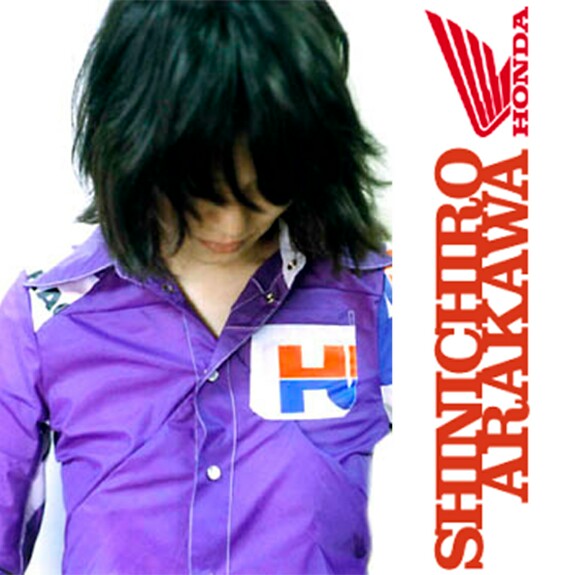
Shinichiro Arakawa's Honda collection is not shown in Paris. It is in Tokyo that the fusion between the Japanese fashion designer and the Motor Company has taken place each season since 1997. Simultaneously an adaptation of the image and a creative outlet, it is possibly the most convincing and successful co-branding process in the fashion galaxy
Collectors
Collectors
Shinichiro was twenty and back in Tokyo after eight years in Paris, when he fulfiled one of his dreams: to bring together two worlds that had never met before, that of the motor bike and that of fashion. He was at the same time in the middle of rediscovering his country with a certain detachment. The daily existence of Japanese society was in his line of sight. He drew his inspiration from many different and unexpected sources such as social contexts and clan aesthetics, or the economy with its freedoms and constraints.
Today he asks me what effect the Hawaiian style of the adolescents of Shibuya would have if it was exported beyond the archipelago. I do not know what to reply, but I think that he has his own idea about the matter.
Today he asks me what effect the Hawaiian style of the adolescents of Shibuya would have if it was exported beyond the archipelago. I do not know what to reply, but I think that he has his own idea about the matter.
His encounter with Honda began when the father of one of his colleagues, at the time with the Racing Team, suggested to Shinichiro that he make the team’s T-shirts. As he himself says, he was then just a kid, but he was working in fashion, so why not.
Contact with the firm progressed gradually, until it was proposed to him that he produce a collection based on the stock of clothes that Honda already sold to its bikers.
Shinichiro wanted to capture the young generation’s attention and lead it into an imaginary universe where the worlds of the motor bike and fashion buyers would be in synergy: he had remarked the rise in the influence of the brand and its logo and decided to create a real sportswear style which could be associated with the image of the Honda brand. His approach was both playful, new and very malicious
Contact with the firm progressed gradually, until it was proposed to him that he produce a collection based on the stock of clothes that Honda already sold to its bikers.
Shinichiro wanted to capture the young generation’s attention and lead it into an imaginary universe where the worlds of the motor bike and fashion buyers would be in synergy: he had remarked the rise in the influence of the brand and its logo and decided to create a real sportswear style which could be associated with the image of the Honda brand. His approach was both playful, new and very malicious
Speed & Craft
The technical clothes are feminised: the suit legs are taken to pieces and reassembled as skirts. The silk-screened cloths are used as patches or as the yokes for shirts or trouser pieces. In the process, between the folds of a dart emphasizing the breast, the logo is discovered truncated or destructured divided by the pattern. Inspite of Shinichiro's legitimate worry, Honda did not take offence at the gibe to its home-style book: he had already earned the right to act creatively on the brand¹s image.
According to Shinichiro, employees at Honda know how to amuse themselves and are not rigid. This would have been impossible for instance with Toyota or other companies. He has made a lucid observation: in a few years only 4 or 5 companies will remain in the world, combining all sectors of activity, hence the importance of creating and setting up areas of freedom within them.
The technical clothes are feminised: the suit legs are taken to pieces and reassembled as skirts. The silk-screened cloths are used as patches or as the yokes for shirts or trouser pieces. In the process, between the folds of a dart emphasizing the breast, the logo is discovered truncated or destructured divided by the pattern. Inspite of Shinichiro's legitimate worry, Honda did not take offence at the gibe to its home-style book: he had already earned the right to act creatively on the brand¹s image.
According to Shinichiro, employees at Honda know how to amuse themselves and are not rigid. This would have been impossible for instance with Toyota or other companies. He has made a lucid observation: in a few years only 4 or 5 companies will remain in the world, combining all sectors of activity, hence the importance of creating and setting up areas of freedom within them.
A showroom was rapidly built and a fashion show programmed in Aoyama. The young and elusive Tokyo fashion world was already in the know, passed the word around and surprised Honda, who had not dared to hope that its image could federate to this extent, by its presence in large numbers at the first show. Extremely rapidly orders flowed in from several stores and the press caught on to these slender figures in their sports colours.
Shinichiro had chosen to make his models parade with Sony Walkmen, from the first available example of 1979 to the most recent one to come on to the market. His attention was to appreciate his new freedom, over-brand the event to the extent of excess and perhaps also make a form of poetic homage to one of his friends working on the design of the Walkmen cassettes for the Sony Corp, to whom it had been explained that very soon their sales would be suspended.
When I said to Shinichiro that he would probably be assigned to the design of CD, MD or even MP3 Walkmen, he replied: "no, I fear not, he'll probably be layed off".
Shinichiro had chosen to make his models parade with Sony Walkmen, from the first available example of 1979 to the most recent one to come on to the market. His attention was to appreciate his new freedom, over-brand the event to the extent of excess and perhaps also make a form of poetic homage to one of his friends working on the design of the Walkmen cassettes for the Sony Corp, to whom it had been explained that very soon their sales would be suspended.
When I said to Shinichiro that he would probably be assigned to the design of CD, MD or even MP3 Walkmen, he replied: "no, I fear not, he'll probably be layed off".
Do you have a Honda?
Recently the pieces of Shinichiro's Honda collection have been seen on the 4 x 3 metre posters of the Tokyo underground, in the press and on Internet. In exactly the same way as a Honda racing bike, a formula 1 car or the android P2 robot, they were integrated in the Group's global communications: "Do you have a Honda?" Like an additional emanation, a significant attainment of the brand.
It amuses Shinichiro to think that soon the programmes of the Paris fashion week will be able to indicate: "March 3rd - 14.00 - Honda", and to have subtly made it possible for the arms of this inventive industrial shogunate to enter the library of fashion indicators.
In October 2000 he even plans to create an event around the collection in his Paris boutique on the rue du Plâtre, which will be transformed for the occasion into a grand prix motor bike garage: this will be part of his continuing desire to open up the line, to make the concept understood and to spread the firm's red wings a little wider across Europe.
Emmanuel Bossuet for Anatomique, October 2000.
Shinichiro Arakawa
1, rue du Plâtre 75004 Paris
Phone : 33 (0) 1 42 78 48 58
Fax : 33 (0) 1 42 78 38 08
www.0cm4.co.jp
Recently the pieces of Shinichiro's Honda collection have been seen on the 4 x 3 metre posters of the Tokyo underground, in the press and on Internet. In exactly the same way as a Honda racing bike, a formula 1 car or the android P2 robot, they were integrated in the Group's global communications: "Do you have a Honda?" Like an additional emanation, a significant attainment of the brand.
It amuses Shinichiro to think that soon the programmes of the Paris fashion week will be able to indicate: "March 3rd - 14.00 - Honda", and to have subtly made it possible for the arms of this inventive industrial shogunate to enter the library of fashion indicators.
In October 2000 he even plans to create an event around the collection in his Paris boutique on the rue du Plâtre, which will be transformed for the occasion into a grand prix motor bike garage: this will be part of his continuing desire to open up the line, to make the concept understood and to spread the firm's red wings a little wider across Europe.
Emmanuel Bossuet for Anatomique, October 2000.
Shinichiro Arakawa
1, rue du Plâtre 75004 Paris
Phone : 33 (0) 1 42 78 48 58
Fax : 33 (0) 1 42 78 38 08
www.0cm4.co.jp
shinichiro arakawa
honda
2000