
Stackable Battery Solutions with Fast Charging and Long Battery Life
For years, homeowners faced an unfair trade-off: you could have a battery that charged quickly, or you could have one that lasted a long time, but not both. Fast charging tends to generate heat, and heat is the enemy of battery longevity. But recent advances in stackable battery technology have broken this compromise. Today’s best stackable solutions deliver both fast charging and long battery life, thanks to improved cell chemistry, sophisticated thermal management, and intelligent charging algorithms. A typical high-performance stackable module can absorb a full charge in one to two hours (a 0.5C to 1C rate) while still delivering 6,000 to 8,000 cycles over its lifetime. That means you can recharge quickly from solar during limited sunny windows, or from the grid during cheap overnight rates, without sacrificing the decade-plus lifespan you expect from a quality battery. For homeowners with variable solar production, electric vehicles, or simply a desire for flexibility, stackable batteries that offer both speed and longevity are a game changer.
The Chemistry That Enables Both Speed and Longevity
Let me explain what’s happening inside these batteries that makes fast charging and long life possible simultaneously. The key is lithium iron phosphate chemistry, but not all LiFePO4 cells are created equal. Fast-charging capable cells use thinner electrode coatings and higher porosity separators, which allow lithium ions to move more quickly between the anode and cathode. However, thinner electrodes could theoretically reduce cycle life. Manufacturers solve this by using ultra-pure materials and advanced electrolyte additives that form a more stable solid-electrolyte interface layer. This layer protects the electrodes during fast charging, preventing the side reactions that typically cause degradation. Additionally, fast-charging cells are manufactured with tighter tolerances – the distance between electrodes is more uniform, reducing local hot spots during high-current charging. Some premium stackable batteries use multi-tab electrode designs, where each electrode has multiple connection points rather than just one. This distributes the current more evenly across the electrode surface, reducing resistance and heat. The result is a cell that can safely accept charge currents of 1C or higher (full charge in one hour or less) while still achieving 6,000 to 8,000 cycles. When you stack multiple such cells together, the overall system inherits these capabilities. You’re not choosing between speed and longevity – you’re getting both.
Intelligent Charging Algorithms
Hardware is only half the story. The other half is software – specifically, the charging algorithms running in your battery management system and inverter. Intelligent charging algorithms are what allow a stackable battery to charge quickly when it’s beneficial and slow down when it’s not. For example, most fast-charging capable batteries use a “constant current, constant voltage” (CC-CV) profile. During the constant current phase, the battery accepts as much current as you can give it, up to its maximum rating. This is the fast part. When the battery reaches about 80% to 90% state of charge, the algorithm switches to constant voltage mode, tapering the current down to avoid overcharging the last few percent. This protects the battery while still getting you to full quickly. More advanced algorithms use temperature-compensated charging. If the battery is cool, it can accept higher currents safely. If it’s warm, the algorithm reduces the charge rate to prevent overheating. Some systems also offer “opportunity charging” – when solar production is abundant or grid rates are extremely low, the battery charges at maximum speed. During marginal conditions, it slows down to reduce stress. You can also manually select different charging profiles. A “fast charge” profile prioritizes speed for times when you need to replenish quickly before an outage. A “long life” profile caps the charge rate at a lower level, extending cycle life by 20% to 30% at the cost of slower charging. Having this choice puts control in your hands.
Thermal Management During Fast Charging
Fast charging generates heat – there’s no way around it. But how a battery handles that heat determines whether fast charging shortens its life or not. Stackable batteries designed for both speed and longevity incorporate active thermal management systems that kick in during high-rate charging. The most common approach is forced-air cooling, where fans draw cool air across the modules. In fast-charging scenarios, the fans ramp up to maximum speed, keeping cell temperatures within the optimal 15°C to 35°C range. More advanced systems use liquid cooling, where coolant circulates through cold plates between each module. Liquid is roughly four times more efficient at removing heat than air, allowing sustained fast charging even in hot environments. Some premium stackable batteries also use phase-change materials – substances that absorb large amounts of heat while melting, acting as a thermal buffer during short fast-charging bursts. What’s important is that the battery management system monitors each cell’s temperature individually. If any cell exceeds its safe limit, the BMS reduces the charge current or pauses charging entirely until temperatures drop. This per-cell protection ensures that fast charging doesn’t cause localized hot spots that age cells prematurely. When you’re shopping for a stackable battery, look for detailed specifications on charge current versus temperature. A system that can maintain 1C charging up to 40°C ambient temperature is well-engineered for both speed and longevity.
Balancing Fast Charging with Daily Cycling
Here’s a practical consideration that often gets overlooked: most homes don’t need maximum fast charging every single day. Understanding your typical daily cycle can help you balance speed and battery life. On a normal sunny day, your solar panels might produce power for six to eight hours. Even a modest 0.2C charge rate would fully charge your battery in five hours – well within the sunny window. So you don’t need fast charging for daily solar cycling. Where fast charging shines is during unusual conditions. Maybe you had several cloudy days in a row, and your battery is nearly empty. A brief sunny break appears – just two hours before clouds return. Fast charging at 0.5C or 1C allows you to capture a meaningful amount of energy in that short window. Similarly, if you’re on time-of-use rates and the cheap overnight window is only four hours long, fast charging ensures you fill your battery completely before rates rise. Some stackable batteries offer a “hybrid” approach: they charge slowly during normal daily cycles to maximize longevity, but automatically switch to fast charging when the battery detects an impending outage or when you manually enable “turbo mode.” This intelligent adaptation gives you the best of both worlds – long life for routine use, speed for when you really need it.
Realistic Expectations and Best Practices
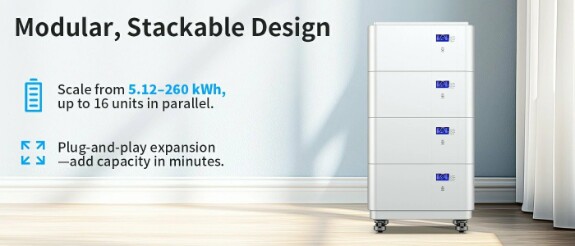
Let me give you some realistic expectations and best practices for stackable batteries that promise both fast charging and long life. First, understand that charging at 1C (one hour) will generate more heat than charging at 0.2C (five hours), even with good thermal management. That heat does cause some incremental aging, but modern batteries are engineered to handle it. A battery rated for 8,000 cycles at 0.5C might still deliver 6,000 cycles if charged at 1C every day – still an excellent lifespan of 16 years. Second, avoid charging at maximum speed when the battery is very hot or very cold. Most battery management systems will automatically limit charge rates outside the optimal temperature range, but you can help by installing your stack in a climate-controlled space if possible. Third, don’t feel pressured to buy the fastest-charging model available. Assess your actual needs. If you have a large solar array and long sunny days, a 0.5C charge rate is plenty. If you have limited solar exposure or a short time-of-use window, prioritize faster charging. Fourth, keep your battery’s firmware updated. Manufacturers often release charging algorithm improvements that boost speed, longevity, or both. Finally, remember that a stackable system lets you add modules to share the charging load. If you need to capture a lot of energy quickly, stacking multiple modules means each one only needs to charge at a moderate rate to achieve a high total charge current. Often, the most elegant solution for fast charging is simply having more modules in your stack.