From MiniNova to Hydrasynth: When Evolution Veered Off Course
It was a perfectly ordinary Tuesday morning — crisp, sunny, and still holding the chill of the early hours — when Jax and Ian agreed to meet at their favorite, blissfully uncrowded coffee shop. Tucked away on the corner of Shady Grove and Blueberry Hill, it was the kind of place where you could sit for hours without anyone bothering you to order another drink.
Jax, true to form, had arrived first. He had already treated himself to a jumbo latte with caramel syrup. Warming his slender, musician’s fingers against the cardboard flank of the massive cup, he stared out the window. Outside, Mateo, the neighborhood street sweeper, was lazily chasing dust bunnies down the sidewalk with a push broom. Jax felt a faint, nagging unease in his gut. His best friend Ian — a reclusive, perpetually distracted electronic composer — had summoned him here with an air of profound mystery, flatly refusing to explain what he wanted or what this was all about.
Granted, Jax possessed a borderline psychic level of intuition, so he already knew exactly where the conversation was heading. He was dead certain: Ian had finally done the one thing Jax had spent months begging him not to do. Ian had pulled the trigger on an ASM Hydrasynth. And knowing Ian, he’d probably paid an absolute overprice for it.
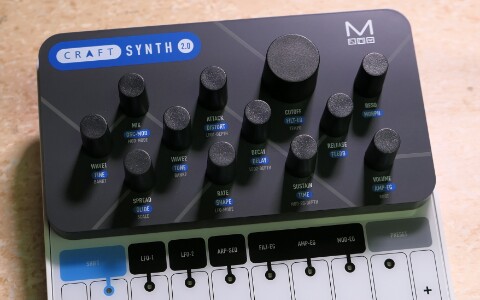
Jax himself was a die-hard, long-time disciple of that cosmic-blue beast: the Novation MiniNova. He knew that machine down to the last button, the deepest sub-menu, and the final row of every single chart in the manual. He knew it inside out, mostly because he’d personally replaced the keybeds, the pitch-bend and mod wheel potentiometers, and the slider for the "Perform Matrix" more times than he could count. More importantly, Jax knew exactly how to squeeze every drop of raw expression out of that featherweight plastic chassis and its notoriously mushy keys during a live set. He knew how to make a crowd move in perfect lockstep with the firing of his own neural pathways. The MiniNova had ceased to be just a synthesizer; it had become an literal extension of his central nervous system. It happens.
And now, his best friend — a guy who had spent his entire adult life holed up in a dark room with FL Studio, rarely showing his music to anyone but Jax — had gone out and bought some obscure "Chinese newcomer." Jax had read and watched hundreds of nauseatingly saccharine, breathless reviews from gear influencers praising this orange-and-black upstart, and the collective hype irritated him to no end. He was locked, loaded, and anticipating a brutal battle. Mentally, Jax was ready to roast this Chinese pretender until it was nothing but a charred slice of Welsh Rarebit. Yet, deep down, he harbored a sneaking suspicion that he might be the one getting smeared across the toast instead. Ian, after all, was an intimidatingly deep, technically formidable human being.
His bittersweet daydream of sonic dominance was cut short by the sharp ding of the shop’s doorbell. Ian walked in. He was wearing his usual faded hoodie adorned with some cryptic, washed-out graphic print, a backpack slung over one shoulder, and a look of intense concentration.
"Alright, spill it," Jax barked, not even waiting for Ian to take a seat or order his customary pot of strong black tea. "Did you actually buy that 'Hydra' thing? You ignored everything I said, didn't you? Come on, tell me — what makes it so much better than my MiniNova?"
Ian, characteristically unhurried, took his time. He calmly slipped off his backpack, hung it over the back of the chair, sat down, and only then did he speak:
"Look, I never said it was 'better,'" Ian began, his voice level. "The Hydrasynth is just more modern. It has more of everything. Think about how long it's been since the MiniNova came out... It was about damn time someone engineered something genuinely new for sound generation."
"Oh, please. What is there left to invent?" Jax scoffed, waving a dismissive hand. "It’s always the same old blueprint: oscillators, wavetables, filters, LFOs, and envelopes. That’s synthesis in a nutshell."
"Sure, but then there's FM..."
"Drop it, Ian!" Jax cut him off. "First of all, FM still relies on envelopes, oscillators, and LFOs. Second, that abstract monster has been around for forty years, and nobody has ever actually tamed it!"
"And yet, it became the literal voice of the disco era and basically defined the entire landscape of 80s and 90s pop music," Ian shot back with a dry, sarcastic grin.
"Yeah, despite that," Jax countered sharply. "They stumbled into a few cool presets for marimbas, slap bass, and digital bells, and everyone has been riding those exact same patches into the dirt ever since."
"Fine, let’s leave the history lesson aside," Ian said, offering a temporary truce. "Let's talk about your MiniNova. What was I supposed to do, buy a synth that came out over a decade ago for an inflated price? Man, a brand-new Hydrasynth Explorer costs the exact same cash today!"
"Exactly!" Jax leaned in, pointing a finger triumphantly. "Because it’s still worth every single penny. Nobody has released anything comparable in its weight class since!"
"Are you serious right now? Let's do the math," Ian said, seizing the momentum. "How many wavetables does your MiniNova have? Thirty-six, right? Right. My 'Hydra' has two hundred and nineteen waveforms built-in. Out of the box. For the exact same money."
Jax blinked, momentarily thrown off by the sudden statistical assault. Ian didn't give him room to breathe.
"Oh, and let’s not forget all your classic static shapes. But even if you lump them all together with the tables, you don't even crack a hundred options."
Jax finally found his footing and launched a counter-offensive.
"I have thirty-six actual WAVETABLES!" Jax exclaimed, thrusting his index finger into the air. "And a wavetable, by definition, is an entire stack of nine distinct waveforms designed for seamless morphing. Do the math, genius. Thirty-six times nine, plus thirty-four traditional shapes... That is THREE HUNDRED AND FIFTY-EIGHT waveforms!" Jax grinned victoriously. "Your Hydra's two hundred and nineteen shapes? Those are just single-cycle waveforms. Basic bricks."
"Whoa, hold on," Ian interjected, raising his hands. "Counting every single interpolation step inside a wavetable as a separate waveform is a massive stretch. At the end of the day, they’re just morphing from a single starting sound. A table is ONE timbre."
"Fine, whatever," Jax conceded. "Even though the MiniNova has both 'evolutionary' and 'revolutionary' tables, but let's not split hairs."
"Tell you what," Ian said, unexpectedly shifting gears. "I’ll play along. Let’s count every single one of your nine interpolation steps as an independent waveform. Spoilers: it’s still not going to save your MiniNova."
Then, Ian did something Jax absolutely did not see coming. He pushed aside the steaming tray of hot tea the server had just dropped off, pulled out his iPhone, and opened the calculator app.
"Look here," Ian said calmly, his thumbs flying across the screen. "You have your pre-packaged, ready-made stacks. Fine. But I have raw building blocks. I can assemble those blocks into any custom stack I want, building my own Wavelist. Eight slots per list. Order matters, repetitions allowed. Want to guess how many unique combinations that gives me?"
Ian tapped the virtual equals sign and silently slid the phone across the table toward his friend.
Jax took the smartphone, glanced at the screen, and froze in utter bewilderment. The number staring back at him was far too massive for his brain to process on the fly. The display read: 5,291,184,662,917,065,441.
“What even is this?” Jax asked, a sharp note of irritation creeping into his voice. “Some kind of a billion millions?”
“Honestly, I don’t know,” Ian admitted, taking his phone back. “Let's just call it a crap-ton of Hydrasynth waveform combinations.”
“A crap-ton is putting it mildly,” Jax let out a nervous laugh.
Few people would readily recognize that the exact number Ian had conjured on his calculator is called five quintillion, two hundred ninety-one quadrillion, one hundred eighty-four trillion, six hundred sixty-two billion, nine hundred seventeen million, sixty-five thousand, four hundred forty-one. Is that a lot?Well, put it this way: astronomers estimate that the number of stars in our entire Milky Way galaxy is roughly ten million times smaller than the scale of that number.
Naturally, without a quick Google search or an AI assistant, our friends didn't know the exact cosmic scale of it either. But intuitively, they both felt that if every Hydrasynth waveform combination were a grain of sand, you could probably sculpt an entire planet out of them. Suddenly, the good old MiniNova, with its ready-made tables and static shapes that didn't even total a hundred variants, began to feel like a cute, retro transistor radio with a single dial for everything, sitting next to a limitless universe of unimaginable sound.
“Let’s not even factor in the number of oscillators,” Ian said, offering a peace offering. “We both have three per voice. No point in cubing a number that’s already breaking the calculator.”
Jax leaned back in his chair, staring at the ceiling for a few seconds as if trying to visualize the sheer scale of what he’d just been told.
“Fine,” he exhaled at last, pulling himself back to Earth from the Mariana Trench of his thoughts. “Let’s say you have a 'crap-ton' of combinations. But music is made for human beings, Ian, not robots. What good are all those numbers if the machine is a nightmare to tweak live? Let’s talk LFOs and performance expression. I have three fully-fledged LFOs that can modulate pretty much anything on earth. And believe me, I modulate everything.”
“I don’t doubt it,” Ian nodded willingly.
“Right. So, one of my absolute favorite tricks is assigning different LFO parameters to the eight Animate pads. That is pure, unadulterated performance! I can literally mold the sound with my bare hands like play-dough, you know?” Jax tapped his fingers rhythmically on the table, mimicking a keyboard, and kept going. “In the middle of a set, my left hand can unleash absolute chaos. One pad gently opens the filter, the second accelerates the LFO rate, the third throws a massive delay tail right on the downbeat. And they’re pressure-sensitive! I’m delivering raw emotion in the here and now. What does your compact Explorer have? Tiny screens and four encoders? What are you gonna do, stand on stage like a statue trying to calculate the perfect rotation angle?”
Ian nodded understandingly. He genuinely respected Jax’s stage experience and had no intention of lecturing him.
“Look, I’m not twisting your words, Jax. I know the MiniNova has a great, highly intuitive interface designed for humans. It’s snappy, it makes sense. It’s a machine from 2012 that still obliterates modern synths on stage precisely because of that straightforward ergonomics.” Ian dropped a generous spoonful of sugar into his tea, stirring it gently before continuing. “You’re throwing three different fingers at three separate pads to warp three independent parameters. But the Explorer is wired differently. It’s more like... a modular robot.”
“Well... I can link parameters too,” Jax chimed in, trying to hold his ground, but Ian pressed on without skipping a beat.
“Sure, you can, but look at the Macros under my screens. I can program a single encoder to simultaneously open the filter, back off the envelope sustain, and morph the actual wave texture inside the Mutator.”
“Yeah, but I’d have to sit there forever configuring parameter ranges...” Jax muttered.
“Exactly, you map it out first,” Ian agreed. “But once you do, a single twist transforms the entire DNA of the patch based on your blueprint. And to breathe life into individual notes while those macros are spinning, I have polyphonic aftertouch. I don’t need to reach for any pads. I just dig a finger deeper into a single key during a solo, and the modulation ignites only inside that specific note, leaving the rest of the chord completely untouched. And don't forget, I can control those macros using the velocity-sensitive pads of an external controller via CC mapping!”
Jax went quiet, idly swirling the melting ice and leftover syrup in his cup.
“I see where you're coming from...” he said thoughtfully. “So, my style is direct manual control over a bunch of independent elements on the fly, while yours is total automation, pre-calculated in advance, where the keys just add the final touch. Ideologically, we’re in completely different trenches.”
“Not necessarily, but look at it that way if you want,” Ian smiled warmly. “You’re operating like a pilot pulling physical levers in real-time. I’m operating like a programmer who calibrates the autopilot first, then corrects the course with a gentle touch on the keys. Oh, and speaking of automation: you have three LFOs. My little engine has six.”
“Six?” Jax looked up, surprised. “Are you having trouble with math? Every spec sheet says five.”
“My math is just fine, and you know it,” Ian grinned, breaking down the count. “Five main LFOs in the modulation matrix. Plus a dedicated sixth one strictly for vibrato, so you don’t waste your primary slots. And by the way, the delay and fade-in times for every single one of them are completely independent. On your MiniNova, that’s a global parameter.”
Jax grunted, silently conceding the Hydrasynth's technical superiority on that front.
“Fine, the global parameter thing is a fair point. That’s always been a thorn in my side, even if it’s a small one. But compare the envelopes! I have six of them! You only have five! That’s six-to-five in my favor,” Jax smirked.
“Back to counting numbers, are we?” Ian smiled tolerantly, taking a long-awaited sip of his lukewarm tea. “Yes, I have five envelopes. But they are five-phase. The formula is DAHDSR. The 'D' stands for Delay—a programmable lag before the attack phase even starts. And the 'H' is Hold, which locks the volume at its absolute peak right after the attack phase finishes.”
“And what the hell is that good for?” Jax asked, genuinely puzzled, finally stopping his spoon from spinning. “The envelope triggers but there’s no sound? Sounds completely useless.”
“It’s incredibly powerful for deep sound design,” Ian explained. “Imagine you’re building a massive, evolving ambient patch where one sonic layer needs to gently drift in from the silence a split second after another. You just set a delay on that envelope, and boom, done. And the Hold phase forces the waveform to freeze at peak volume before the decay even begins. Now throw in the fact that I can choose the curve shape—exponential or logarithmic—for every single phase independently. Your six envelopes hit hard and straight, but my five turn the sound into a living organism. They can modulate each other, creating textures that breathe on their own without you ever touching a knob.”
Any other conversationalist at this point would have thrown up their hands and said, “Alright, you win the automation debate.” Any practicing electronic musician would have instantly visualized the routing and realized how devastatingly powerful this was for soundscapes. There was simply no comeback. But this was Jax. Remember, he knew his MiniNova inside out. Instead of backing down, he visibly lit up.
“That trick, bro, is called recursive modulation. Do I need to remind you that on the MiniNova, you can select any envelope as a source and assign it to modulate the time of a phase within that exact same envelope?”
“No, no, no, man! Spare me!” Ian laughed, waving his hands in mock surrender. He realized Jax wasn't going to be easily fooled. Seeing an opening, Jax decided to drop a massive hammer.
“You should look at the filters instead! My MiniNova has two of them, and I can choose from fourteen different filter types with a ridiculous amount of routing options: series, parallel, series-parallel... where the entire signal hits the first filter, then feeds into the second, and I can balance the blend between the single-filtered and double-filtered signal!” Jax was on fire now. “I have patches where only the third oscillator and the noise generator feed into the first filter, while the first two oscillators and their ring mod go straight to the second! I have routing schemes that—”
“Alright, alright! Mercy!” Ian cried out, laughing. “I yield! I have nothing to counter that!”
“To be completely honest,” Jax dropped his voice to a conspiratorial whisper, “half the time I get lost in those routing configurations myself. But whenever I hit a creative block, I just sit down and mess with those filter paths. The stuff that comes out sometimes makes me think, ‘Hot damn, Jax, you’re a genius!’”
Both friends burst into a hearty laugh.
“My filters inherit the DNA of the legendary Novation Supernova,” Jax added, his voice losing its competitive edge, replaced by pure curiosity. “How does your Hydra handle it?”
“The Explorer takes a slightly more surgical approach,” Ian said. He picked up his teaspoon and used the back of it to trace an imaginary signal path on the wooden tabletop. “It also has two filters, and you can run them in series or parallel. But the first filter features sixteen meticulously modeled types. It’s got everything: from the legendary, fat Moog ladder filter and the screaming Korg MS-20 to a rare vocal formant filter that literally makes the synth talk. The second filter is simpler—a classic SEM design. Well, an emulation of it, anyway.”
The SEM is a holy-grail analog multi-mode filter with a 12 dB per octave slope, originally designed by engineer Tom Oberheim in 1974 for the Oberheim Synthesizer Expander Module. It has two iconic features: first, its state-variable architecture allows it to function as a low-pass, high-pass, or band-pass filter. Second, it lets you seamlessly morph between low-pass, notch, and high-pass modes. You can sweep that morph control to carve out entirely unique, transitional timbres. Because of its 12 dB slope—unlike the heavy 24 dB Moog filters—the SEM sounds incredibly bright, airy, and open, and it doesn't lose its low-end punch even when you crank the resonance.
Both guys understood this history perfectly, but Ian couldn't resist the pleasure of savoring his new gear's potential in front of a formidable opponent.
“I can use a knob or a modulation source to morph it from a low-pass to a band-pass, and then right into a high-pass using the Morph parameter,” Ian continued. “You have more convoluted routing options, which is cool. But I have historical accuracy, distinct analog character, and that exact expressiveness because I can modulate that filter morph with envelopes, LFOs, aftertouch, or whatever I want. More importantly, the layout actually makes sense out of the box. Novation went a bit off the deep end with their menu-diving, if you ask me.”
“Fair enough,” Jax agreed, but immediately tossed more fuel onto the dying embers of the debate. “But I will absolutely smoke you on the effects section! The MiniNova has five dedicated slots for any combination of FX you want. Five, bro! I can chain three reverbs and two delays back-to-back if I feel like it! And what about the unique 32-step gator? I can turn the most boring, static drone into a pumping trance riff in two seconds! Your hyped-up Hydra has a grand total of four FX processors, and two of them are permanently locked into delay and reverb!” Jax had done his homework; his Hydrasynth specs were dead-on.
“Guilty as charged,” Ian nodded calmly. “The MiniNova is the undisputed champion of chaotic, wild effects flexibility. It’s a total live-performance powerhouse. The Explorer’s FX chain is rigid and simpler: Pre-FX, Delay, Reverb, and Post-FX. But every single algorithm in there is specialized and studio-grade. It doesn’t make your machine or mine any worse. They’re just built for different jobs.” Ian paused, leaning forward with his elbows on the table. A spark of genuine sound-design passion lit up his eyes. “But tell me this, Jax. Now that we’re talking about the raw core of the sound... What can your MiniNova actually do to a waveform before it ever touches a filter or an effect? Say you select a standard sawtooth on your oscillator. How do you fundamentally mutate its geometric shape at the root, inside the generator itself, before all that mixing magic?”
Ian smirked, triumphantly crossing his arms. He thought he had backed Jax into a corner, but the veteran gigging DJ knew his blue machine too well.
“If you think I’m just rocking bare plastic shapes under the hood, Ian, you’re dead wrong. Sure, I don’t have your fancy Mutators, but the Novation engineers knew exactly what they were doing. Built straight into the oscillator engine is a feature called Density. I turn one dial, and my sawtooth instantly clones itself — the engine generates up to eight virtual copies of the wave, detunes them, and unleashes a massive wall of sound that makes your eardrums vibrate. And it does it without sacrificing a single voice of polyphony! Plus, I have Virtual Sync for that classic, screaming hard-sync tone. Hell, I can cross-modulate the oscillators with FM synthesis so hard it’ll make your digital head spin!”
“As if your machine isn't digital!” Ian chuckled.
Jax completely ignored the comment and pressed on with burning enthusiasm. “My MiniNova can rewire the DNA of a sound right at the starting line, trust me.”
Ian nodded respectfully. He always appreciated it when someone could back up their gear talk with solid facts.
“Alright, alright, Novation’s Density is stuff of legends, I’ll give you that. And a full 20-slot modulation matrix inside a mini-synth is an incredible achievement...”
“An achievement?” Jax cut him off with a smirk. “That matrix occupies mere micrometers of silicon on a chip! The chassis size has nothing to do with it. The real magic is how it’s routed. I know your Hydra has thirty-two slots, and sure, that sounds bigger. But on the Explorer, they’re straight lines: Source to Destination, point A to point B. My MiniNova’s mod matrix is recursive. I can make one slot modulate the depth of another slot, locking them into feedback loops and fractals, forcing the system to feed into itself, mutate, and evolve.”
“Assuming you can figure out how to program it without going insane,” Ian cracked a joke, but Jax plowed right through the sarcasm.
“My twenty recursive slots will out-chaos your thirty-two straight lines any day of the week.”
Ian went quiet for a long moment, quietly acknowledging that Jax had just deployed some heavy artillery from the realm of avant-garde sound design.
Outside the window, Mateo the street sweeper seemed to feel the tectonic shift in the debate. He stopped pushing his broom, leaned both hands on the handle, and stared through the glass at the two guys, as if he too were trying to grasp the depths of recursive modulation.
A heavy silence hung over the table.
Eventually, Ian broke the spell. “Look, you’re absolutely right about the complexity of the MiniNova’s mod matrix,” he conceded. “It makes the machine wildly unpredictable. Chaotic, even. But the Hydrasynth Mutators operate on a different plane of existence. When I feed a wave into a Mutator, I’m warping it on a molecular level. First off, I have hard sync too. And FM, obviously. Except I can run pure, genuine, hardware-grade Thru-Zero FM synthesis.”
Jax narrowed his eyes. He knew the math. In traditional FM synthesis, if you crank the modulation depth too high, the carrier frequency hits a logical dead end—zero hertz. A standard digital synth freaks out at zero, and the sound devolves into harsh, unmusical digital garbage and clipping. But Thru-Zero technology allows the Hydra’s engine to pass right through zero into negative frequencies, simply flipping the phase of the waveform.
“So you’re saying it holds its pitch stability even on extreme settings?” Jax asked.
“Perfectly,” Ian nodded. “You get this incredibly gorgeous, metallic timbre, but it stays pristine and completely musical.”
“Wow,” Jax offered a rare, genuine compliment.
“I can do a WaveStack, creating five detuned copies of the wave,” Ian continued, riding the wave of momentum. “I can run any waveform through three different types of Pulse Width Modulation—classic, asymmetric, or completely non-linear! And then I can feed it through a harmonic Comb Filter... Man, that thing is beautiful. It operates directly on the raw waveform shape. It’s not even a filter in the traditional sense; it’s more like a pound of programmable nanorobots injected straight into the clay. The Mutator accentuates or carves out specific harmonics before the sound ever catches a glimpse of the actual filters. Your MiniNova definitely can't do that.”
“Can’t argue with that,” Jax muttered, his confidence finally dipping.
“It’s a set of seven different surgical tools that reshape the clay before your hands ever start sculpting it into pots or statues,” Ian said with growing fire. “And I can chain two of those Mutators back-to-back on a single oscillator. The scale is completely different, man. It’s not just thickening a sound or routing a modulation loop; it’s a targeted mutation of the sonic genome itself. Do you even want to bother comparing LFOs now?” Ian asked, leaning over the table with a playful, intimidating glare.
“Can we skip it? Please?” Jax begged in a theatrically submissive voice.
The two friends, perfectly locked into each other's wavelengths, played along with the joke. But Jax wasn’t ready to let the battle end just yet. He snapped back up.
“Actually, let’s go! I know you have five... oh wait, excuse me, six of them, and I only have three. But man, what a three they are!” Jax knew his machine’s strengths. The MiniNova’s LFOs come packed with a massive library of complex, ready-made shapes, including specialized musical patterns. On top of that, every generator can be switched into a Slew mode to smooth out sharp edges, or run in One-Shot mode—where the LFO cycles exactly once per keypress, essentially transforming it into an extra envelope. Combined with a ridiculous number of clock-sync modes, those three LFOs were the MiniNova’s absolute killer feature.
But as it turned out, even on Novation’s home turf, ASM had left Ian with a massive ace up his sleeve. The Hydrasynth was a freak of nature because its five main LFOs weren't just standard wave generators—they were full-blown design suites. First, there’s the Step LFO. It’s not just a pre-baked pattern; it’s a fully programmable step-sequencer ranging from two to sixty-four steps.
“For every single step, you manually dial in the modulation value from minus sixty-four to plus sixty-four,” Ian took over the conversation like a machine gun. “And if you activate SemiLock, those values lock onto exact semitones—and boom, your LFO is playing a chromatic melody.”
“Let me guess, a quick eight-step bassline?” Jax joked.
“Exactly! Billie Jean all day long!” Ian laughed.
“Or an evolving 64-step sequence with a bizarre time signature—piece of cake. Second, the Hydra has a unique One-Shot mode called Step. It’s not just a single-cycle LFO run—the MiniNova can do that too. It’s a mode where the sequence doesn't loop; instead, every single time you press a key, the LFO advances exactly one step forward.”
“Whoa...” Jax murmured, visually calculating the possibilities.
“Right? So a single Step LFO becomes a step-sequencer clocked by your actual keyboard playing: hit a note, step one; hit another, step two. And when you combine that with full polyphony and the TrigSync Poly mode, every single voice gets its own independent copy of the LFO...”
“Hold on, what the hell is TrigSync Poly?” Jax interrupted.
“TrigSync means the LFO phase resets from scratch every time you strike a new note. The start of the modulation is locked hard to your attack. And the Poly part ensures that the LFO remains polyphonic: every note you play gets its own individual LFO engine running in parallel. Imagine playing a chord where every single note inside the harmony is running its own independent melodic sequence! It’s no longer just modulation, Jax; it’s a self-contained polyphonic arrangement.”
Jax stared blankly into his latte. It looked like he was trying to count the individual atoms in the foam.
“Wait, Ian. You’re telling me that when I strike a note, a personal LFO is born just for that note? And it lives its own life until I let go of the key?”
“Exactly! And not just one — literally a whole squad for every single voice. And the Hydra has eight voices. You can stack up to five independent LFOs on one single ringing note! Five, Jax!”
Jax usually hated being lectured, but he could feel that Ian was completely consumed by the sheer awe of his synth's architecture, so he let it slide.
“And every single one can run in poly mode. That means every note in your chord triggers its own tiny team of modulators. Five per note, times eight voices of polyphony... you’re looking at a literal orchestra of forty LFOs running simultaneously. Forty!” Ian was gesturing so wildly he nearly knocked over his teapot. “One LFO modulates the filter, the second handles a stepped volume sequence, the third pans the sound... and it’s doing it for every note individually. When you hit a new key, those five LFOs fire from absolute zero, completely oblivious to what the other voices are doing. Can your MiniNova do that?”
Jax looked back down at his cup. “It has one global LFO shared across all voices,” he said softly. “It shakes all the notes at the exact same time.”
“Right,” Ian said, his voice softening. “On the MiniNova, one giant hand shakes the whole tree. On the Hydra, every single finger gets its own personal animator. Five animators per finger, eight fingers—go paint whatever you want.”
“Forty...” Jax repeated slowly, then suddenly flashed a sly grin. “Are you sure about that? Or is this just your bedroom producer fan-fiction?”
“I’m positive,” Ian said, though a tiny flicker of doubt crossed his mind. Truth be told, he hadn't actually mapped out a 40-LFO patch yet. Being a textbook gear nerd, he had simply memorized the official manual cover-to-cover twice—once before buying the synth, and once right after ripping open the box. But the sheer volume of possibilities the developers had crammed into the machine would take months to master, let alone the handful of days he’d had it. He corrected himself with a calmer tone. “The manual states it in black and white: every one of the five LFOs has an independent Mono/Poly/Single/TrigSync setting. In Poly mode, a discrete LFO instance is generated for every voice. Eight voices, five LFOs—forty total. It’s not marketing hype; it’s the actual core architecture. You can laugh all you want, but the Hydra’s math is absolute.”
“Ian, man...” Jax smiled, finally claiming his turn to use a relaxed tone. “Do you even realize what you’ve gotten yourself into? Compared to your Hydra, learning Python looks like playing with building blocks.”
“Hey, I’ll survive,” Ian chuckled.
“Seriously, what did you buy? Am I gonna have to visit you in an asylum in three months?”
“Not a chance,” Ian grinned, driving the final nail into his competitive coffin. “Thirdly, the Hydrasynth has an LFO Quantize feature that steps the output signal into discrete values from one to twenty-four. Run a basic sine wave through a Quantize filter, and you get a beautifully stepped rhythmic pattern. Plus, the Level parameter lets you control the global amplitude of an LFO with a single knob, even if it’s routed to ten different destinations in the Mod Matrix. And if forty LFOs somehow feel small, you can set the envelopes to Loop. They cycle from two to infinity, effectively giving you five extra pseudo-LFOs to play with.” Ian finally let out a massive sigh. “Whew! Honestly, it feels like the engineers started designing the Hydrasynth by building the LFO section, poured their entire collective sanity into it, and then built the rest of the synth around it.”
“Alright, I get it,” Jax laughed. “I guess there’s no point in me telling you about the MiniNova’s phrase sequencer...”
“Probably not, considering neither of us has an actual sequencer.”
“But we do have a killer arpeggiator,” Jax countered, trying to splash a little lighter fluid onto the dying embers of their debate.
“So do I,” Ian said calmly. “And it’s not just a basic up-and-down run. It has sixty-four pre-programmed musical phrases baked right in. Plus, they included Ratchet and Chance controls. And in the 2.0 firmware update, they added Step Offset and expanded the range to six full octaves. The best part? You can modulate the arpeggiator parameters using LFOs, envelopes, or aftertouch. The actual pattern lives, breathes, and morphs as you play.”
“No kidding?” Jax leaned forward, genuinely intrigued. “Phrases? Like rhythmic presets? Like on those little Yamaha PSS-A50 keys?”
“Exactly like that,” Ian nodded. “The whole concept of that little Yamaha instrument revolves around those phrase arpeggios.”
“Man, those little things are hilarious,” Jax laughed. “Though to be fair, that tiny keyboard sounds way better than it has any right to. DJs have been buying them in droves. I used to have one, actually.”
“I still have mine,” Ian smiled.
“See, if Yamaha hadn't been so cheap and had given the A50 at least a physical pitch-bend wheel—or hell, even another button like the Motion Effect... actually, three buttons! One for pitch, one for filter, one for modulation... man, that instrument would be priceless. I’d probably love it more than my MiniNova!”
“Ha!” Ian snorted. “Good luck with that. Marketing departments will be marketing departments, man. But with ASM, I don't feel that corporate stinginess at all. That’s why I fell in love with the Hydrasynth. It honestly feels like the designers built it without checking in with the marketing team once.”
“Sounds like a myth, but I’ll take your word for it,” Jax doubted playfully.
“It’s true! What would you say if I told you I can modulate my arpeggiator patterns using polyphonic aftertouch? Think about it: I strike a chord, press down a bit harder, and the arpeggiator instantly switches to an entirely different rhythmic framework because my aftertouch pressure is actively changing the phrase selection number. Or I can set it so the phrase updates based on the loudest note or the average pressure of the chord—true expression, entirely live, in real-time.”
“Shut the front door...” Jax whispered, slowly shaking his head side to side.
A quiet stillness settled over their table once more. The loud hiss of the espresso machine hummed in the background, and outside the window, a flock of sparrows fought viciously over a few stray muffin crumbs dropped onto the concrete by a previous customer.
Jax was the first to break the silence. “Ian... does that massive brain of yours realize that your Hydrasynth is literally just the evolution of my MiniNova?”
“No, bro... it’s not an evolution. It’s a straight-up Cambrian Explosion.”
“Elaborate,” Jax challenged him with a grin.
“Think about it! Ever since the MiniNova came out—and honestly, long before it— the entire synth industry has been running in place. For decades, everything evolved down the exact same predictable track: a standard oscillator, a traditional filter, an envelope, some basic LFOs... Move an inch to the left or right, and you’re still hitting the exact same technical ceiling from the late twentieth century. And even when someone tried to break away, like with FM synthesis, it was a total nightmare to program. You said it yourself: nobody ever truly tamed FM. I’ll go a step further—the goal of intuitive, intentional FM sound design is practically impossible to solve mathematically.”
Ian leaned back, warming his hands on his mug. “There are Bessel functions, sure, and direct calculation formulas... but they are irreversible. There is no mathematical formula where you can plug in a desired harmonic spectrum and calculate exactly which operator parameters will generate it. Too many vastly different configurations yield the exact same timbre. Mathematicians call it an ill-posed problem. Nobody knows how to handle it efficiently. You either have to use gradient descent to guess the parameters or rely on genetic algorithms, which collapse under massive computational complexity. FM synthesis has been around for half a century, and there hasn’t been a single workflow breakthrough. It’s pure artistry, intuition, and happy accidents. Because of that, every 'new' synth model for years was just a cosmetic facelift for standard virtual analog modeling.”
Ian gestured toward his bag. “But with the Hydra, it feels like the engineers ripped off the shackles. They took the exact same fundamental elements we all know, but the routing freedom and the sheer abundance of tools... it’s all familiar, controllable, and logical. On the other side of the equation, yeah, you nailed it—it’s a Cambrian Explosion in the theory of evolution. Simple organisms populated the earth for billions of years, perfectly predictable and basic. And then—boom! In a flash of geological time, evolution unleashes millions of completely insane, unseen forms that share absolutely nothing with the past. The Explorer is that exact evolutionary explosion of ideas for me. I haven't seen a hardware workflow like this even in my favorite VSTs—and trust me, software has some wild stuff.”
Jax sat in silence, digesting the massive wave of information. Ian didn't interrupt him.
After a few minutes of quiet, Jax suddenly snapped back. “Yeah, I still don't buy it!”
“Who are you arguing with now? The manual or the math?” Ian teased.
“Look, if we’re talking about a Cambrian Explosion, that was the birth of synthesis itself,” Jax argued, his voice full of passion. “The Theremin, the ANS synthesizer... and then everything exploded at once — Robert Moog, Don Buchla, John Chowning! Before that, humanity spent centuries locked into pure acoustics—violins, horns, drums. Then — bam! A whole universe of brand-new sounds. That was the real Cambrian Explosion of the sonic palette.”
Ian thought about it for a second, then nodded. “Fair points. I can agree with that.”
Warmed up by the concession, Jax kept going. “But when Sequential came up with Vector Synthesis in the mid-80s, that was the evolutionary milestone comparable to the moment the universe created mankind. I actually have a tiny clone of it from Behringer—the Pro-VS mini. Man, I love that little thing. Honestly, it feels deeper than the MiniNova in some ways.”
“No way,” Ian raised his eyebrows.
“Seriously. It’s just that it only has four voices and absolutely zero performance controls. But if it had the interface, I’d be tearing up stages with it. It’s my secret weapon for late-night inspiration. Ever heard of that little beast?”
“Honestly, no. But I know Vector Synthesis and the Prophet-VS inside out, believe me. One hundred and twenty-eight basic waveforms, four oscillators running simultaneously. Their signals blend together using complex mixer envelopes, and yeah...” Ian cut his own sentence short and grabbed his phone again. He tapped the calculator a few times and slid the screen over to his friend.
The screen displayed: 2,684,354,560,000.
Jax spent a few seconds counting the commas, then leaned back in his chair, looking slightly disappointed. “Only two and a half trillion? I was positive it would be bigger than your Hydrasynth.” He caught Ian's drift instantly.
“I expected a bigger number too, honestly,” Ian admitted.
“But combinatorics get weird when you try to calculate a vector synth. On my Hydra, we counted every single combination of custom wavetables as a distinct sound, which is admittedly a bit of a stretch...”
“You counted it!” Jax smirked.
“Alright, fine, I counted it. My bad. But technically, a Hydrasynth wavetable isn't a brand-new harmonic spectrum. It’s a sequential set of spectral combinations managed by the Wavescan feature. On a vector synth, those exact blending functions are handled by a mixer envelope. And trying to calculate that is a nightmare. It’s a five-point envelope, and every point defines a precise balance across four independent waveforms. The base math is simple: one hundred and twenty-eight to the fourth power, multiplied by ten thousand...”
“Hold on, where did ten thousand come from?”
“That’s the number of discrete values on the X-Y joystick grid—assuming a standard one hundred by one hundred matrix.”
“Ah, gotcha,” Jax muttered.
“Right. So, on that mixer envelope, you can enable loop repetitions, which technically pushes the variations into absolute astronomical numbers.”
“And what about the Hydrasynth?”
"Well, at first glance, it seems simpler — just standard ADSR plus envelopes. But there are five of them, and you can assign a dedicated envelope to each individual oscillator. You can only imagine the kind of sonic acrobatics that allows. Culturally speaking, I think both synths offer a mind-boggling playground of dynamic spectral morphing. Whether one has ten or twenty orders of magnitude more doesn't really matter. Neither you, nor I... hell, not even the rest of humanity combined will ever have enough lifetimes to fully map out that universe of possibilities.
In theory, the Hydrasynth gives you more options for instantaneous, raw timber, while the vector Prophet gives you more options for how that timbre evolves over time. But that’s only true until you let the Hydra loose and start modulating those oscillators — with all their wavescans and hidden tricks — using its entire army of LFOs and envelopes. That's when the real party starts."
"I hate to rain on your parade, bro," Jax cut back in, snatching the steering wheel of the conversation. "But on the vector Prophet, the filter envelope is just as insanely complex as the mixer envelope. Meaning, it also loops and cycles. So yeah... good luck sleeping tonight with that knowledge.
"Ian went dead silent, turning the thought over in his mind, before finally conceding: "Strong move. I’ll give you that."
"And that was 1986," Jax pressed on, refusing to relent.
"Actually, that’s missing the entire point," Ian said. "The Prophet, as you correctly pointed out, dropped in the mid-80s. And it was nothing more than a desperate digital response to Yamaha and their mind-blowing DX7, which had spent the last five years turning the sonic palette of pop music completely inside out. So if we're talking about the 'Genesis moment' of synthesizers — the creation of man — that title belongs entirely to the discovery of FM synthesis. That was something genuinely, fundamentally new. And it remains incredibly powerful even by modern standards.
On paper, it looks like everything else. Boring, even. Simple sine-wave oscillators, convoluted envelopes, and LFOs. But it unlocked a terrifyingly vast cosmos of sound that had never been heard before — and hasn't been topped since. Honestly, I wouldn't even dare to calculate the combinatorics of FM: six operators, thirty-two algorithms, frequency ratios, output levels, envelopes... trying to run the numbers on that is completely pointless."
Jax sat in silence, chewing on the thought, before unexpectedly nodding. "Fair enough," he muttered.
A quiet lull settled over the table again. It felt like there was nothing left to fight about. Ian finished the last of his tea, sensed the shift in the air, and drew a line under the whole thing:
"Look, Jax, your MiniNova is an incredible performance tool. It's simple, it’s intuitive. Granted, I still think its designers went a bit off the deep end with the filter routing, but all in all, it’s a brilliant piece of gear. I’d love to own one. Honestly, the way you just talked it up makes me want to buy it. But I already have the Hydrasynth, and no matter how you slice it, it feels like the next, vastly higher step in evolution."
"Even if it’s just a side branch!" Jax smirked suddenly. "Compared to FM, I mean. You have to admit, after FM, synthesizer evolution didn't keep climbing up toward some higher mathematical peak. It just kind of veered off to the side, wandering around the same old bushes. Look at all those endless Behringer clones of vintage synths: the WASP, the Cat, the Kobol, the MS-20... Or Roland endlessly re-releasing the SH-101 and the TB-303. You know exactly what I mean."
"Of course," Ian agreed, a smile breaking across his face. "But thanks to you, I think I finally get it now."
"Get what?"
"Sound design evolution didn't move toward making the sounds themselves more complex. It moved toward making the process of creating them easier and more ergonomic. More intuitive, more controllable. All this nostalgia and the endless reissues of vintage gear exist precisely because those old synths felt close and understandable to a human being. I mean, what good is FM if it can spit out some alien, unimaginable texture with one hand tied behind its back, but you have no clue what to do with it? How do you even begin to perform with that?"
"Well, you can, technically—" Jax tried to interject, but Ian plowed right ahead without breaking stride:
"And my Hydra — hate it or love it — is the absolute peak of that specific evolutionary line."
"Oh, come on!"
"Whether you like it or not, it's true. For all its staggering complexity and power, the Hydrasynth doesn't choke the musician. It gives them comfortable, familiar tools. Unlike FM, where the sheer abstraction almost always hogs the blankets," Ian concluded, his face stretching into a deeply satisfied grin.
"Hey, without my MiniNova paving the way, your Hydra wouldn't even exist. My blue beast showed them the light."
"Sure, Jax. If you say so," Ian said, his voice dropping into a tired but warm tone.
They both smiled, and then, completely in sync, let out a genuine laugh. It was that specific, exhausted, but deeply affectionate laugh shared only by old friends who have just realized something profoundly important about the world and themselves. Every ounce of tension from the morning's battle evaporated instantly.
"Alright, 'pinnacle of creation,'" Jax said, lifting his cardboard cup to swirl the lukewarm dregs of latte at the bottom. "Shall we roll? Next Saturday I’m playing a set at The Terminal. You'd better show up. I'll show you what real, visceral energy feels like, instead of those sterile, laboratory 'mutations' of yours."
"Yeah, yeah, I know the drill. But deal, I'll be there," Ian nodded. "I just hope your MiniNova isn't too offended by my mathematical teardown."
"Please! She's fine," Jax winked, setting the empty cup down. "She's tough, she's stood the test of time. 'Cambrian explosion' this, 'trillions of combinations' that... yeah, yeah. At the end of the day, a simple sawtooth wave and a low-pass filter have been ruling the music world for almost a century."
"Your precious FM flashed bright," the DJ couldn't help but add, "left a footprint, and vanished!"
"Sure, Jax. Whatever you say." Ian had completely lost the urge to argue. He was suddenly imagining his Hydrasynth waiting for him back home, and he realized he loved the thing even more now, precisely because of this ridiculous fight with Jax.Ian smiled, instinctively pushed his slipping glasses back up the bridge of his nose, and reached into his backpack for his wallet. But Jax was already ahead of him — whipping out his card like a magician pulling a rabbit out of a hat, he tapped it against the wireless payment terminal held patiently in mid-air by the server.
"Alright, next round's on me then," Ian said with a smile.
"Early bird gets the worm!" Jax replied, his eyes flashing with affectionate mischief.
Outside the glass window, the sparrows were still noisily squabbling over the remnants of the crushed pastry, which Mateo had graciously left alone, letting the birds have their little feast. He had moved his slow, steady work a good distance down the street. He, too, seemed to have grown tired of the friends' heated debate, having lost interest a long time ago.
The two young men stood up, exchanged a firm handshake, and stepped through the coffee shop door into the warming, sun-drenched day. And then, right there on the threshold of the place that had sheltered them, they turned and walked in opposite directions. They marched in perfect rhythm, both of them locked in the exact same thought.
They were thinking that the long-awaited future of sound design had apparently arrived, and yet, they were both already feeling a strange, nostalgic pang for the good old days of a simple sawtooth wave and a filter envelope. And deep down, each of them felt just a little bit sorry for the MiniNova and the DX7.
hydrasynth
mininova
novation
синтезатор
asm