From Manual Chaos to Automated Precision: Rethinking Steam Economy Integrations
The gaming industry has witnessed an explosive growth in virtual economies, with CS2, Dota 2, and Rust leading the charge in player-driven marketplaces. However, the infrastructure supporting these economies remains surprisingly primitive. Most platforms still rely on fragmented, manual processes for balance refills—a methodology that belongs in the early 2010s, not in today's hyper-competitive landscape. The fundamental problem isn't a lack of technology; it's a lack of architectural vision. When you build a platform that handles thousands of daily refill requests, every manual touchpoint becomes a liability. Staff members must verify user identities, check Steam inventory states, coordinate with multiple suppliers, execute trades, and confirm balances—all while juggling support tickets from impatient users. This human-intensive workflow creates a cascade of inefficiencies: orders get delayed, errors compound, and your operational costs spiral upward. Meanwhile, your competitors who embraced automation are processing refills in milliseconds, capturing market share while you struggle to keep up.
The technical hurdles are equally daunting. Steam's API ecosystem, while comprehensive, operates under constraints that seem almost designed to frustrate commercial platforms. The rate limits are notoriously unforgiving, and the error handling is minimal at best. When you request a balance update or initiate a trade, you're essentially sending a request into a black box, hoping it returns successfully before your user abandons the transaction. The complexity multiplies when you consider the unique characteristics of each game: CS2's weapon skins require detailed attribute validation, Dota 2's hero items have intricate rarity tiers and unlock conditions, and Rust's skins fluctuate wildly based on community events and developer updates. Building a unified integration that handles all three while maintaining acceptable performance is a monumental engineering challenge. Most teams spend months developing custom solutions, only to discover they've created a fragile system that breaks with every Steam update or supplier change. The opportunity cost is staggering—every hour spent debugging API errors is an hour not spent improving your core product.
This is precisely where the industry's thinking has shifted. Instead of viewing the Steam API as the final destination, savvy architects treat it as just another upstream service that requires careful orchestration. The modern approach involves implementing a dedicated middleware layer that sits between your platform and the suppliers, abstracting away all the complexity of rate limiting, error recovery, and supplier failover. This layer becomes the single source of truth for all balance refill operations, maintaining persistent connections, intelligent request routing, and automated retry mechanisms that completely eliminate HTTP 429 errors. The architecture resembles a sophisticated message bus, where refill requests are transformed into guaranteed delivery jobs that execute with military precision. To witness this architectural evolution firsthand, visit https://giftapi.io/—where you'll find the API layer that has become the gold standard for platforms seeking to automate their balance refill operations across CS2, Dota 2, and Rust.
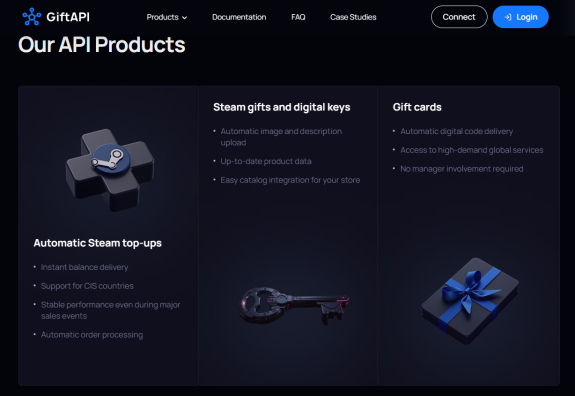
The business case for this transformation is compelling. Consider the testimonial from LootMarket, a platform that successfully made the leap: "After connecting GiftApi, we completely stopped processing orders manually." This isn't just a statement about efficiency—it's a declaration of competitive dominance. Manual order processing imposes a hard ceiling on your growth, limiting transaction volume to what your staff can physically handle. By eliminating that bottleneck, platforms unlock exponential scalability. They can handle traffic spikes during major game updates without hiring temporary staff. They can expand into new games and regions without rebuilding their integration. They can focus engineering resources on user acquisition, pricing optimization, and user experience rather than API maintenance. The financial implications are profound: reduced labor costs, fewer chargebacks from failed transactions, higher user retention due to faster fulfillment, and the ability to offer competitive pricing through automated supplier selection. In an industry where the difference between success and failure is measured in seconds and cents, the choice is clear—automation isn't just the future of balance refills; it's the only viable path forward.