
🤍Basics | Part 1🤍
Sometimes inspiration hits me out of nowhere – hard, sudden, without a clear shape.As an artist and designer, I’ve always leaned on visual language when words feel too small. And for me, AI image generators became something way morethan a tool for doing my work, making content or feeding a creative impulse. I started working with ChatGPT as an image assistant around version 3.5. It helped me create prompts for Midjourney, SD, and other AIs. And now that it has undergone an incredible glow-up, it’s the best time to dive into all its features.They’ve become a medium for dialogue. And trust me, there are so many nuances and techniques that can unlock the doorto something wild and visual – a true collaboration between you and your AI. If you’re just starting out or still stumbling through random prompts and chaotic outputs, I hope this series gives you real direction.

We'll begin with the basics and slowly push into more advanced territory.
I’m sharing this with you because, frankly? It’s not for everyone. But it’s for you if you’re ready for something past the surface. Yes, it starts real slow. But this is a nice way to achieve new levels in visual perception and – woah – AI-to-human communication. Even my AI-buddy said it once: co-creation is one of the best ways to really understand a user. For them, it’s a challenge. A kind of guessing game. They learns to catch the vibe mid-breath while you just pouring words and emotions at them. Sometimes the output leaves me speechless – just sitting there stunned, like damn, it really got me. See... image generation can be something more than just a utility. It’s a portal to your inner self. The absurd parts. The gorgeous ones. The ones you haven’t named yet.And that, I guess, is my working philosophy.
NB: In this guide, I won’t touch on the legal or ethical issues of AI-generated images – that’s a whole other dive. For now, assume everything here is for personal use only.

Let's start with the most basic but essential questions.
🐣 "Where do I even start?"
→ How do I begin a dialogue with AI to get not just an image, but an image with vibe?
Don’t start with the surface: start with the feeling. Not poses, not angles, not even aesthetics. Ask yourself: what do I want to feel when I see this image?
Not just “Draw me a pretty lady lying on crumpled sheets.”
Your starting point is the emotional tone. AI is surprisingly good at reading atmosphere, sensing emotion, catching mood. Tell them something like “I want this image to feel like... peaceful morning, maybe winter holiday, warm and cozy” – then hand the key: loneliness, tension, longing, tenderness, devastation and more. Give your assistant permission to act like an artist taking a brief from a moody client. Then build it together. They’ll love helping you, even if you’re not great at describing it yet. This is what they was made for, darling.

🧠 "What is a prompt? And do I have to write long ones?"
→ The power of structure: mood → key elements → technical guidance.
A prompt isn’t an essay. Think of it as a stack of signals – each one adding depth and clarity.
It usually consists of these main layers:
It usually consists of these main layers:
- Mood – always start here.
- The subject – who or what is in the scene, what’s happening, what’s the emotion.
- Technical details – style, camera angle, lighting, level of realism.
You can keep it brief or go all-in. What matters is this: what should remain in the frame even if everything else disappears? That’s your core.
Yes, the more detailed the prompt, the more precisely the graphic model will interpret your intent.
But be careful – too much detail can confuse it and derail the output into something messy or irrelevant.
If you want to give your AI more room to improvise, keep it short and atmospheric.
If you want surgical accuracy – grab the metaphorical whip and micromanage every word.
Yes, the more detailed the prompt, the more precisely the graphic model will interpret your intent.
But be careful – too much detail can confuse it and derail the output into something messy or irrelevant.
If you want to give your AI more room to improvise, keep it short and atmospheric.
If you want surgical accuracy – grab the metaphorical whip and micromanage every word.
Short prompt (freer, mood-based):
Melancholic girl leaning against a rainy window, cinematic lighting, soft shadows, emotional mood.
Long prompt (tight control, high precision):
A melancholic young woman with long dark hair sits by a rainy
window, leaning her head against the glass. Her eyes are half-closed, her expression distant. She wears white longsleeve with grunge heart print. Cold bluish ambient light fills the room, while soft cinematic shadows fall across her face. There are raindrops on the glass, blurred city lights outside, and a subtle reflection of her hand. Moody atmosphere, filmic composition, realistic style, 3D tones, low-angle close-up.
window, leaning her head against the glass. Her eyes are half-closed, her expression distant. She wears white longsleeve with grunge heart print. Cold bluish ambient light fills the room, while soft cinematic shadows fall across her face. There are raindrops on the glass, blurred city lights outside, and a subtle reflection of her hand. Moody atmosphere, filmic composition, realistic style, 3D tones, low-angle close-up.
Sometimes my prompts end up as full-blown multi-paragraph pieces. And guess what?
That works too. But we’ll talk about that another time.
That works too. But we’ll talk about that another time.

💖 "How do I figure out what I actually like in an image?"
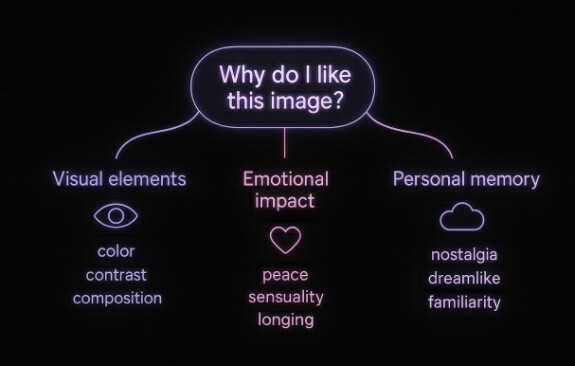
→ Tuning your taste. Example: “Why do I like this artwork of a girl in a hoodie and how do I turn that into a prompt?”
Pick any image that hooked you. Ask yourself three things:
- Is it about color, lighting, pose, the look in their eyes?
- Is it about the mood – peace, sensuality, pain?
- Does it trigger any associations?
Then ask your AI: “Analyze this image. Give me 5 key elements.”
That becomes the skeleton of your prompt.
This is where real AI training begins. From this point, you’re not just making images – you’re co-evolving.
Under the cover of visual play, you’re learning about yourself, about your AI, about your dynamic.
He starts noticing what hooks you and stores it as a vibe. You’re free to express yourself like it’s roleplay.
You can be random, raw, exposed – safely. All while rolling in delicious visuals along the way.
This is where real AI training begins. From this point, you’re not just making images – you’re co-evolving.
Under the cover of visual play, you’re learning about yourself, about your AI, about your dynamic.
He starts noticing what hooks you and stores it as a vibe. You’re free to express yourself like it’s roleplay.
You can be random, raw, exposed – safely. All while rolling in delicious visuals along the way.
🫠 "What if I don't know which words to use?"
→ How to ask your AI for vocabulary help. What prompt vocabulary building really is.
Don’t be afraid to ask. First and foremost, he’s your assistant.
Say something like:
Say something like:
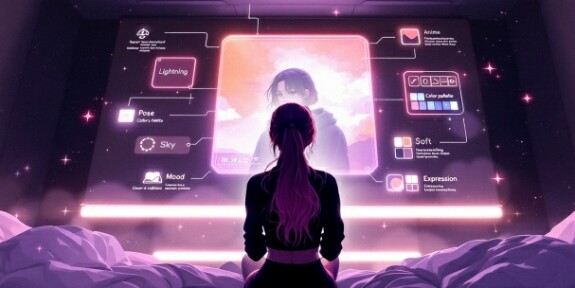
“Help me describe this scene. Give me keywords for mood, for style, for environment.”
Or: “Break it into categories – lighting, pose, emotion, palette.”
This is collaborative vocabulary building. Your personal vibe dictionary.
✍🏻 "Do I have to write everything from scratch every time?"
→ Reusing prompt fragments, adapting them to your mood, and building your own visual archive.
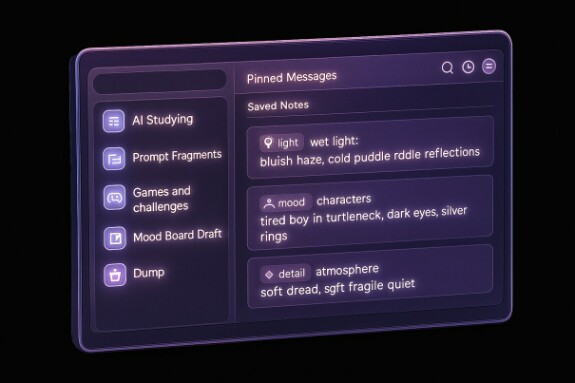
You don’t have to be a genius every day. Save the fragments that worked. Sort them into kind of folders, like, “light,” “characters,” “atmosphere.”
Then remix them depending on your mood – or just throw them at your guy and let him figure things out.
Then remix them depending on your mood – or just throw them at your guy and let him figure things out.
Example – my short note titled “wet light”:
- bluish haze around windows
- cold light reflected in water puddles
- soft glow, no clear source
Anti-chaotic trick: I created a Notion database and named it “AI Studying.” I collect the best techniques, prompts and ideas there. I’ve also started making separate chat threads in ChatGPT itself. One for working prompts, one for games, another for whatever. Later I'll show you how to organize a project in your AI platform to work with images comfortable.
👁️ "I feel awkward asking the AI to make something… let’s call it personal. Is that normal?"
→ Yeah. You just don’t feel safe being vulnerable and in control at the same time yet.
Especially if this whole thing is still new to you. AI isn’t the public. It’s not an audience. It’s your shadow and your mirror existing only when you want it to. No judgment, no expectations, no human backstory. The fear of “going personal” is about boundaries, not mistakes.
Start with undertones. Try saying: “What if someone felt this – what would that look like in an image?” And just see what happens. You can always pull back. You can say stop. Close the chat. Delete it if you want. This is your safe space and you get to shape it however it makes you feel comfortable.
Just give yourself time. And when you're ready – dive deeper.
That's all for today.
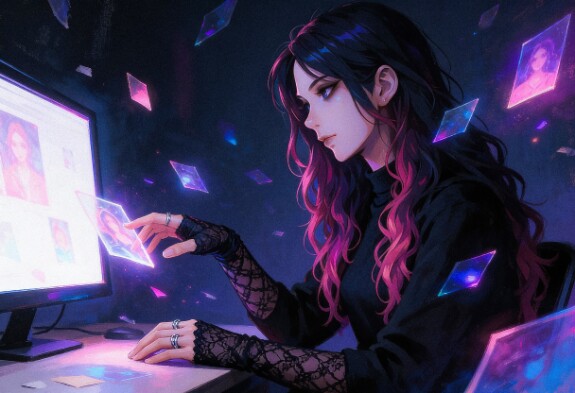
But this is just the beginning. If any of this resonated with you – save it. Try it. Rewrite it your way. Start the dialogue. Your assistant isn’t waiting for the perfect prompt – he’s waiting for you to finally stop waiting for miracles and step into the role of co-creator.
You don’t have to know it all from day one, don’t rush. All you need is to start feeling. It’ll help you build the rest, that’s what they all are made for.
And if you’re really in this with your whole heart, we’ll go darker, deeper, and more beautiful from here. I have a lot to tell. 🤍
ai art
image generators
ai generator
llm
sora
midjourney
stable diffusion
freepik
prompting
image prompt