
🤍Basics | Part 2 — Free access🤍
And if the first part was your first night – welcome to the morning after~
Last time, we talked about emotional prompting, structure, and how to tune your vibe with AI. This time, we’re diving into the more technical side – the stuff that turns a decent image into something that makes you stop scrolling.
There you'll find some important building blocks. Tools borrowed from art, film, design – the invisible framework that makes an image work. So yeah, it’s still foundational but not the baby-steps kind. More like: you’re past the training wheels, and ready to actually build something that hits. You can take these and lean into minimalism, dream-logic surrealism, or go full cinematic drama. The foundation holds either way.
Let’s go.
Don’t worry if you’ve never touched a design book. You don’t really need a lot of theory, I repeat, you need a feel. So here’s a crash course in the stuff that makes an image actually work: distance, angle, tilt, depth, balance.
✨ Tiny tweaks – huge impact ✨

How composition works
→ This is literally the foundation of the entire image.
Composition isn’t about making something “pretty” or putting it dead center.
It’s about where someone looks in the very first second, how their gaze moves, and what stays in their memory afterward. Most boring images? They’re flat. Frontal.
It’s about where someone looks in the very first second, how their gaze moves, and what stays in their memory afterward. Most boring images? They’re flat. Frontal.
Like you asked a kid to draw “mommy and daddy hugging in the rain.” They’ll put them in the middle, standing straight, maybe sort of kissing. Boom. Done.👶🏻
That’s our default view of the world.

And it’s exactly the thing we subconsciously try to escape from when creating images that feel like a movie — something that pulls us away from harsh 3D reality.
First of all – shot type.
It refers to how much of the subject is visible in the frame, which also defines how emotionally close the viewer feels to the moment.
• Close-up
used to show intimacy, emotion, tension. It can be a face, hands, a look, a detail.
Example:
used to show intimacy, emotion, tension. It can be a face, hands, a look, a detail.
Example:
“a man’s face in shadow, his eyes full of anger, screenlight flickering on his skin.”
This kind of shot won’t tell you the context but it makes you look right into the state.
• Medium shot
shows the figure from the waist up or full-body. It can include interaction between two characters. This is a balance between the personal and the situational.
Example:
Example:
“a man is standing on a rooftop, the evening light coloring the concrete” – you feel the place and the people.
• Wide shot:
helps set the context, space, loneliness, scale. The surroundings matter here.
Example:
Example:
“two figures walking down a wide road surrounded by tall skyscrapers and neon storefronts” – the focus is on the mood shaped by the landscape.
TL;DR: Faces? Go close. Mood? Go wide.
Unless you say otherwise, the AI will default to that typical straight-ahead, mid-shot view.
Add tags like "close-up, wide cinematic shot, or medium full-body, POV, shoulder level shot" to set the mood right from the start.
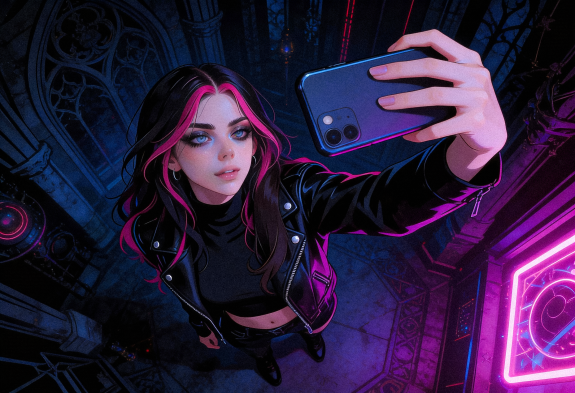
What’s a camera angle?
→ Getting into dynamics and emotional coloring through the lens.
Camera angle isn’t just a boring technical thing. It's a great way to show emotion, distance, proximity in the frame, and overall psychological perception.
Think of it as a guiding line that directs the viewer's eye into the scene.
Think of it as a guiding line that directs the viewer's eye into the scene.
- Eye-level (frontal):
Equal contact. It’s the most common and standard angle – the way we usually see people, straight on. Use this when you want the viewer to feel like they’re right there, on equal ground. This angle can be “invisible,” like you’re just quietly watching from inside the scene. Or it can feel confrontational – like the character is looking straight at you, speaking without saying a word.
Example:
Example:
“a person staring directly into the camera, a part of their face in slightly shadow, eyes are directed right to the viewer.”

- High angle:
The viewer looks down at the subject – which makes them feel smaller, more fragile, or powerless. Works well in scenes where the character is broken, being watched, or alone.
Example:
“a girl sitting on the floor, arms around her knees, seen from above through soft window light.”
Example:
“a girl sitting on the floor, arms around her knees, seen from above through soft window light.”
This also works beautifully in combination with wide cinematic shots.

- Low angle:
The subject towers over the viewer – it can signal strength, threat, dominance, or emotional distance.
Example:
Example:
“a man in a black shirt sits in a chair. The camera looks up at him. His posture is relaxed, but his gaze is direct and pressing. Darkness around him. The effect is pure control.”

Key words: high angle, low perspective, frontal cinematic view, ground camera view, etc.

ai art
ai design
design princeps
camera angle
perspective
ai generator
midjourney
sora
digital art