creator cover TonyTuanx
TonyTuanx

TonyTuanx 

Making soup out of science, coffee and creativity

2subscribers

11posts

Showcase

2
goals3
1 of 10 paid subscribers
(EN) I'll be able to cover coffee beans costs and focus more on brewing! (RU) Я смогу покрыть расходы на зёрна и сосредоточиться на заварке кофе!
1 of 2
$0 of $359 raised
(EN) I'll buy DiFluid R2 refractometer to improve the workflow! (RU) Я куплю рефрактометр DiFluid R2 для улучшения рабочего процесса!

About

(EN) Hi! My name is Tuan (also Tony), and I'm very passionate about science, coffee and creativity. My dream is simple: I want to be able to do coffee science starting from simple experiments from a perspective of a consumer (how to brew tasty coffee) to a perspective of a scientist (chemical and physicochemical analyses to biological studies in vitro/in vivo). 
If you find my work or my content helpful and interesting, you can support me here! 
PLEASE READ!!!: As far as I know there might be some issues with the subscription system on this platform, so do it at your own risk; donating, in my opinion, might be a safer option if you want to support me, because at least if the donation process wasn't successful you wouldn't lose your money. Always do your research, and for those, who are brave enough to subscribe - massive thank you, because we don't really have much options here in Russia.
(RU) Здравствуйте! Меня зовут Туан (можно и Тони), и я очень сильно увлечён наукой, кофе и творчеством. Моя мечта простая - проводить исследования, связанные с кофе, начиная от простых экспериментов с точки зрения потребителя (как заваривать вкусный кофе) до более сложных с точки зрения учёного (химический/физико-химический анализ и биологические исследования in vitro/in vivo).
Если Вы находите мой контент полезным и интересным, Вы можете поддержать меня здесь!

READ THIS IF YOU CONSIDER SUBSCRIBING

PLEASE READ!!!: As far as I know there might be some issues with the subscription system on this platform, so do it at your own risk; donating, in my opinion, might be a safer option if you want to support me, because at least if
the donation process wasn't successful you wouldn't lose your money.
Always do your research, and for those, who are brave enough to
subscribe - massive thank you, because we don't really have much options
here in Russia.
You can still gain lifetime access to the Google sheet with my brewing database by donating 5$ with your email address, so you don't necessarily have to subscribe.
Additionally, I'm still thinking about whether I should build this platform just for English speaking audience or try to translate it to Russian. Either way, my goal is to share information and excitement about coffee to any and every coffee enthusiasts, so it doesn't matter in the long run if I split the content into different languages in different platforms or create it all in one place, as long as it becomes a sustainable thing. I have time to think about it, and I'd like to hear your thoughts on it too.

"Soak Pass" - A New Technique That I'm Exploring

Recently, I've tried to brew AeroPress soup with a modified technique, which produced the thickest, heaviest in the body cups I've ever tasted. I called this technique a "Soak Pass".
The idea is that the most easily extracted compounds in the coffee are low molecular weight compounds, which contribute to acidity and saltiness, even umami taste perceptions. If you discard the first portion of the brew, you can make the brew more balanced with less sourness and salty/umami tastes. This concept is not new, and some people have been practicing this for quite some time in the context of pourovers, competitions and just brewing coffee at home as far as I know.
However, what I was more interested in was the applicability of this concept to low ratio percolation brews, such as AeroPress soup/espresso-strengths, to enhance the body of the brew. In theory, the latter extracted compounds are less soluble, have higher molecular weight and contribute to tactile sensations more.
I've tried to brew it three times so far, and the results were delicious, in my opinion, of course. Here's what I did:
1) As usual, added 18g of finely ground light roast Kenyan coffee (ZP6S at 1.0) to an AeroPress, tamped with the plunger and added paper filter on top of the puck;
2) Added 27g of room temperature and immediately inserted the plunger and pressed to the bottom of number 4 on AeroPress to drain the soaking water. The first portion of the extraction usually weighted around 8-10g, so the grounds absorbed water at a 1:1 ratio at this stage;
3) Removed the plunger and added 36-54g of boiling water, drained the coffee for around 50-60 sec and pushed to the hiss. The amount of boiling water depended on how much coffee I wanted out, and because the puck was almost saturated in the previous step, the output was usually the amount of boiling water added at this step plus/minus 1g.
I was amazed at how balanced the cups turned out with a lot of sweetness and body. These Kenyan beans were very acidic in other recipes, but with the "Soak Pass" the acidity was just right. Of course, the TDS was less at around 5-6.8%, because the sour and salty first portion contained a huge amount of solubles, but if it's that tasty then I'm all for it.
Book a Call For Consultation about AeroPress Soup/Pourover/Big Batch Brew
Get on a call with me for explanation on brewing with Puck Percolation techniques, recipes, or for helping with dialing in your brews!
Post is available after purchase
Get a Lifetime Access to My AeroPress Brewing Database!
Get a lifetime access to my brewing database for a price of 5$ (a cup of V60)!
After the payment, DM me w/ your email to access Google Sheet!
Post is available after purchase

(EN) AeroPress Pourover Grind Size vs Extraction Yield Correlation

So I've been gathering data on AeroPress Pourover style brews (this recipe: https://youtu.be/njxTlITJ6Ds), and I noticed something really interesting (which I mentioned in the video): the grind size has a significant impact on the resulting extraction yield, when dose and brewing ratio is kept under constant across different beans with different roasts and processes, albeit the water temperature ranged from 60 to 70C. The data is scarce, sure, so I decided to test out the formula from the linear regression ("before" graph), which predicts 28% extraction yield by grinding coffee at 1.0 on ZP6S.
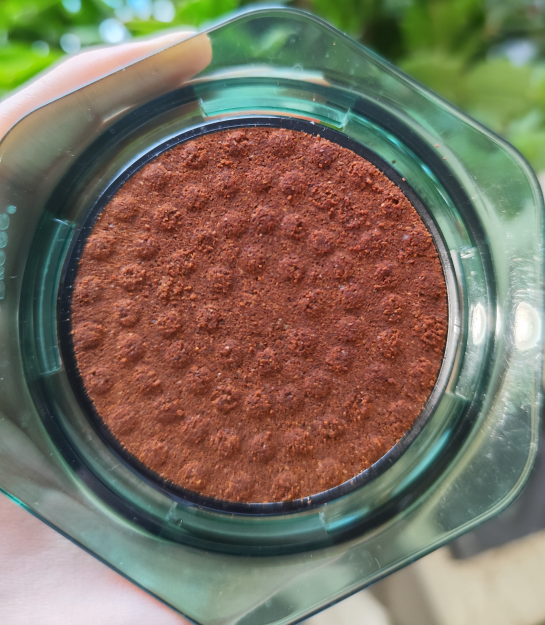
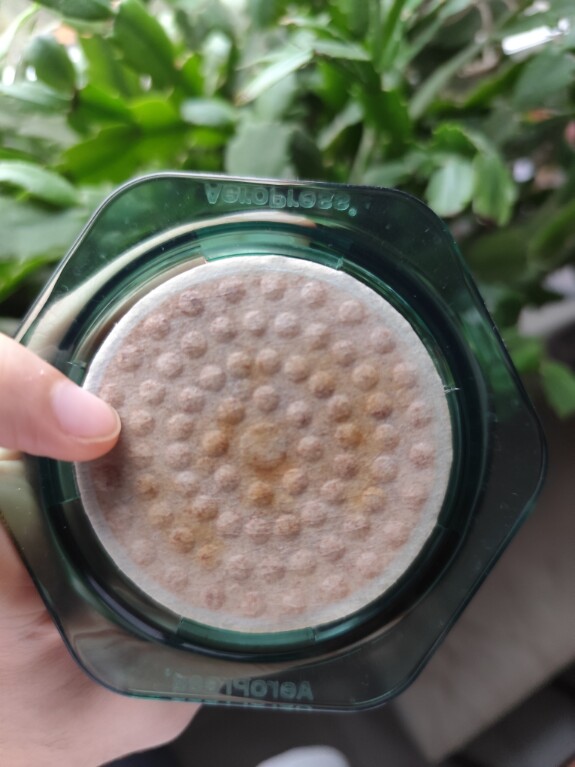
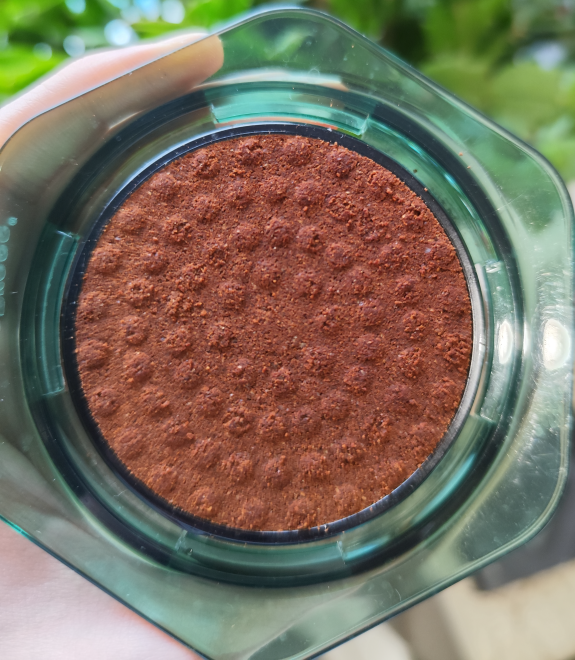
It did not hit 28%! It only reached 23% EY, which is still pretty high, but I was wondering what might be the reason for it. My first thought was to inspect the puck, and surely enough, it had several channels (see if you can find dark spots):

(EN) Weekly Brewing Reviews №2 (09-15/11/25)

Hello! Here is weekly review of the brews that I made this week; all of them have been added to my Brewing Database, which you can get a lifetime access to if you subscribe to CoffeeTonoia tier or donate 5$ with your email address, so that I can add you to the Google Sheet. Anyways, here are the brews:
1) Brazil Cerrado (natural, medium roast by Energy Coffee) - brewed several times
1.1) 18.0g (ZP6S at 1.0), 27g boiling water soak and 30.7g boiling water
Method: Modified Espresso-Strength Puck Percolation. No tamp! TBT 2 min 40 sec, 35.0 g out
A bit heavier body, not offensive, drinkable, but a little salty and highly astringent; puck looks HORRIBLE, huge dark area, suggesting channeling; pretty common stuff with boiling soak, I should say. Brix 9.2, so 7.8% TDS and 15.2% EY
1.2) 18.2g (ZP6S at 1.0), 36g boiling water soak and 30g boiling water
Method: Modified Espresso-Strength Puck Percolation. No tamp! TBT 2 min 45 sec, 43.3 g out
Used a cotton pad on top of bottom paper filter to see if the channeling could be reduced; the puck still looks terrible with dark region; still a bit heavier body, still a little bit saltiness. Despite this, okayish niceish brew, I think. Less astringency, less bitterness. Brix 8.2, so ~7.0% TDS and 16.6% EY.
1.3) 18.2g (ZP6S at 1.0), 30g room temp soak and 30g boiling water
Method: Standard Espresso-Strength Puck Percolation. No tamp! TBT 2 min 20 sec, 38.1 g out
Watery, very light body; I actually liked this brew, but it's reeally underextracted. Puck is pretty uniform with some dark regions. Brix 7.8, so ~6.6% TDS and 13.9% EY.
1.4) 18.2g (ZP6S at 2.0), 57g boiling water
Method: No Tamp AeroPress soup (high flow). No soak, just add water and press. TBT 45 sec, 39.3 g out
Silty mouthfeel, unpleasant sourness, felt some fermented apples though? Puck with dark spots. Brix 7.6, so ~6.5% TDS and 13.9% EY.
(Early Access) Will It Soup? Ultra Fine Turkish Coffee Edition (Coffee Experiment)
Can I pull an AeroPress soup with ultra fine grounds? Subscribe to get an early access to the video! 
Level required:
CoffeeTone (КофеТон)

(EN) Weekly Brewing Reviews №1 (01-08/11/25)

Hello! So I decided to start documenting my brews to collect the data and see if it can be analyzed in bulk in the future. I totally screwed it up though, because the app where I write down my notes doesn't keep track of date of changes (skill issue). Oh well, I will try to do my best to write down the dates from now on, as well taking some pics whenever it's possible! Here are the brews that I've done this week:
1) Decaf Colombia Manzanares (washed, sugar cane decaf, omni roast by rockets.coffee) - brewed twice
1.1) 17g coffee (ZP6S at 3.5), 250g water at 70C
Method: Puck Percolation for AeroPress pourover-style. Puck prep by tamping and sandwiching the puck between bottom and top paper filters, then pour and 2 min drain.
Very nice, sweet and balanced coffee! Posted on YT shorts and repeated it for long-form video. Didn't measure EY%, but a week ago this recipe landed at 19% EY.
The output on average is 225g.
1.2) 18.2g (ZP6S at 0.5), 60g water at 65C
Method: No Tamp AeroPress soup (high flow). Grind, add grounds and level them, add top paper filter, pour, one push for soak to just around number 3 on AeroPress and then push with all my strength. Total brew time (TBT) ~40 sec, 44.9 g out.
Kind of umami, not offensively bitter and not very acidic, just kind of strong and little boring; Brix at 7.7, so around est. 6.5% TDS and 16.1% EY.
2) Uganda Rwenzori (natural, "espresso" (looks medium) roast by QQ Coffee)
18.2g (ZP6S at 1.0), 60g water at 60C
Method: No Tamp AeroPress soup (high flow). TBT ~30 sec, 43.3 g out.
Was okay, had a nice acidity 3/5 with 1/5 bitterness, however it definitely felt underextracted, which was confirmed by Brix 7.9, so 6.7% TDS and ~16% EY. Pretty even extraction overall, but medium to dark roasts always give me trouble in terms of EY!

How accurate is the Brix refractometer? Part 1 / Насколько точен рефрактометр по шкале Брикса? Часть 1

(EN) An analog Brix refractometer is a useful tool to estimate total
dissolved solids (TDS) in a coffee brew. I use it regularly in my
testings to learn more about how different brewing variables alter the
extraction.

It has been well established that the Brix value correlates linearly
with TDS (https://doi.org/10.1007/s00217-013-1917-x),
and the commonly used conversion formula is as follows: TDS (%) = 0.85 x
Brix. There were also independent studies that replicated this observed
relationship between Brix and TDS (https://doi.org/10.13140/RG.2.2.10679.27040, https://quantitativecafe.com/2022/06/16/calibrating-a-cheap-refractometer/).
I admit, I have yet to read these studies in their entirety. However, one must still
be critical of these formulas, especially when the formula comes from a
correlation. And I still needed to at least calibrate my refractometer,
so I used some instant coffee to see if this relationship holds true.
To my surprise, a linear regression gave me TDS (%) = 0.99 x Brix for
instant coffee, which was very interesting! It is just one experiment,
but I plan to repeat it with different instant coffees with multiple replicates, as well as use sucrose/sugar dilutions as control/reference samples.
Why is this important? Well, the relationship between TDS and refractive index (RI) was established by gravimetry method, i.e. by oven drying coffee samples and weighting the residual solids. After that, the relationship between the weight and the RI measured beforehand is analyzed. But wait, what about RI measurements after oven drying? What if the RI was lower, if the dried samples were to be dissolved in the same amount of water as in the initial sample? Then the TDS that is calculated in commonly used refractometers for coffee is underestimated. Maybe I'm missing something and should do more research, which I intend to do. I will continue my thoughts in the next post about refractometer, as well as dive into some experimental details. For now, here's a messy Excel sheet with results from the aforementioned experiment (at the end of this post).
(RU) Аналоговый рефрактометр по шкале Брикса - это полезный инструмент для оценки количества растворенных частиц (TDS) в кофе. Я пользуюсь им постоянно в моих тестах, чтобы лучше понять, как разные переменные в заваривании меняют экстракцию кофе. Известно, что значение Брикс линейно коррелирует с TDS (https://doi.org/10.1007/s00217-013-1917-x), а формула для перевода значений Брикс на TDS такова: TDS (%) = 0.85 x Брикс. Независимые исследования аналогичным образом установили такую же зависимость между этими параметрами (
Subscription levels4

CoffeeTone (КофеТон)

$2.16 per month
(EN) Your support is a tone that will build up into a beautiful melody, which will help me in my creative endeavors! You will get access to Boosty-exclusive content, and be a part of this curiosity-driven community!
(RU) Ваша поддержка - это прекрасный тон, который поможет мне в моей творческой деятельности! У Вас будет доступ Бусти-эксклюзивному контенту, и Вы будете частью этого сообщества, дышащим любопытством!

CoffeeTonic (КофеТоник)

$3.6 per month
(EN) Feeling fancy with that espresso-tonic, huh? With your sparkling support, your suggested ideas on what content/video you'd like to see will be prioritized!
(RU) Я смотрю, у Вас бодрящее настроение, как у эспрессо-тоника? C Вашей игристой поддержкой, Ваши предложенные идеи о темах контента/видео будут в большем приоритете!

CoffeeTonoia (КофеТонойя)

$5.8 per month
(EN) WOW! Your support will be a valuable contribution to understanding coffee. You will get access to everything in the previous tiers + access to a Google sheet with my brewing data! Also you will be mentioned as a major contributor at the end of my videos on YouTube!
(RU) ОГО! Ваша поддержка станет ценным вкладом в понимании кофе. Вы получите всё, что перечислено в пред. уровнях + доступ к Гугл-таблице с данными по моим заваркам, а также будете упомянуты в конце моих видео на Ютубе!
Subscription Spots Are Limited

CoffeeTonality (КофеТональность)

$14.4 per month
(EN) Just WHAT. You're not just supporting a creative endeavor now, you're supporting scientific endeavors too! That's unbelievable! You get everything from the previous tiers, as well as access to a private chat exclusively for scientific discussions!
(RU) Простите, ЧТО. Теперь Вы поддерживаете не только творческие дела, но и научные исследования! Просто невероятно! Вы получаете всё, что было в предыдущих уровнях, а также доступ к приватному чату исключительно для обсуждения научных дел!
Go up