
How to show time trial in cross-country skiing. Part 2: graphics
A time trial race is an information-rich event. But the current broadcast capabilities to convey this information and give the viewer a complete picture of the race are extremely limited. The graphics are not informative.
Current graphics
Almost all information interaction with the viewer comes down to the following graphic panel.

It displays no more than four names at a time, and often only two. If the passage of the timing point by the skier of interest to the viewer was not shown, then in order to find out his result, he need to carefully examine the graphics over the next few minutes in search of the desired data. At the same time, a positive outcome is not at all guaranteed, including for the main favorites of the race (see the table from the previous part of the analysis).
The graphics modestly tell only about those timing points that are included in the broadcast. But the fight continues throughout the entire distance, and sometimes the situation in the race changes almost at every segment. However, this data remains behind the scenes.
Future graphics
Interestingly, the graphics used to be more detailed, but recently they have changed towards thoughtless, uninformative minimalism. Also, more detailed information about the race than at the World Cup can be obtained at major national competitions in Sweden and Norway.
A simple solution that will significantly improve the graphics is to increase the number of names displayed in the results panel. The number 8 was chosen as a rational option: it is sufficiently detailed and does not clutter the picture. Minimalism also does not stand aside. Namely: minimalism - before crossing the timing point, details - after it.

Results panel before crossing the timing point

Results panel after crossing the timing point
What do the numbers in brackets mean?
In the time trial, athletes are at different stages of the race: some have already finished, others are in the midst of the race, and others have just started. The options for completing the distance also differ: some start quickly, others improve at the finish, etc. Thus, we get sets of results at different timing poins, none of which fully reflect the position in the race until all athletes finish. Only after this moment does the results table at the finish line acquire such quality.
However, nothing prevents you from combining separate data from different timing points into a single generalized ranking and getting a complete picture of the race at any time. It is the positions of skiers in such a virtual ranking that are shown in the pictures.
Now let's look at the full version of the frame.

On the left is the virtual ranking panel. It is updated live every time any athlete crosses a timing point. The place in the ranking is duplicated on the right in the results panel. From the previous pictures we can notice that Perttu Hyvärinen, after passing 3.7 km, rose from 4th to 3rd position in the ranking. An improvement in the ranking is indicated by a green indicator. We also see that Calle Halfvarsson's ranking is lower than Harald Amundsen's, despite the fact that he is ahead of the Norwegian on the displayed timing point. This means that at later timing points there was a castling between them.
On the virtual ranking panel opposite each athlete there are two indicators. The first is an indicator of passing the timing point. It has already been mentioned. At the moment the timing point is crossed, it lights up in a certain color, depending on how the athlete’s ranking has changed. Green – the ranking has been improved, red – worsened, yellow – unchanged, blue – the athlete has just been added to the ranking (passed the first timing point).
At the same time, information appears about which particular timing poin has been passed and with what gap. For race leaders, such additional information is available at any timing points; for others, only at basic timing points. This limitation was added so as not to overload the broadcast with secondary information.
The second indicator is located after the four-letter skier code. This is an indicator of the phase of the distance. If three sticks are lit, the skier has finished, two are in the final third of the distance, one is in the middle of the distance, zero is at the beginning.
A couple more pictures of the virtual ranking panel.


Another useful element is comparative graphs.
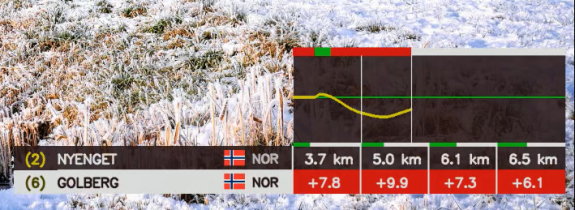

Finally, after the race is completed, you can please the viewer with analytics.


This gives us a whole new level of detail, presented in an easy-to-read format. This should satisfy the needs of both big fans of time trial racing, as well as beginners and those who are cool about the discipline. The whole race is now at your fingertips.
UPDATE
It was decided to change the behavior of the indicator of passing the timing point on the virtual ranking panel. Now it works as follows. If a skier improves his ranking, then the indicator lights up green, and the indicators of those athletes who have worsened their rating due to this light up red, and vice versa. If the athlete's ranking has not changed after passing the timing point, the indicator does not light up. It was also decided to abandon the display of gap on the virtual ranking panel.