

Senari
Artist
2subscribers
14posts
$398.31 of $2 825 raised
For ChocoPie
About
₍ᐢ. .ᐢ₎
Hi! I'm here to make you feel good~
Aesthetically, of course!
❤
Aesthetically, of course!
❤
I draw furry art, many examples are in my Furaffinity page
My commissions are open! I'm excited to bring your ideas to life in my artworks. Let's create something awesome together!
You can contact me in any convenient way to take a commission (using telegram is preferred 'cause this way I'll instantly get a notification on my phone)
Also, you can always message me if you need any emotional support or just want to chat! I'm always here for you, frens! <3


Meme face
I love this so so much

Another gift for another friend's birthday
I'm a birthday gift-giving machine!


My character design guide
When creating a character design, you need to think about the following things, gradually working out the character from a general impression to specific details:
Scope. Where will the character be used? Each scope has its own characteristics. Designs for animation should be as simple as possible and have as little detail as possible, while designs for adopts should be shiny and full of detail. For animation you need to draw poses, emotions, turnarounds; for a card game you don't need this, it's enough that the character looks good in one pose
Idea. The basis of any character is an idea, a story. Write a few words that characterize the character. What feelings should they evoke? What idea do they represent? Take some time to visualize the character, to feel them, to understand them, to become them
Shape Motif. The silhouette should be easy and quick to read. The character should be recognizable from the silhouette. Shapes (round, square, triangular) should convey the character's idea. It is possible and even necessary to use combinations of shapes - main shape, secondary shape, shape for details. Use the big/medium/small principle. Sometimes it makes sense to draw a character from stain, first working on the main (outer) silhouette and then on the secondary (inner) silhouette
Distinguishing features. 1-5, ideally 3 details/traits. They can:
a) Define the archetype/profession/class of the character
b) Add character to the character
a) Define the archetype/profession/class of the character
b) Add character to the character
Archetype. There should be defining symbols - elements that characterize the character. A hat for a cowboy, a cap for a cook, a triangle hat for a pirate. A long robe for a wizard, a big sword for a warrior. These are stereotypes that begin to speak before the design speaks
Characterization. That thing that makes your character your character, that sets him or her apart from the walking template you addressed in the last step. This is where you can (and should) try to hook the viewer into making them wonder. For example, the thief's dagger is made of seemingly fragile glass. The princess is obviously only pretending to be a damsel in distress. Why? How? For what? These are the questions that grab your attention and make your eyes search for the answer. This stage is what you should maximize your investment in, and tell the character through the image
Nuance. A candy for the most attentive who have spent enough time with your design to notice this. These are little hints at the answer to the questions the viewer has asked before. The princess's arms are all scarred. Did she break out of her own imprisonment and come for revenge? Or is she the monster- In the thief's dagger, countless reflections of reality flicker. What if he has the magic of reflection? Suddenly a moment more and we'll see him surrounded by doppelgangers- Here you can also leave hooks for further character development
character design
Paradise apple
A character design I made for a contest organized by an artist friend of mine. The theme of the contest is "Paradise apple"
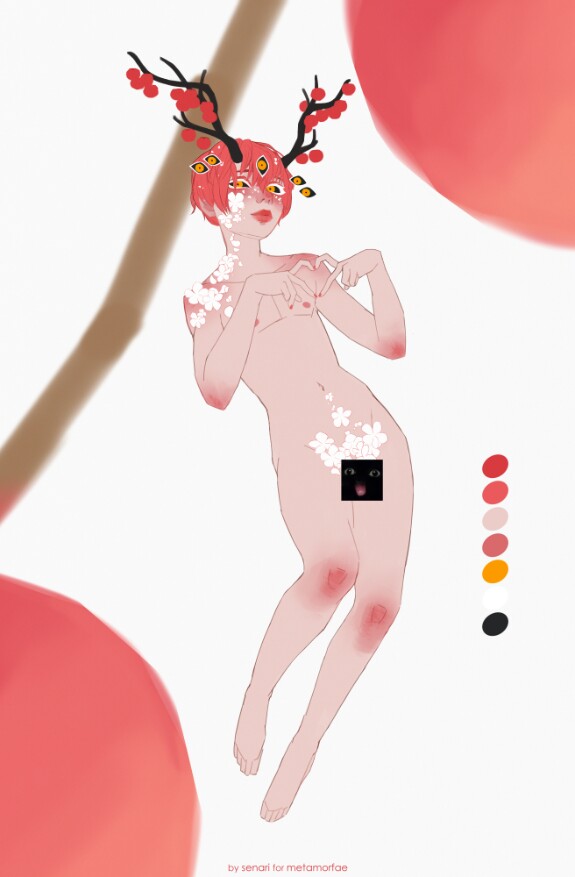
character design
Subscription levels1
Fren
$3.6 per month
- Early access to my drawings
- Painting processes
- Tips and tricks
- Painting processes
- Tips and tricks