
2.2 Organisational structure
The main point of this class is to understand the ways to describe how human resources are organised in different organisations and to draw organisation charts.
0:00 Intro & objectives
0:53 Key terms
13:27 Organisation charts
23:35 Organisational structures vs external factors
28:20 Change (HL only)
36:02 Back to objectives
Class objectives:
— Explain 9 key terms that relate to the topic (AO2)
— Analyse and draw different types of organisation charts (AO2, AO4)
— Discuss the appropriateness of different organisational structures given change in external factors (AO3)
— [HL only] Discuss changes in organisational structures (AO3)
i. KEY TERMS
Explain 9 key terms that relate to the topic (AO2)
Even though the title of the chapter is «organisational structure», we will talk about structures in detail a bit later. For now, we’ll define some of the terms to facilitate your understanding of organisational structures and their types. If you feel a bit confused and you don’t have a clue about what organisational structure is, you can think of it as a way how things get done in a company, who gives orders, who gets things done, who’s in charge of what. But again, first of all, let’s build a foundation on which we’ll build more detailed knowledge by defining 9 key terms that relate to organisational structure.
Delegation is the passing on and entrusting of certain tasks from managers to subordinates. Simply speaking, it’s when managers give (delegate) some work to employees. Delegation is a win-win situation: managers focus more on strategic decisions by delegating tactical tasks (more about strategies and tactics in 1.3), and employees feel that they are trusted and have meaningful and interesting (hopefully) things to do. Delegation is not a reward! It’s just a natural thing in any organisation and it’s as essential to any organisation as air to our planet. You don’t reward people with air, right? It’s just an everyday normal thing that everyone has. So the same thing with delegation. If there was no delegation, then the boss would do all tasks on her/his own and there would be no organisations at all!
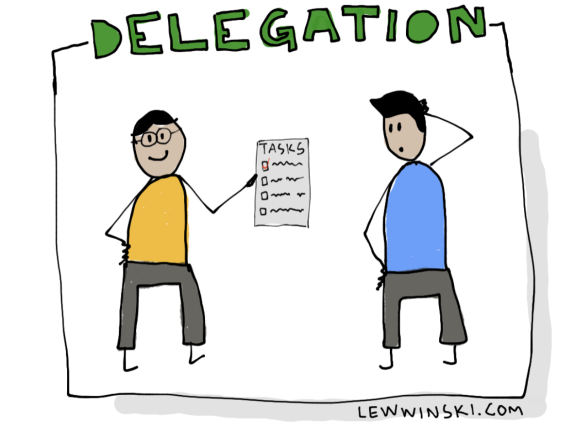
Figure 1. Delegation
Span of control is the number of subordinates (employees) who are directly accountable to a manager. Simply speaking, it’s a number of employees under a manager. Span of control can be wide and narrow. One is not better than the other. Organisations with wide span of control have fewer layers, lower managerial costs, effective communication and larger teams that are harder to control directly. Organisations with narrow span of control have more layers, are more costly, have prolonged communication and «us and them» culture, but are easier to control directly. «Us and them» culture is when employees and managers do not really feel like they are one team and there’s not much unity between them, it’s when employees/managers call themselves «us» and the other group — «them». Personally I think «us and them» culture is not cool.

Figure 2. Span of control: wide vs narrow
Hierarchy is an organisational system that is based on ranking. Levels of hierarchy are different layers in a hierarchical structure. Line manager is a person directly above an employee on the next hierarchical level. There can be many line managers on different levels. Line managers are essential to hierarchical structures. Hierarchical structures are clear and easy to understand and they create a sense of belonging because people easily understand their place in the hierarchy and can see who they work with, who they are accountable to and who they are responsible for. However, hierarchical structures might result in isolation between departments (and «us and them» culture, again) and they are quite inflexible because people tend to only do work that’s strictly determined by the hierarchy.

Figure 3. Hierarchical structure and levels of the hierarchy
Chain of command is a system by which orders and instructions are passed down in an organisation. The more levels of hierarchy there are, the longer the chain of command is. Thus, chain of command can be long or short. Longer chains usually indicate narrow spans of control and their features (see the «span of control» paragraph), while shorter chains of command indicate wider spans of control and the corresponding features. The longer the chain of command is, the more formalistic and bureaucratic organisations tend to be, which prolongs decision-making and hinders creativity.
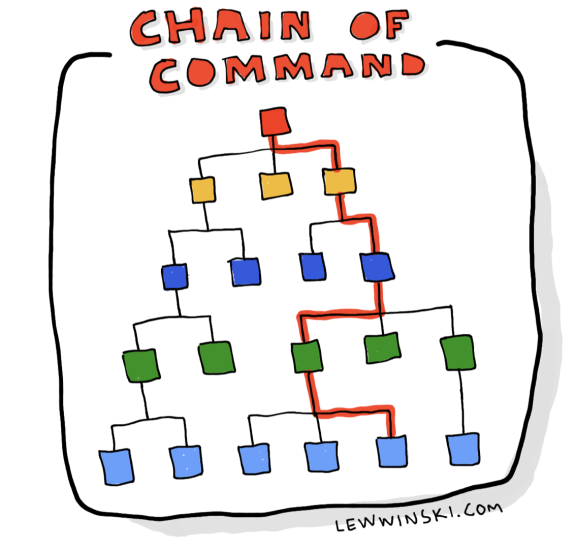
Figure 4. Chain of command
Bureaucracy is the execution of tasks that are guided by excessively complicated administrative rules and procedures. Simply speaking, it refers to too many rules and procedures and paperwork in an organisation. For example, filling in the reports, tedious paperwork, long chains of command, formality, impersonal attitudes, high degree of accountability. Bureaucratic organisations are quite inflexible and hinder creativity and risk-taking because people are reluctant to do all these things if there are too many rules and if you need a permission for everything you do. People naturally become the gears in the mechanism that support the huge bureaucratic machine. In my opinion, the most bureaucratic organisation ever was USSR. We all know how it ended, haha. Adhocracy is the opposite of bureaucracy. It does not mean that bureaucracy is bad and adhocracy is good. Balance between the two is what leads to success. Too much of anything is bad for everything.

Figure 5. Bureaucracy vs adhocracy
Centralisation is the concentration of power and decision-making in a single authority (one person or group of people). Simply speaking, it’s when all decisions are made by one person or a small group of people. Centralised organisations usually make quick decisions, have a good sense of direction among staff, are easier to control, and are efficient in critical situations. However, they add pressure/stress for senior management (because all decisions are on them and they are in charge of everything), they are inflexible, power plays are common (it’s a tactic to increase someone’s power, for example when the boss says «you have to do it because I’m your boss and I said so»). In addition, delays in decision-making are common for centralised organisations (waiting for the boss to okay employees before they can proceed), and it can be demotivating for some people because there is no reward for initiative, you should simply do what you’re told to do.
Decentralisation is the transfer of power and decision-making from a single authority to several people/groups. Simply speaking, it’s the opposite of centralisation. Usually, decentralised organisations have employees that are more engaged and motivated, and like working in teams. However, these organisations might experience increased admin costs (because there are more managers and decision-makers who need to be compensated for administrative work), decision-making might be more time-consuming (because agreement among many decision-makers is needed to proceed), and besides, decentralised organisation might potentially lose control over employees and not get anything done. Again, centralised doesn’t necessarily mean bad and decentralised doesn’t necessarily mean good, it’s all about finding balance.

Figure 6. Centralisation vs decentralisation
Delayering is the process of removing one or more levels in the hierarchy. It does not necessarily result in downsizing! If a management layer is removed, it doesn’t mean that these delayered managers have to leave. They will most likely be distributed among upper and lower layers of the hierarchy. Delayering implies removal of management, not necessarily removal of people (redundancies and dismissals). Some of the advantages of delayering: it reduces admin costs, improves the speed of communication, encourages delegation and empowerment. However, delayering might create anxiety and sense of insecurity, overload staff, and prolong decision-making (because there is wider span of control, and thus there are more decision-makers after delayering).

Figure 7. Delayering
Matrix structure is a system whereby employees report to several managers and work in cross-departmental teams. Simply speaking, it’s when employees make different teams from employees in different departments and different levels of the hierarchy in order to complete different projects. The opposite of matrix structure is functional structure (traditional hierarchical structure that we talked about before). However, matrix and functional structures can coexist and overlap inside one organisation. For example, if there is an IT company with traditional hierarchy with CEO, department heads, and employees in each functional department (HR, marketing, production and finance), and the organisation has to design a new app, they might create a team for it that will include people from all functional departments and from all levels of the hierarchy. And lastly, matrix structures are very common for project-based work, where people form teams to complete a project, and then they form new teams with different people for the next project.

Figure 8. Matrix structure within functional/hierarchical structure
Nowadays, organisational structures (especially in creative industries) tend to get flatter and wider, with more delegation, wider spans of control, less levels of hierarchy, shorter chains of command, and tend to become less bureaucratic and more decentralised. See? 5 minutes ago you probably wouldn’t understand the previous sentence as well as you do now. Well done! You should feel good about learning so much in such a short time.
ii. ORGANISATION CHARTS
Analyse and draw different types of organisation charts (AO2, AO4)
Organisational structure is an arrangement of professional relations at work. By professional relations I mean who the boss is, who the manager is, who colleagues are, who works in one department and who works in another, how these departments and people cooperate, etc. Basically, organisational structure is «the whole thing», the way organisation functions in terms of human resources.
Organisation chart is a graph that represents organisational structure by showing the relationships of accountability and responsibility. Simply speaking, it’s a picture that shows organisational structure. If organisation is a family, then their type of organisation chart is family tree. Accountability is a down-to-top (upwards) type of professional relationship which means being responsible to someone on the higher level of the hierarchy. For example, if you are a clerk, then you are accountable to your line manager. Responsibility is a top-down (downwards) type of professional relationship which means being in charge of someone on the lower levels of the hierarchy. For example, if you are a school principal, then you take authority over teachers. In other words, you are responsible for teachers.

Figure 9. Organisation chart
Organisation chart shows many things that we learnt in the previous part of chapter. For example, the following:
1. Functional departments
2. Chain of command
3. Span of control
4. Channels of communication
5. Levels of hierarchy

Figure 10. Things you can tell from an organisation chart
There are two categories of organisation charts. The first category refers to the «height» of charts, to how many levels they have. In this category, there are two types of charts: flat (horizontal) and tall (vertical). Flat and horizontal here are synonyms, same as tall and vertical, so you can choose the name that sounds more pleasing to your ear in each category. Another category refers to the purpose of the chart, to the main idea that it is demonstrating. In this category, there are three types of charts: by product, by function, by region. These two categories always overlap, so charts can be vertical by product or horizontal by region, etc. Let’s have a closer look at all the types of charts in both categories.

Figure 11. Types of charts
With regards to the first category («height»), we are going to compare flat (horizontal) and tall (vertical) charts in 9 different aspects. See the table below for comparison between them.

Figure 12. Comparison of flat (horizontal) and tall (vertical) charts/structures
I think all the things in the chart are pretty self-explanatory and if you understood the key terms from the first part of this chapter, then you shouldn’t have problems understanding the differences between tall and flat structures.
With regards to the second category (purpose of the chart), I will give you some examples. Chart by product indicates all the products that an organisation is providing. For example, the chart for Yum! Brands Inc. might include Pizza Hut, Taco Bell and KFC, and then, under each product (brand, in this case), a traditional hierarchical chart by function. Chart by function is the most traditional kind of chart that indicates the functional departments in the organisation: marketing, HR, finance and accounts, operations (see 1.1 to review business functions). By the way, it doesn’t have to be 4 departments only, and it doesn’t have to be departments that correspond to the main 4 business functions. Organisations can structure their departments based on their needs however they want, even though they usually have departments that are in charge of the main business functions. And finally, charts by region show the regions in which organisations operate. Sometimes these regions overlap with real geographic areas and continents, but most of the time they refer to the regions that organisations define themselves. For example, for 1BO, there are 3 regions in the world: Asia-Pacific, the Americas and AEME (Africa, Europe, Middle East).

Figure 13. Examples of charts by product, by function and by region
As you have probably guessed already, one type of chart doesn’t contradict the other, thus they are not mutually excluding. A chart by product can also include a chart by function within itself. Besides, all the 3 types of charts in the Purpose category can be either flat (horizontal) or tall (vertical), which means that different categories of charts aren’t mutually excluding as well. In addition, very often, organisations prepare different kinds of charts for different purposes. For example, if an international educational organisation wants to show to people worldwide that they have schools all over the world, they’ll show the chart by region. But if the purpose is to show how Asia Pacific branch of that organisation works, who’s the big boss there and who’s accountable to her/him, then a chart by function would make more sense. And finally, if the purpose is to show what kind of education programmes the organisation offers (primary years, middle years, diploma, career-related), then a chart by product would make more sense.
Just a reminder that chart is a diagram that represents organisational structure. Thus, even though the purpose of this part of chapter was to study the charts, we have studied structures as well. Flat/horizontal, tall/vertical, by product, by region, by function — all of these characteristics apply not only to charts, but to structures that these charts represent as well.
And one more thing. In addition to traditional hierarchical charts, there are also matrix structures that we learnt in part 1 of this chapter. For them, there is no one rule or way to draw because they are super flexible and unique in each particular situation. In order to practice matrix structure charts, imagine that you are a very-very bad student (I’m just saying «imagine», haha) and think which teachers and school administrators will be involved in the «project» of helping you study better and try to represent the team of these people in a matrix chart. That would be an example of a unique matrix chart for you only. Also, compare it to the traditional organisation chart of your school. Have fun!
iii. ORGANISATIONAL STRUCTURES VS EXTERNAL FACTORS
Discuss the appropriateness of different organisational structures given change in external factors (AO3)
The most important thing in this part of chapter is to break down the objective and understand what we are actually trying to learn here. As you can see from the subheading above, the objective of this part of chapter is to discuss the appropriateness of different organisational structures given change in external factors (AO3). The three key words in this objective are: structures, external and change. Let’s have a closer look at these key words.
Structures is what we discussed in the previous two parts of chapter. By now, you should already know what these types of organisational structures mean: hierarchical, matrix, horizontal (flat), vertical (tall), by product, by region, and by function. If you are HL student, then in the next part of chapter you will also learn about project-based and Shamrock organisations.
External factors refer to anything in the external environment that impacts businesses. If you want to have a more systematic understanding of what is going on in the external environment, you can use a tool from the Toolkit called STEEPLE analysis. I’ll just briefly say now that the tool helps managers to categorise all the factors from the external environment into 7 categories: social, technological, economic, environmental, political, legal, ethical. So, anything from the external environment (including 7 STEEPLE factors) can impact organisations and force them to reconsider their structures.
The last key word is change. Change is one of the CCES concepts of the business management course. Change is the alteration or modification of any aspect in the external environment.
By now, you should understand that organisations might have to adjust or change their structures if there is something in an external environment that forces them to do so. Your goal here is to discuss whether this or that structure is appropriate under the given circumstances from the external environment. You might ask a very good question: «I understand all the types of organisational structures. I understand that external factors can change and impact organisations. But how do I discuss the appropriateness of structures given the external change?». Here’s how you might do it.
The «SLAP» rule applies to more or less any AO3 (evaluation) question. According to it, you can discuss organisational structures in terms of the following factors: S — stakeholder implications, L — long-term and short-term implications, A — advantages and disadvantages, P — priorities (for example, mission or objectives). In addition, you may evaluate different structures in terms of communication, sustainability, leadership, costs, and anything else that is relevant. The secret here is to keep your analysis balanced (on the one hand… on the other hand…), link your analysis to the case study, and demonstrate a well-justified judgement. Your BM teacher should know very well what AO3 is and how to answer thus type of questions.

Figure 14. Evaluation of appropriateness of different structures given the change in external factors
iv. CHANGE (HL ONLY)
Discuss changes in organisational structures (AO3)
In the previous part of chapter, we learnt that organisations might change their structures due to external factors. In addition to external environment, change might come from within as well. Regardless of what causes change, it is a fact that organisations have to be flexible and change their organisation structures. In addition to hierarchical, matrix, flat (horizontal), tall (vertical), by function/region/project, HL students also learn project-based and Shamrock structures, and, most importantly, learn to discuss/evaluate changes in organisation structures.
Project-based organisation is a type of organisational structure that has human resources organised around projects, as opposed to the hierarchy, or purpose, or other factors. For example, think of a construction site. The team is assembled for construction of a building and then it is dissembled upon completion. In this example, the project is construction of a building, and all the human resources are organised around that project. Another example could be any IT company that decides to create a new app and invites people from all levels of hierarchy and all departments to participate in this project. Any kind of business that is involved in «one-of-a-kind» (project) activities could be an example of a project-based organisation.

Figure 15. Project-based organisation
An attentive student might ask: «Haven’t we learnt that already and isn’t it called matrix structure?». Project-based organisations and matrix structures are similar and one often implies the other. However, they are not the same. Project-based organisation is a characteristic of an organisation that works on «one-of-a-kind» activities (projects) and has a new team for each project. Matrix structure is a characteristic of an organisational structure that implies the fact that people from all departments and levels of hierarchy work together on certain tasks.
Shamrock organisation is a type of organisational structure that divides the workforce into three «leafs» depending on how essential they are to the organisation.
1. Core staff — full-time professional workers that usually work full-time and are crucial to the organisation. They are usually the key decision-makers of the organisations. CEO, engineers, directors, administrators could be some of the examples of core staff.
2. Outsourced (contractual) staff are subcontractors that perform some non-core activities for the organisation. These are usually businesses that specialise in something that is not essential to the organisation. For example, many film production companies outsource 3D visual effects to other companies. These effects are very important, but not as important as the film director, actors, and cameramen who are impossible to outsource because they are core staff members.
3. Temporary (peripheral) staff are workers that are employed only when needed on a part-time temporary basis. For example, amusement parks often hire some extra staff (usually students that are on summer vacation) for peak season.

Figure 16. Shamrock organisation and Charles Handy
Shamrock organisation was suggested as a theory by an Irish organisational behaviour theorist and philosopher Charles Handy. Shamrock is not only a good analogy for an organisational structure, but also one of the main symbols of Ireland.
So, you know all the types of organisational structures now and it’s time to look back at the objective for this part of chapter: «Discuss changes in organisational structures (AO3)». The relationship between change and Project-based and Shamrock organisations is that these two types of organisations is what businesses nowadays tend to become. More and more organisations, especially the ones that have creativity among their core activities, tend to become less hierarchical and vertical and more flexible and flat. This transition (from hierarchical to flexible, including Project-based and Shamrock) comes with certain implications, both positive and negative. If you review the features of flat (horizontal) structures in part 2 of this chapter, you will see what kind of advantages and disadvantages organisations that experience change in their organisational structures might have.
Look back at class objectives. Do you feel you can do these things?
— Explain 9 key terms that relate to the topic (AO2)
— Analyse and draw different types of organisation charts (AO2, AO4)
— Discuss the appropriateness of different organisational structures given change in external factors (AO3)
— [HL only] Discuss changes in organisational structures (AO3)
Make sure you can define all of these:
1. Delegation
2. Span of control
3. «Us and them» culture
4. Hierarchy
5. Levels of the hierarchy
6. Line manager
7. Chain of command
8. Bureaucracy
9. Adhocracy
10. Centralisation
11. Power play
12. Decentralisation
13. Delayering
14. Matrix structure
15. Functional structure
16. Organisational structure
17. Organisation chart
18. Accountability
19. Responsibility
20. Flat (horizontal) charts
21. Tall (vertical) charts
22. Chart by product
23. Chart by function
24. Chart by region
25. Project-based organisation [HL]
26. Shamrock organisation [HL]
27. Core staff [HL]
28. Outsourced (contractual) staff [HL]
29. Temporary (peripheral) staff [HL]
Creator has disabled comments for this post.