
Toolkit 3. STEEPLE analysis
The main purpose of STEEPLE analysis is to examine the impact of external environment on organisation.
0:00 Intro
0:57 How to
12:50 Pros and cons
15:20 How to apply it in IA
20:57 Sample IA extract
21:59 Outro
Chapter contents:
— How to — how the tool works
— Pros and cons — evaluation of the tool
— IA — how to apply the tool in IA
— Example — sample IA extract with the tool
i. HOW TO
How the tool works
STEEPLE analysis is a business tool that examines external environment in terms of 7 factors: social, technological, economical, environmental, political, legal, and ethical. Each of the factors can present opportunities and threats, which means that factors are just neutral things that may have positive influence (opportunities) or negative influence (threats). Thus, STEEPLE analysis is basically a collection of facts that are broken down into 7 categories and interpreted as opportunities or threats.

Figure 1. STEEPLE analysis factors
☝🏼 Singular: analysis. Plural: analyses, not analysises.
The most important thing about STEEPLE analysis is that all its factors are external. Whatever you include into STEEPLE analysis should be something that happens outside the organisation, not within. Since all factors are external, you may ask: «So STEEPLE analysis is the same for all organisations then, because they all operate in the same environment?» The answer to that is «no». Yes, from the big perspective, external environment is the same for all. However, when it comes to a single organisation, only certain aspects of the external environment are relevant. That is why:
— STEEPLE analyses are different for different organisations,
— STEEPLE analyses for the same organisation but conducted at different times are different,
— STEEPLE analyses for the same organisation conducted by different people are different.
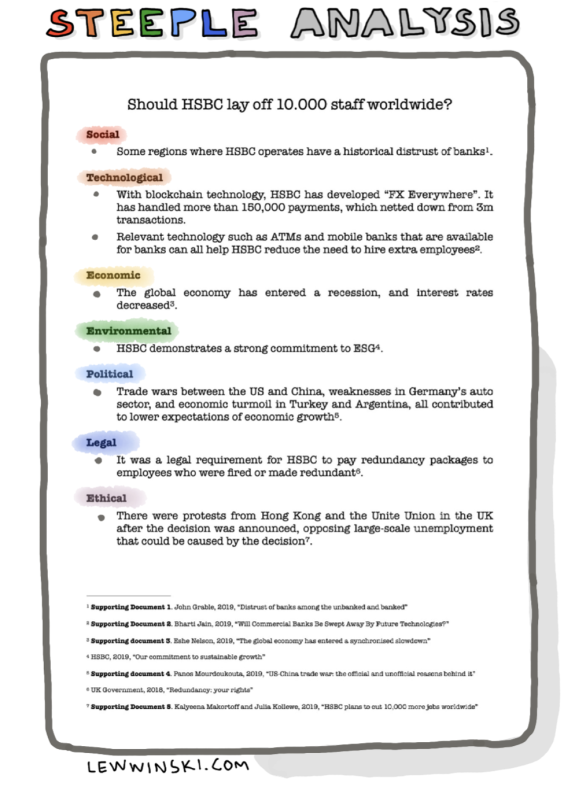
Figure 2. STEEPLE analysis example (without interpretation)
So, how to conduct STEEPLE analysis? Hopefully, you will have a thorough understanding of how to do it as you read the chapter further, but in a nutshell, there are 4 steps:
1. Compile evidence of all 7 factors, citing all sources.
2. Decide which factors impact the organisation mostly, explain why.
3. Analyse whether the main factors present opportunities and threats.
4. Move on with decision-making.
Let’s see what the factors in STEEPLE analysis mean. As you read, try to figure out the difference between political and legal factors. Very often, students struggle understanding the differences between those two.
☝🏼 Keep in mind that whatever you read about each of the STEEPLE factors are just some of the examples. STEEPLE factors are not limited to these examples. It might be a good idea for you to extend the list of examples with a couple of extra examples for each factor.
☝🏼 The purpose of this chapter is to figure out how STEEPLE analysis works and how to apply it effectively in internal assessment. If you feel like some of the examples under each STEEPLE factor do not make any sense to you, make sure you look them up online and understand what they mean.
Social factors are characteristics of population, its structure, size, and indicators. Social factors might include but are not limited to:
— lifestyles,
— fashion,
— trends,
— education,
— demographics.
Technological factors are application of scientific inventions for practical purposes. Technological factors might include but are not limited to:
— infrastructure,
— technology,
— inventions,
— innovation,
— R&D.
Economic factors are characteristics of financial systems. Economic factors might include but are not limited to:
— economy,
— inflation,
— economic growth,
— business cycle,
— trade balance.
Environmental factors are issues that refer to the natural environment and the use of natural resources. Environmental factors might include but are not limited to:
— global warming,
— carbon footprint,
— UNESCO,
— sustainable development goals.
Political factors are issues that relate to governing, policy making, and decisions made by governments. Political factors might include but are not limited to:
— policy,
— lobbying,
— political stability,
— political regime,
— trade policy,
— embargoes,
— tariffs,
— quotas.
Legal factors are issues that relate to law enactment, compliance with laws. Legal factors might include but are not limited to:
— legislation,
— regulations,
— Health & Safety,
— minimum wage,
— recruitment practices.
Ethical factors are issues that relate to moral principles. Ethical factors might include but are not limited to:
— corporate social responsibility (CSR — chapter 1.3),
— fair trade,
— sustainable practices,
— ethical marketing.
So what do you think the difference is between political and legal factors? In my opinion, political factors are more about decision-making and the impact of the decisions made. For example, US imposing a tariff on imports from China is a political factor because the intention is to politically influence the Chinese government. Legal factors are more about obligations and compliance with law. For example, smoking ban inside airplanes is just a law that everyone has to follow. There is no politics in this law.
☝🏼 Use your favourite dictionary and look up the meaning of «politics» and «law». This will strengthen your understanding of these two factors.
It is crucial to make sure the statements in STEEPLE are in the right category. That is why, phrasing and justification matters greatly. If you are not sure which category a particular fact belongs to, make sure you phrase it in such a way that it is really straightforward and unambiguous. For example, let’s say town X imposed a ban on vehicles with internal combustion engines. Is it political, environmental, or legal? It would be political if this decision is made by the mayor in order to influence certain lobby. It would be environmental if it’s main purpose is to reduce carbon emissions and protect the environment. It would be legal if the main point of this law is to develop a mechanism that helps to maintain zero exhaust gas emission levels in town X. See? The same fact may be interpreted from different perspectives. This subjectivity is a limitation of STEEPLE analysis but also an opportunity to interpret the factors/impact in the most relevant way. Practice interpreting the same fact from 7 different perspectives (social, technological, economical, environmental, political, legal, and ethical), just for fun.
Oh, and one more thing. Make sure every fact you use in your STEEPLE analysis is not something that your intuition tells you or something that you feel. There has to be evidence for it that comes from a credible source. These sources, by the way, are most likely to be your supporting documents in internal assessment. Please have a look at Figure 2 again to see how to cite sources effectively.
ii. PROS AND CONS
Evaluation of the tool
☝🏼 Pros and cons of STEEPLE and SWOT analyses are quite similar and yet there are some differences. Read attentively and identify what is different from SWOT analysis (Toolkit 1).
On the one hand, STEEPLE analysis encourages proactive thinking. Proactive means you are thinking ahead. It’s the opposite of reactive, when you only start thinking after something bad happened. In addition, it is quite a simple tool to understand and apply. And lastly, if STEEPLE analysis is not based on someone’s intuition, it is evidence-based.
On the other hand, STEEPLE analysis is based on qualitative (soft) data, which may be interpreted in different ways. As I mentioned in the previous section of this chapter, two different managers of the same company will produce two different STEEPLE analyses for the same company. So the tool is quite subjective and is prone to bias. In addition, this tool does not provide an action plan. Upon completion of STEEPLE analysis, managers simply have a list of facts broken down into categories. So the actual interpretation, thinking, and discussion start only after STEEPLE analysis is complete. And lastly, this tool considers external environment only, so managers might need to support their decision-making with some other tools like SWOT analysis (Toolkit 1) or ratio analysis (chapters 3.5 and 3.6) in order to examine internal factors that might have a strong influence on organisation as well.
Overall, STEEPLE analysis works best at the beginning of decision-making process, when external environment has a significant impact on organisation.
iii. IA
How to apply the tool in IA
☝🏼 There are some similarities in application of STEEPLE and SWOT analyses in BM internal assessment and yet there are some differences. Read attentively and identify what is different from SWOT analysis (Toolkit 1).
With regards to CCES concepts (Change, Creativity, Ethics, Sustainability), it is quite easy to justify how STEEPLE analysis refers to any of the four concepts… That is because the tool is used at the beginning of decision-making process in order to see the big picture of the external environment. This may be useful for any issue organisation is facing, be it a change that organisation is (or will) experience, or a creative strategy to launch a new product, or an ethical issue that needs a response, or a matter of sustainable development. Just remember, that the most important thing is to analyse the connection between the key concept (Change, Creativity, Ethics, Sustainability) and the organisation that you study in your IA.
☝🏼 In your lA, it is better not to put STEEPLE analysis in the end or middle of your paper. Make sure it’s the first or one of the first tools that you use. That is because one of the purposes of this tool is to kickstart decision-making and to see the big picture. If STEEPLE is not at the beginning of the Analysis section of your IA, then you demonstrate that you do not know how to apply this tool effectively and thus you reduce the chances to get full marks.
Very often, students use STEEPLE analysis superficially, when there is no need to examine external environment, just because the tool is easy to apply. Please avoid it and do not use STEEPLE if you are unable to effectively justify why this tool is crucial for answering the research question.
Another important thing in application of STEEPLE analysis is synthesis of data. Synthesis means being able to process and compile information from different sources in one place. STEEPLE analysis is perfect for demonstrating synthesis! It gives you a perfect chance to use several supporting documents and other sources in one place. The more sources, the better! Just make sure you cite all the sources (see footnotes in Figure 2 as an example of how to do it) and make sure your STEEPLE analysis is not based on a single source. It goes without saying that you must not use someone else’s STEEPLE analysis in your internal assessment. You have to find your own data, synthesise it, present it, and then interpret it.
One of the most important criteria for Business Management IA is Criterion D: Analysis and Evaluation. In order to score 5 out of 5, you may not only evaluate the value of STEEPLE analysis as a business tool (see the pros and cons in the previous section), you may also evaluate what STEEPLE analysis shows. In order to analyse and evaluate what it shows, you may interpret the factors/facts as opportunities and/or threats and use the SLAP rule (Figure 3) by analysing the implications of STEEPLE factors for internal and external stakeholders, by analysing long-term and short-term implications, by analysing advantages and disadvantages that different STEEPLE factors come with, and by evaluating whether the outcome of STEEPLE analysis is in line with organisation’s priorities.

Figure 3. SLAP rule for evaluation
iv. EXAMPLE
Sample IA extract with the tool
Enjoy the sample in Figure 4! And remember that there is more than one way to apply STEEPLE analysis in IA, so the provided extract is not prescriptive and is provided for reference and inspiration only.
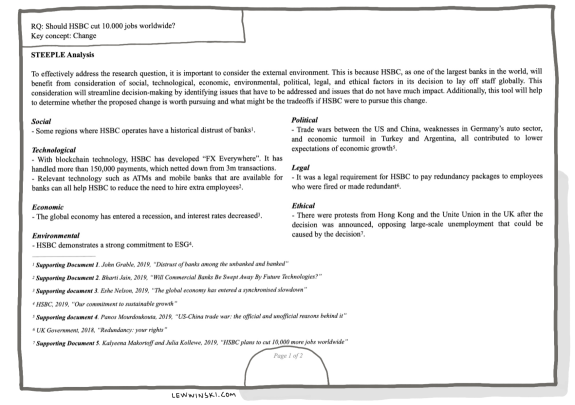
Figure 4a. IA sample (STEEPLE analysis extract) — page 1

Figure 4b. IA sample (STEEPLE analysis extract) — page 2
pdf
steeple sample.pdf318.02 Kb
Do you have a sense of achievement about what you learnt?
— How to — how STEEPLE analysis works
— Pros and cons — evaluation of STEEPLE analysis
— IA — how to apply STEEPLE analysis in IA
— Example — sample IA extract with STEEPLE analysis
Make sure you can define all of these concepts:
1. STEEPLE analysis
2. Social factors
3. Technological factors
4. Economic factors
5. Environmental factors
6. Political factors
7. Legal factors
8. Ethical factors
Creator has disabled comments for this post.