
Teach 2.1 Types of exam questions
The main point of this video is to learn the types of exam questions.
0:00 Intro
1:13 Exam papers
1:40 Exam components
3:50 Command terms
5:18 Assessment objectives (AO)
6:32 The REAL types of exam questions
☝🏼 The examples provided in this chapter are intentionally extreme for learning purposes.
☝🏼 Request markschemes and past papers from your teacher!
Without the markschemes and past papers, you won’t be able to fully succeed or truly understand what exam questions look like and how to approach them. Throughout this chapter, I will remind you several times to request them. BM teachers usually have access to these documents and can share them with students. I am unable to provide them here due to copyright restrictions. So make sure you find a way to access past papers and markschemes if you really want to understand what exam questions require and how they are assessed.
TYPES OF EXAM QUESTIONS
Papers, assessment objectives (AO), command terms, n-markers
There is a separate chapter (Teach 3) that describes Business Management exam papers in detail. In this chapter, however, we only need to briefly introduce what exam papers are. What matters here is not the papers themselves, but the types of questions that can overlap across them. The table below provides an overview of the question types across different papers.

Figure 1. Summary of question types
As you can see from the table in Figure 1, there are three exam papers (with Paper 3 being for Higher Level only). Each paper may include questions that address all four kinds of assessment objectives (AOs — explained later), and the questions can be worth 1, 2, 4, 6, 10, or 17 marks.
Here’s a slightly more detailed overview of exam components in Figure 2.

Figure 2. Summary of exam components
As shown in Figure 2, Paper 1 is the same for both Standard and Higher Levels, Paper 2 differs between the two, and Paper 3 is only for Higher Level. The Internal Assessment, explained in detail in chapter Teach 5, is also included. The table shows the total marks and the weightings of the different papers.
Now, the most important part of this chapter is the assessment objectives, or simply AOs. There are four of them: AO1, AO2, AO3, and AO4. Understanding which AO a question targets is the key to success. The secret lies not in the type of paper or in the number of marks awarded (1, 2, 4, 6, 10, or 17), but in the AOs. If you can identify which AO the question is assessing and know the right strategy for that AO, you will be able to answer exam questions effectively. Pay close attention to the command terms for each AO.
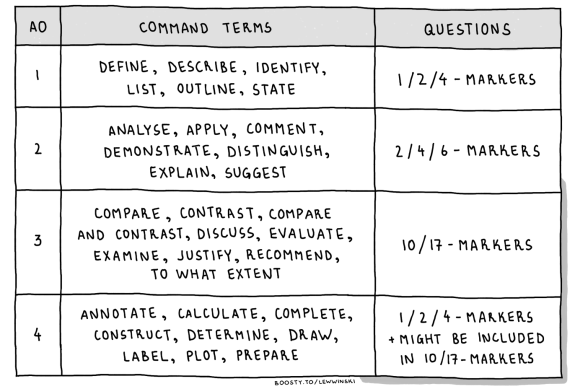
Figure 3. Summary of assessment objectives
Simply put, AO1 questions ask you to state something, AO2 questions ask you to explain or analyse something, AO3 questions ask you to evaluate something, and AO4 questions ask you to apply or create something. State, explain, evaluate, create. The key point to remember is this:
☝🏼 What matters is not the number of marks, but the type of question. Learn to identify the AO.
As you read through this chapter, you will need to complete the table in Figure 4. There are seven types of exam questions, and different strategies apply to each group:
1. AO1 1-markers (including double 1-markers)
2. AO1 2-markers (including double 2-markers)
3. AO2 2-markers, 4-markers, and “222” 6-markers
4. AO2 “33” 6-markers
5. AO3 10-markers
6. AO3 17-markers
7. AO4 questions

Figure 4. Exam questions comparison table
Good luck!
If you have carefully read this section of chapter "Teach 2: How to answer exam questions", you should now understand:
— Types of exam questions
Make sure you can define all of these:
1. Assessment objective 1 (AO1)
2. Assessment objective 2 (AO2)
3. Assessment objective 3 (AO3)
4. Assessment objective 4 (AO4)
Lewwinski Business Management © 2025
Creator has disabled comments for this post.