
I’M RECITING MY LINES TO DRAGONS
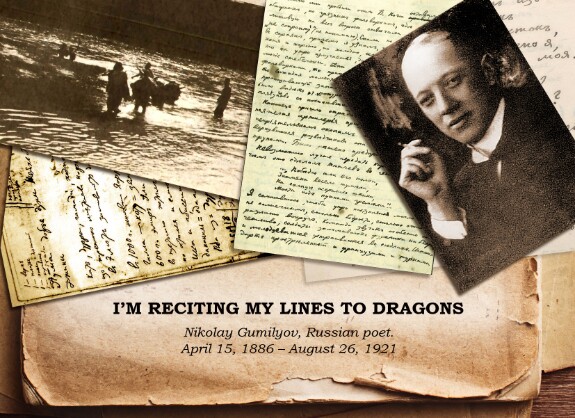
In my native Russian culture and history, there is a person: a traveler, an explorer, and a soldier.
…and a poet. His name was Nikolay Gumilyov.
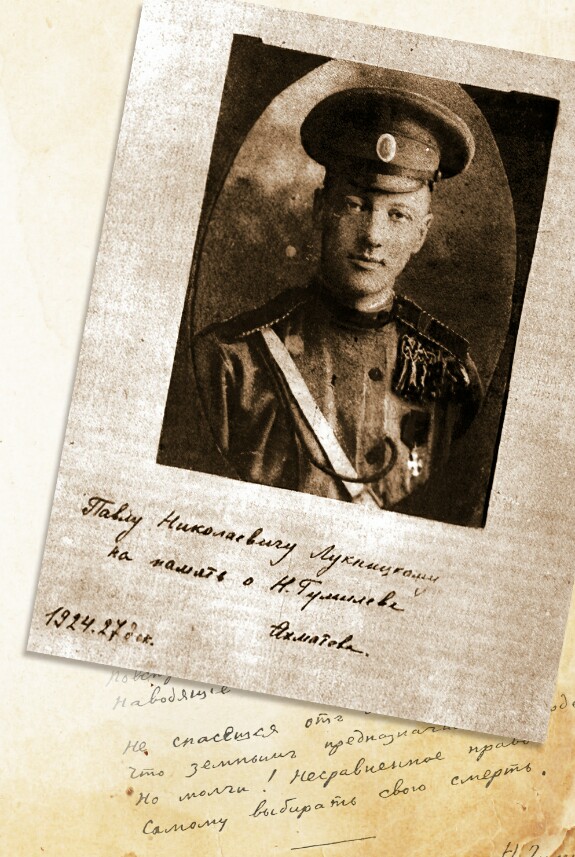
Gumilyov fought in the First World War and was twice awarded for courage. Не took multiple trips to Africa, spending much time there and earning the locals’ friendship and trust. He was fascinated with history. Becoming a prominent explorer of Africa, he brought a large collection of African artifacts to the Saint Petersburg Museum of Anthropology and Ethnography. Gumilyov was the first translator of Epic of Gilgamesh into Russian (albeit from a French translation, not the Babylonian version).
Nikolay Gumilyov was a strong and vibrant man, a talented poet (his New Hyperborean journal was published in England for a while). He co-founded the literary movement of Acmeism, which was severely criticized by many of his contemporaries. Gumilyov rebuffed them by writing, in one of his articles on poetry, that “a poet’s creation has no need to justify its being”.
Gumilyov considered poems as living creatures in their own right. And these creatures had to be perfect – to survive through centuries and to become reliable companions and invisible helpers to their readers. A poem’s life is valuable by itself, like any other life, while the poet is responsible for making their child as perfect as possible.
Born from life, the art comes back to it […] as an equal to an equal.
Nikolay Gumilyov
Gumilyov paid peculiar attention to the study of the poem’s anatomy, its form and structure. His ambition was to create a living being with free will.
Gumilyov himself and his reader are a romantic explorer and adventurer. Not a toothless and harmless one but a predatory rebel creating himself through his art – and through a fight.
MY READERS
Nikolay Gumilyov
(English translation by Vladimir Markov and Merrill Sparks)
The old vagabond in Addis Ababa,
Who conquered many tribes,
Sent me one of his black lancers
Greeting me with my own poetry.
A lieutenant, who used to lead gunboats
Under enemy fire,
Recited my poems to me all through the night
Upon the southern sea.
A man, who midst a crowd had shot
The Emperor’s ambassador,
Came up to shake my hand,
To thank me for my verse.
Many of them — strong, wicked and gay —
Who killed elephants and people,
Who died of thirst in the desert,
Who froze on a polar ice-floe,
Loyal to our planet (Strong, gay and wicked),
Carry my books in a saddlebag,
Read them in groves of palm trees
And abandon them with the ship.
I don’t offend them with hypertensions,
Or humiliate them with too much heart.
Don’t bug them with vital allusions
To the contents of an empty shell.
But when bullets whistle by,
When waves break the sides of the ship,
I teach them not to fear,
Not to fear and to do their job.
And when a woman with a beautiful face,
The only dear face in the world,
Says, ‘I don’t love you’,
I teach them to smile,
To leave her and never go back.
And when the last hour comes,
When the red, even mist films their eyes,
I will teach them to recall quickly
Their entire pleasant-cruel life
And all their own, strange earth...
And when standing before God’s face
To await calmly His Judgement
With simple, wise words.
Some critics described Gumilyov’s verse as cold, dead, and heartless; just an imitation of poetry. I have no idea why these fiery lines would feel cold to anyone. In high school, I would learn dozens of Gumilyov’s poems by heart, browsing the school and village libraries for any drops of information about the author. Now, almost twenty years later, having revised my values and reinvented myself more than once, I come to enjoy his poetry just as avidly, taking just as much delight.
I wish I could understand why anyone would describe these vibrant lines as dead and soulless.
Actually, Gumilyov was also described as soulless by some of his contemporaries who accused him of being cold and arrogant. But those who didn’t accept this first impression as final truth and looked beyond the surface were seeing him differently. One of them was Vladislav Khodasevich. This is what he wrote about Gumilyov:
"He was incredibly young at his heart, and maybe at his mind as well. He always seemed so childlike with his buzz cut, his grammar-school-boy bearing, his fascination with Africa and with warfare, and his arrogant demeanor that surprised me so much at our first meeting – and that would come off him suddenly on multiple occasions until he checked himself and put it back on. Like every child, he liked to pose as an adult. For a company of child prodigies gathering around him, he was an honored mentor, a teacher of poetry. The children loved him. After lecturing them on writing verse, he would sometimes play blind man’s buff with them".
Gumilyov knew how to be sincere and spontaneous. In his verse, he would often use the image of a child, of his own younger self. According to his contemporaries, Gumilyov always treated children just as seriously as adults. He would see them not as semi-finished things that are yet to become sensible personalities (a fairly common view in that era) but as human beings with finely developed senses and complicated feelings. Similarly, he would see himself at any age as a child and an adult at the same time. Children in his poetry have a charming demeanor, sincere and serious.
CHILDHOOD
Nikolay Gumilyov
(English translation by Burton Raffel and Alla Burago)
I loved the great meadows
and their honey scent
and clumps of trees, and dry grass
and bull’s horns in the grass.
Every dusty bush along the road
shouted, “I’m playing with you!
Walk around me, watch out,
and you’ll see who I really am!”
Only the fierce autumn wind, roaring,
could stop my games:
my heart would thump, it was heaven itself,
I felt sure I would die
With my friends, never alone,
with soft warm flowers, with cool cold flowers,
and up over those far-off skies
I would guess it all, all at once.
If I love this new game, this war
and its big bangs,
it’s simply that human blood is no more sacred
than the emerald juice from a blade of grass.

***
Nikolay Gumilyov also had a big ego. That was the trait that made him a warrior, a traveler, and a poet. It became the starting point of his self-creation, his toughening himself up, his overcoming of fears. That’s not to mean that having a big ego is unambiguously good. It’s not; it stands in the way of accepting yourself as you are, with all your weaknesses, and it keeps urging you on and on until you fall down exhausted. This is where I must step in to note that some people hate everyone who has a sense of dignity and who can stand up for themselves. For them, everyone who won’t give them everything they want will be evil. But what we call excessive ambition can actually help one develop the traits that deserve respect – and eventually make them an admirable person.
Here is what George Ivanov, a poet and Gumilyov’s friend, wrote about his ambition:
"I don’t know whether it was a good or an evil fairy that put her gift of endless ambition into Gumilyov’s cradle. This gift made him the pride of Russian poetry; this gift became his death.
When Gumilyov was seven, he threw a tantrum at another boy’s outrunning him. At eleven, he attempted suicide after his family and their guests had witnessed him disgrace himself by mounting a horse awkwardly. The next year he fell in love with a young girl. After seeing her in the street, he followed her for a while. When she was about to enter her house’s gate, he ran up and, panting, professed his love to her. She called him a fool and banged the door shut, leaving him absolutely devastated, near-blind and near-deaf. He wouldn’t sleep for many nights after, planning his revenge on her. Was it a good plan to burn down the house that witnessed his shame? What about becoming a rogue and kidnapping her? The grudge held by his twelve-year-old self was so deep that even at thirty, his voice had bitterness as he told about it, although he was doing his best to make this story sound funny.
Gumilyov was a weak and clumsy child, not really good-looking, but he would compete eagerly with the strongest, nimblest, and prettiest ones. Every new failure only urged him on.
Roaming the local park for hours, he would think about all possible ways to reach his dream: a summit of glory. Could he become famous as a general? As a scientist? Or as a bomber destroying the city of St. Petersburg? He didn’t really care about which way to take; only about people saying his name again and again with admiration and awe.
Gradually, he came up with his plan of conquest. He could ascend to glory by writing the best verse that ever existed; the dazzling, deranging, dumbfounding verse. But it was not only his verse that had to be dumbfounding, but his own life as well. He had to fill it with dangerous journeys, with feats of courage, and with beautiful women loving him.
This childish dream he pursued for the rest of his life. He fought in duels. He hunted lions. He enlisted in the war where his bravery won him two St. George crosses. Finally, he joined a conspiracy that got him killed. Although most of all he loved a quiet life in the countryside: taking long walks alone, playing chess, and writing his poems".
CHOICE
Nikolay Gumilyov
(English translation by Martin Bidney)
Though a piler of towers be ravaged,
Though a flier down headlong be hurled
When, submerged in the world-well and savaged,
Gripped in madness he curses the world,
Though the sacker of cities be shaken,
Overturned like a statue of stone,
By the all-seeing Father forsaken,
Left to mourn in his torment alone,
Though the cavern explorer may cower
By the backwater, stagnant, of streams
When he meets a proud panther whose glower
Will outheat all the demons in dreams,
Though you cannot evade what a mortal
Will endure as the payment for breath,
Yet be silent: your right is the portal
Of your dying – of choosing your death.

***
The Tagantsev conspiracy (or the case of the Petrograd Military Organization) was fabricated by the Soviet secret police in 1921 to terrorize the scientific and artistic community. 61 people were executed on false charges. The total number of victims, including those who died while being arrested, amounted at 103 people.
Gumilyov belongs to those people who, like bright lanterns, illumine the shameful truth written in the book of History. Every attempt at studying his biography is bound to reveal much more than just one poet’s death. If it weren’t for Gumilyov, I’d have probably remained oblivious of the others who were killed in that case, some on utterly ridiculous charges. The spouses who brought tea to the “conspiring” guests of their husbands. The family members whose only guilt was not reporting a “suspicious” conversation to the authorities.
Gumilyov’s exact place of execution is still unknown. The supposed spots are marked by plain iron crosses.
Gumilyov wasn’t a revolutionary type. He had a life’s work he valued more than any revolution; more than dying for a lost cause. But Gumilyov could not stay indifferent to the injustice being done to those around them.
“He… denied the Communism and he mourned the fate of Russia falling into the grubby hands of the Bolsheviks. But he never opposed them publicly. Not because he’d rather stay safe and avoid the risk; that was an alien motive to him as a soldier who looked death in the face more than once. It was because politics was not among his interests,” Solomon Posner wrote about Gumilyov in 1920-1921.
As I read the materials of the Tagantsev conspiracy, on Gumilyov’s attitude toward the Bolsheviks, I was struck by this atmosphere (resonating so much with current events). The atmosphere of forced, suffocating silence. Of pain boiling inside, and impossibility to do something about it as any protest is doomed.
The next fragments are from the memoirs by Vasily Nemirovich-Danchenko who knew Gumilyov:
"I remember one of those walks.
A blizzard was throwing waves of snow at our faces, and our feet were drowning in the snowdrifts. Gumilyov stopped and said in a painful voice: “This world must have the sun somewhere. And the warm sea. And the azure-blue sky. Will we live to see them? And the brave, strong people who don’t have to wriggle like worms to escape the iron heel of the triumphant lout. They live happily and sing the songs of freedom. It’s the Russia of the future – free and happy and thriving. We just won’t live to see it.”
This cry of the heart was particularly striking when coming from a man as composed and calm as he used to seem; only to seem and not to be. His composure was but a mask; a mask of pride and contempt for vulgarity, meanness, and faintness of heart.
<…>
Their power stands on two hosts: the Red Army, and the army of spies, the second far greater in numbers. I’m surprised that someone is still plotting at a time like this. Blind men, they’re propelling themselves right into the betrayers’ arms. I’m no coward. I have a warrior spirit. But I wouldn’t join any secret society in this situation.
<…>
No hope for a change of power in Russia. All the effort by those who love it and fight for it will be broken against that solid wall of espionage, with a degree of pervasiveness never known in human history. The whole society is soaked with it like a sponge with water. You can’t trust anyone. No help from abroad either. The foreign states would rather have their share of the looted wealth that the Bolsheviks would throw over to appease them. No, no mutiny is possible in this country. Don’t waste your time even thinking about it. Everyone who pins their hopes on it is outright stupid – and playing their cards into the Bolsheviks’ hands".
The next testimony is from Yury Zobnin, a scholar of Gumilyov’s heritage who believed that the Tagantsev conspiracy was real.
"In 1920-1921, Gumilyov actually took part in an anti-Bolshevik secret organization known as the Tagantsev conspiracy that operated in Petrograd, but his role was a minor one, probably limited to completing occasional small tasks (which is probably just as true for all members of the so-called professor group). In other words, although Gumilyov considered it possible, and potentially beneficial, to resist the Communist regime, his part was nothing near a leader, a prominent ideologist, or even an active member of the anti-Bolshevik movement.
His character was a poor match for the role of a professional conspirator that required one to be cynical, and morally flexible. “Gumilyov taking part in a conspiracy is just as much of an absurd joke as Zinoviev fighting in a duel,” a 1921 obituary said. “Gumilyov could enlist as a soldier; he could hunt wild lions in Africa. He could probably even call Zinoviev by phone to tell that he was going to come and kill him in an hour. But Gumilyov as a secret plotter – have we all gone crazy to believe such a nonsense?”
The majority of Cheka members working on the case apparently shared this view. M. L. Slonimsky, who got to see some of the Tagantsev conspiracy materials as part of the OGPU museum exhibition in the late 1920s, described the conspiracy map composed by the investigators based on the arrested people’s testimonies as “showing Gumilyov in a very secondary role – working with intellectuals in the outlying districts”.
Nonetheless, Gumilyov was sentenced to death and executed. Furthermore, the official Soviet version showcased him and other intellectuals, not leaders and militants, as the main actors in the Tagantsev conspiracy".
Zobnin believed that the execution of Gumilyov, Tagantsev and other famous people was used by the Bolsheviks to intimidate the intellectual community, to bind everyone into obedience by killing just a few. For a goal like this, a harsh punishment for a minor guilt was just perfect. In a country ruled by terror, everyone had to be aware that their every word could be interpreted as treason, which meant death not only to them but to all their nearest and dearest ones.
***
Despite all the mentions of death in Gumilyov’s poetry, and his great taste for risk, he had too much love for life to want to die young. His self-perception was someone “midway upon the journey of our life” (a line by Dante Alighieri that Gumilyov was going to use as the title for his next book). He wanted to live to the age of ninety at the very least. He worked on his new poems and larger pieces; he taught to poets and engaged in lots of other activities.
But at the same time…
Viktor Iretsky, Gumilyov’s contemporary, wrote in his memoirs:
"It happened when his last book, Fiery Column, was print-ready; the first two pages were already out. One evening, when I was in my office in Petropolis, I got a letter from Gumilyov. He asked us to insert, if possible, another poem that he believed was extremely important for the perception of his book as a whole.
The poem was titled My Readers. As the publisher read it aloud, the lines about the poet’s books teaching their readers to meet death without fear got our attention.
“Why is he even writing this?” the publisher said with a shrug.
“It’s just his usual pretentious posing,” I replied.
Several days later, Gumilyov was arrested. After the news of his execution reached us, we remembered those lines once again, this time with deep sadness. But the saddest fact was that My Readers turned out to be the last of Gumilyov’s known works. There were rumors, though, that he wrote something else in the prison. The Guild of Poets made an attempt to obtain his last writings from Checka but failed.
We are so eager to build cause-and-effect links from the mere coincidences that we see all around us. Let’s do it again as a tribute to the great poet; let’s believe that he had the gift of foreseeing his fate".
Vladimir Polushin, who wrote a book about Nikolay Gumilyov, mentioned that the poet met his death without fear:
"Dzerzhibashev, the Checka member who got executed later in 1924, openly admired the courage that Gumilyov displayed in the interrogations. Poet Sergey Bobrov, the Checka informer, told G. Ivanov: “He died a fine death, you know. I heard from those who were there. Smiling, he finished smoking his cigarette. He even impressed the Checka. A rare man to accept death with that much dignity.”
No one of those who knew Gumilyov in person ever doubted the truth of this testimony. And it gives me another idea. Among all those peaceful people who were executed alongside him, he was the only one who had been a soldier, the only one who had looked death in the face. His display of courage in his final hour should’ve provided at least some support to the others – or at least I hope so.
Despite Gumilyov’s demanding much of himself, despite his obsession with masculinity, fortitude, and warrior spirit, he never made any disparaging comments about those who couldn’t live up to his vision of a perfect person. It was his personal vision, and he only expected himself to comply. It was his way of life, not his way of feeling superior. However critical he was of the world around him (“life of hard modernity”), he was never critical of ordinary people.
Gumilyov was creating himself from his lines, striving for his vision of his perfect self. If anyone could lend any support to those poor people terrified by the close and pointless death, it was him. He did it not by eloquent words or false comforts, neither by a scornful command to put themselves together and be men in the face of death. He did it by his own example.
***
After Gumilyov’s execution, his heritage was silenced and hidden away for over sixty years. From 1923 to 1986, none of his works were published in the Soviet Union. They had to be really scared of him to prohibit his innocent lines that had no calls to overthrow the government or to rebel against it. According to the letter published in the Ogoniok magazine in 1986 (followed by the actual publication of Gumilyov’s work), the poet “never wrote a single line directed against the Soviet government”.
But Gumilyov’s verse was probably disturbing to every mean, freedom-hating soul, despite having zero political content and zero references to the topical issues of his era.
Polite with life of hard modernity:
Between us two, there is a border
Nikolay Gumilyov
(English translation by Dmitry Belyanin)
This border, this wall of disdainful silence that he had erected between himself and that life spoke more than any words of hate. Gumilyov stood behind his wall unbroken, unbending, and beyond their reach. That was what made him so scary to a totalitarian government. It could reach those who escaped abroad and destroy them nonetheless; it could grind into dust those who stayed, but it could do nothing about someone who withdrew into their inner reality to remain free there. The government had no reasons to proclaim Gumilyov as its enemy (even the Tagantsev conspiracy charges against him were obviously ridiculous). But still his poetry, and the very mention of his name, remained prohibited until the beginning of Perestroika.
There is still much controversy about whether the Tagantsev conspiracy was real or not. I don’t know if we ever discover the truth about that, but it gives me a bitter feeling that these people are still being denied their right to rebel; the right they literally paid their lives for.
I hope for another rehabilitation of the Tagantsev conspiracy participants. Not like the past one in 1992, when it was declared that their executors had made a mistake of killing the innocent. No. I’m waiting for the rehabilitation of the very right to rebel against a dehumanizing order of things; against a government that tolerates and encourages a brutal treatment of individuals. What used to be considered as a crime allegedly committed by the Tagantsev conspiracy members should be redefined as a feat of courage.
***
THE CONQUISTADOR
Nikolay Gumilyov
(English translation by Yevgeny Bonver)
Conquistador, set in the iron armor,
I gaily follow the outgoing star,
I go over precipices, harbors
And rest in joyful groves, so far.
Oh, how wild and starless heaven's shelter!
The haze is growing, but, silent, I must wait.
Conquistador, in iron armor set,
I’ll find my love, find it sooner or later.
And if the stars are void of midday words,
I shall myself create them for the worlds,
And warmly charm them by the songs of battles.
I am a brother to the gulfs and storms,
But I will plait into my uniforms
A lily — the blue star of flourishing valleys.
ME AND YOU
Nikolay Gumilyov
(English translation by Rupert Moreton)
Yes, I know, we are not together,
From another terrain I’m hewn,
Won’t allow the guitar to tether,
I prefer wild zurna’s tune.
I don’t visit the halls and salons
Where an audience sits in black
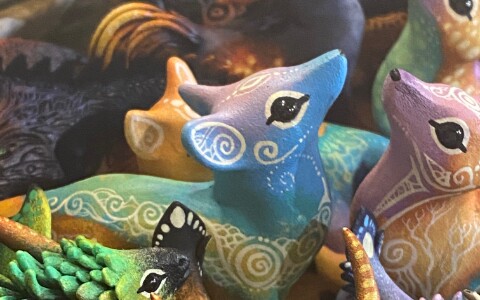
I’m reciting my lines to dragons,
Waterfalls and the cloudy stack.
Like an Arab in desert places
Craving water his thirst to slake
Do I love – not knight, who faces
Skywards, watching the stars awake.
Not abed will I reach my dying
With a lawyer and quack beside,
In some crevice shall I be lying
Where by ivy the light’s denied:
I’m not bound for a place of order
Realm of Protestants in the skies,
But where bandit and whore and hoarder
Raise their voices to me: “Arise!”
English translation by Ingrid Wolf.
PS:
This article was written for the Alien: Covenant gift art book dedicated to the movie "Alien: Covenant" and its main character David. But in order for this article to be understandable and accessible to a wider public, I sadly shortened it, removing links to the film. Those who would like to read this article without modification can download the file below.
The second file is in Russian, without abbreviations.
pdf
NikolayGumilyov_ENG.pdf5.24 Mb
pdf
Nikolay Gumilyov_RUS.pdf4.57 Mb
hontor_articles
Thank you, this article was a very important work for me!
Your article is wonderful and a detailed introduction to him.
Deborah