
ANVER'S ANATOMY
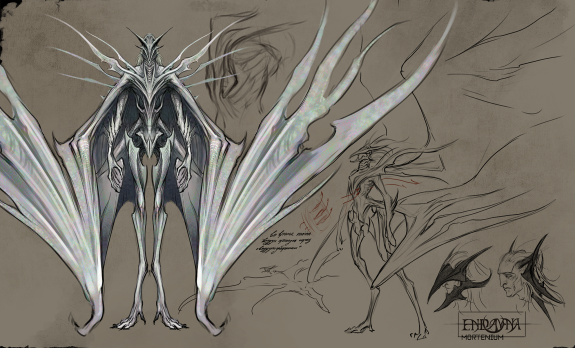
Finally, a reference to the average Anver. Today we will talk more about their anatomical features than their history.
It is important to note that the basic version with key anatomical features is shown here, but in reality there is great diversity, similar to the number of species of butterflies or birds. Anvers are polymorphic: their physical appearance consists of a substance called “mother-of-pearl lakes” — places where Neakharat (the world of humans) and Anveropolis (the world of anvers) intersect. When transitioning from the transcendent Anveropolis, the soul of an Anver is covered with a film from the surface of the lake, creating a rather unstable shell for it. It performs its main function, protecting the environment from the influence of a powerful soul, but in the eyes of humans, the appearance of Anvers is prone to constant distortions and changes.
“Beauty is in the eye of the beholder.” Anver, who has decided to settle among humans, soon takes on a human appearance, but this happens on a psychological level rather than a physical one. People themselves begin to see Anvers in human form with only a few differences from ordinary humans, and if Anvers do not use their wings at a given moment, for example, they are seemingly ignored by human consciousness.
It is also common for anvers in human form to be perceived as either gender neutral or as the gender preferred by a particular person. If a person is naturally more inclined to trust the male gender, they will see a more masculine version, and vice versa. In reality, anvers are genderless. The perception of their appearance also depends on a person's attitude towards them: the same representative can be perceived as a “disgusting, scary creature” or, conversely, as a “beautiful being.”
The vision of an anver also depends on the context. A person who sees it in the sky will most likely perceive it as a creature similar to the one depicted in the reference, and among people, at some point, they will not even immediately understand that what they are looking at is not a human being at all.
It is for this reason that you could see very humanized images of Emperor Deos and a couple of Anver images on the wall.
By the way, the unstable surface of their bodies gives the effect of mother-of-pearl in any form. If you are not entirely sure whether the person in front of you is human or Anver, just look closely at their skin or visual distortions in the details.
From the point of view of a dry description of their usual form, it should be noted that they usually have two pairs of wings (the lower ones are steering wings), elongated proportions, the mandatory presence of chitinous plates in the form of a beak (which perform a utilitarian function in the setting itself, and a symbolic one in my perception), as well as air intakes on the chest, which perform a respiratory function during flight.