
Corvin Castle Unveiled: An Insider’s Journey Through Transylvania’s Gothic Crown
Forget everything you think you know about castles. Corvin Castle isn’t just another stop on a tourist trail—it’s a living, breathing monument to ambition, cruelty, and architectural genius. And experiencing it through a private guided tour transforms what could be a simple visit into something far more profound: a personal encounter with history itself.
The Prelude: More Than Just a Drive
Your private tour of Corvin castle begins long before the castle comes into view. Unlike crowded group excursions where you‘re herded along like cattle, this is an experience tailored entirely to you. Your guide—typically a local historian or passionate storyteller—will pick you up from your accommodation in cities like Cluj-Napoca, Sibiu, or even Bucharest, depending on your itinerary. The drive through the Carpathian foothills becomes an engaging preamble rather than dead time. As you watch the landscape shift from modern Romania to ancient countryside, your guide begins painting the picture: the rise of the Hunyadi dynasty, the Ottoman threats that necessitated such fortifications, and the political intrigues that swirled around this powerful stronghold. This contextual foundation ensures that when you finally lay eyes on the castle, you‘re not just seeing stones—you’re seeing centuries of drama condensed into one breathtaking silhouette.
The Grand Reveal
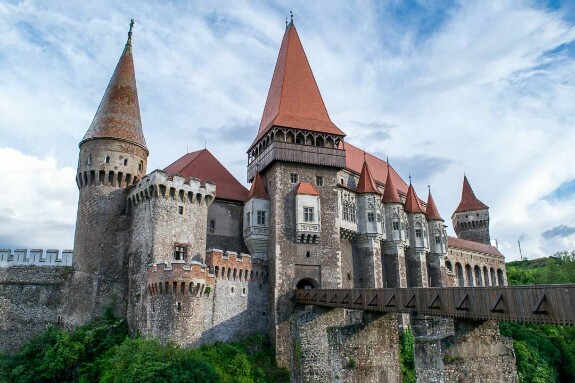
And what a silhouette it is. As you round the final bend, Corvin Castle erupts from the landscape like a Gothic fantasy made manifest. Its towering spires, red-tiled roofs, and ornately carved stone balconies seem to defy gravity as they cling to a rocky outcrop above the Zlaști River. The castle‘s sheer size is staggering—it’s one of the largest in Europe—but it‘s the details that captivate: the asymmetrical windows, the flying buttresses, the countless turrets that seem to reach for the sky like stone fingers. Your guide will pause here, allowing you to absorb the view while explaining how this 15th-century masterpiece evolved over time, blending Gothic, Renaissance, and even Baroque elements into something uniquely Transylvanian.
The Crossing: A Drawbridge Moment
The main entrance is via a massive drawbridge—a feature that immediately transports you into another era. In medieval times, this bridge was raised nightly, sealing the fortress against invaders and, perhaps more chillingly, trapping those inside. As you cross, your guide might share a detail that most visitors miss: the bridge was rebuilt several times, and its current iteration, while historically accurate, incorporates stones from the original 15th-century structure. Every step you take echoes with the weight of history. The ticketing process is seamless—your private guide handles everything, often including priority access that bypasses the sometimes lengthy queues. Within minutes, you‘re through the massive gate and standing in the castle’s sprawling inner courtyard, the true heart of this fortress.
The Interior: A Labyrinth of Stories
For the next two to two and a half hours, you‘ll traverse a maze of halls, chambers, and staircases that few tourists ever fully appreciate. The Knights’ Hall is the showstopper—a vast ceremonial space with soaring vaulted ceilings that seem to swallow sound. Your guide will describe the banquets that once filled this room, where Hungarian nobility plotted campaigns and celebrated victories. Above you, the stone ribbing of the ceiling creates an almost celestial pattern, a testament to the Gothic craftsmen who built this marvel without modern engineering.
The Diet Hall offers a more intimate glimpse into governance, where decisions that shaped the region were debated. Here, your guide might pause to show you the carved stone crests of the Hunyadi family, explaining the symbolism behind the raven holding a ring—a motif that appears throughout the castle. The Council Room, with its Renaissance influences, shows how the castle evolved beyond pure military function into a residence suitable for royalty.
But it‘s the darker corners that often linger longest in memory. The Torture Chamber, with its grim collection of iron maidens, thumbscrews, and racks, offers a visceral connection to medieval justice. Your private guide can tailor the depth of this exploration—if you have children or prefer to avoid graphic details, they’ll adjust accordingly. The Bear Pit, another sobering highlight, was once a death sentence for prisoners tossed to hungry bears. These macabre features aren‘t gratuitous; they’re essential to understanding the brutal realities of the era, and your guide contextualizes them within the broader history of European feudal law.
The Legend of the Well
Perhaps the most haunting story your guide will share is the legend of the castle‘s well. According to lore, three Turkish prisoners were forced to dig a well deep into the rock, promised freedom if they struck water. After 15 years of backbreaking labor, they finally reached water—but instead of liberation, they were executed. The inscription carved into the stone wall reads, “You who are thirsty, drink, but remember those who dug for you.” Some say the well is cursed; others claim to hear the prisoners’ ghostly whispers still echoing from its depths. Your private guide will invite you to peer into the well, letting the story settle as you gaze into the darkness.
The Dracula Connection
No tour of Corvin Castle would be complete without addressing its most famous prisoner. Vlad the Impaler—the historical figure who inspired Bram Stoker‘s Dracula—was held in the castle’s dungeons for a period during the 1460s. While his imprisonment was brief, his presence has forever linked this fortress to vampire lore. Your guide will separate fact from fiction, explaining Vlad‘s actual relationship with the Hunyadi family and his role in the Ottoman wars. This nuanced storytelling is one of the key advantages of a private tour: you get the real history, not the sensationalized version, but delivered with enough drama to keep it utterly captivating.
Practical Perks of a Private Experience
Beyond the storytelling, the practical benefits of a private tour are significant. The castle is notorious for its physical demands: steep, winding staircases, uneven cobblestones, and narrow passages that can be challenging for some visitors. Your guide moves at your pace, offering a steadying hand where needed and suggesting alternative routes when possible. They’ll also ensure you hit the prime photo spots at the right times—the drawbridge view at midday when the light floods the courtyard, the tower perspectives that capture the sweeping valley below, and the quieter corners where you can frame shots without other tourists in the background.
The tour is also remarkably flexible. Perhaps you‘re fascinated by the military architecture and want to linger on the battlements; maybe you’re more interested in the domestic life of the castle and prefer the kitchens and living quarters. Your guide reads your interests and adjusts accordingly. And because this is a private experience, you have the luxury of asking as many questions as you like, digressing into tangent topics, or simply pausing to absorb the atmosphere in silence.
The Return and Beyond
As your tour concludes and you cross the drawbridge for the final time, you‘ll carry more than just photographs. You’ll have developed a personal relationship with this place—an understanding of how a fortress can embody both the highest achievements of human artistry and the darkest impulses of human power. The journey back gives you time to process, with your guide offering recommendations for local restaurants, nearby attractions like the Corvin Museum or the Hunedoara city park, or suggestions for where to continue your Transylvanian adventure.
A private guided tour of Corvin Castle is not merely sightseeing; it‘s a masterclass in history, architecture, and legend, delivered by an expert who ensures that every moment—from the drive to the drawbridge to the final farewell—feels exclusive, personal, and utterly unforgettable. This is Transylvania at its most majestic, stripped of cliché and revealed in all its complex, Gothic glory.