creator cover Readaily / Articles by 🇬🇧 level for every day
Readaily / Articles by 🇬🇧 level for every day

Readaily / Articles by 🇬🇧 level for every day 

Read, listen and take tests in one place

2subscribers

44posts

goals1
0 of 100 paid subscribers
Once we hit 100 subscribers, we will start developing an app/bot for your convenience 😉

About

No more searching for what to read and listen to in English 📚
Here you can find real articles on different topics, adapted to your 🇬🇧 level.
All articles can be read for free❗️first 12 hours❗️Don't miss it.
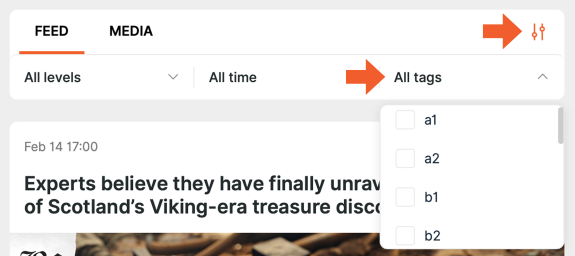
Use the "Filter" and "All tags" to find the articles you need, it will reduce your time!
Basic levels: #A1 #A2 #B1 #B2

My sister is stressed and emotionally distant. How can I assist her? (B2)
Readaily / Articles by 🇬🇧 level for every day
My sister is stressed and emotionally distant. How can I assist her? (B2).mp3
0:00
2:44
I am in my 30s and the middle of three sisters. Though we live in different parts of the UK and rarely meet in person, we stay in regular contact and try to reunite a few times a year.
My older sister has always been a maternal figure to me and my younger sister, as our biological mother was volatile, emotionally distant, and hypercritical. We now have minimal contact with her. However, in recent years, my relationship with my older sister has grown increasingly strained. I miss the bond we once shared, but I’m also deeply worried about her mental state – she appears chronically stressed and overwhelmed.
She has two young children; her eldest exhibits challenging behavioural issues. While my sister manages them admirably, her relationship with her partner is fraught with tension. I believe this dynamic exacerbates her child’s anxiety. Though she insists she doesn’t need help, I feel powerless to support her. My younger sister acknowledges her stress but avoids involvement, noting she often takes her frustrations out on others.
I consulted psychotherapist Lisa Bruton, who theorised that my sister was likely a “parentified” child — forced into a parental role during childhood due to our mother’s emotional absence. Bruton explained that such individuals often become overly self-reliant yet resentful, particularly when they become parents themselves. “This isn’t something you can resolve,” she clarified, “but understanding her background may help you reframe your expectations.”

My sister is stressed and distant. How can I support her? (B1)

Readaily / Articles by 🇬🇧 level for every day
My sister is stressed and distant. How can I support her? (B1).mp3
0:00
2:18
I’m in my 30s and the middle of three sisters. We live in different parts of the UK, so we rarely meet, but we stay in touch by phone and try to see each other a few times a year.
Growing up, my older sister became like a mother to me and my younger sister because our own mother was harsh, critical, and emotionally distant. Now, we barely speak to our mother. However, over the past few years, my relationship with my older sister has become strained. I miss our closeness and worry about her, as she seems overwhelmed and stressed.
She has two young children. Her eldest child has behavioral challenges, and while my sister handles them well, her relationship with her partner is tense. I believe this tension affects her child’s anxiety. She insists she doesn’t need help, but I feel powerless to support her. My younger sister avoids the situation but agrees she’s stressed and takes it out on others.
I spoke to psychotherapist Lisa Bruton, who suggested my sister might have been a “parentified” child. This means she was forced to act like a parent to us because our mother wasn’t there emotionally. Bruton explained that parentified children often become overly independent and resentful, especially as parents themselves. “You can’t fix this,” she said, “but understanding it might help.”
Bruton advised me to see my sister as a flawed person, not a perfect parent. She recommended talking to her face-to-face or writing a letter, as messages can be misunderstood. Meeting alone, without family, could help. She also suggested doing something relaxed together, like a walk or coffee, to rebuild connection.

My sister is stressed and doesn’t talk much. What can I do? (A2)

Readaily / Articles by 🇬🇧 level for every day
My sister is stressed and doesn’t talk much. What can I do? (A2).mp3
0:00
1:57
I am in my 30s and I’m the middle sister of three. We live in different parts of the UK, so we don’t meet often, but we talk regularly and try to see each other a few times a year.
My older sister was like a mother to me and my younger sister because our real mom was angry, cold, and critical. Now, we rarely talk to our mom. But recently, my older sister and I have grown distant. I miss our closeness and worry about her. She seems very stressed and overwhelmed.
She has two young kids. The oldest child has some difficult behavior. My sister is good with them, but she often argues with her partner. I think their arguments make her child anxious. She says she doesn’t need help, but I want to support her. My younger sister agrees she’s stressed but doesn’t get involved.
I spoke to a therapist, Lisa Bruton. She said my sister might have acted like a parent when she was young because our mom wasn’t there for her. She had to take care of us and didn’t have support. Lisa explained that children like my sister often become too independent and angry, especially as mothers. I can’t fix this, but it helps me understand.
Lisa said I should see my sister as a normal person with her own problems, not a perfect parent. She suggested talking face-to-face or writing a letter, so she can understand my feelings better. Meet her alone, without family. Do something fun together, like a walk or coffee.

My sister is stressed. She is not close. How can I help? (A1)

Readaily / Articles by 🇬🇧 level for every day
My sister is stressed. She is not close. How can I help? (A1).mp3
0:00
1:47
I am in my 30s. I have two sisters. We live far apart but try to talk and meet sometimes.
Our mom was angry and unkind. Now, we don’t see her much. My older sister acted like a mom to me and my younger sister. But now, we are not close. I worry about her. She seems very stressed.
She has two young children. The oldest child has some problems. My sister is good with them, but she argues with her partner. This makes the home stressful. I think the child feels this stress. My sister says she doesn’t need help, but I want to help her. My younger sister agrees she is stressed but stays quiet.
I asked a therapist, Lisa. She said my older sister might have felt like a “parent” when she was young. She didn’t have a mom to help her. Now, she tries to do everything alone but feels angry. Lisa said I can’t fix this, but I can understand her better.
Lisa said my sister is not a perfect parent. She is just a person with problems. To help, I should talk to her face-to-face or write a letter. She needs time to think.

Experts believe they have finally unraveled the enigma of Scotland’s Viking-era treasure discovery (B2)

Readaily / Articles by 🇬🇧 level for every day
Experts believe they have finally unraveled the enigma of Scotland’s Viking-era treasure discovery (B2).mp3
0:00
2:32
Discovered in 2014 in a Scottish field, the Galloway hoard – the richest Viking-era treasure ever unearthed in Britain or Ireland – may finally reveal its ancient secret: who owned it when buried over a millennium ago.
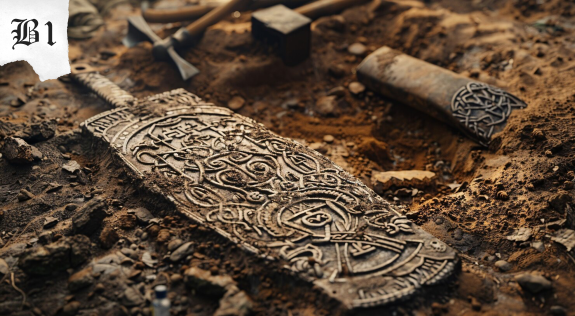
The hoard, a mix of gold and silver artifacts, appears to have belonged collectively to a “community,” mirroring its modern public ownership under National Museums Scotland (NMS) since 2017. A breakthrough came from a recently decoded runic inscription on a silver arm ring: “This is the community’s wealth.”
Dr. Martin Goldberg of NMS noted the timing coincided with the treasure’s first international exhibition in Australia: “We’re sharing it globally, aligning with its inscribed message of shared ownership.”
Experts initially puzzled over the cryptic inscription (“DIS IS ЇIGNA ˑFˑ”). The final rune “F,” flanked by dots, was identified as "feoh" (Old English for “wealth”), while “ЇIGNA” translates to "higna" (“community”). “DIS” is likely a misspelling of “this,” possibly reflecting regional pronunciation akin to parts of modern Ireland.
Goldberg highlighted the rarity of such terminology on jewelry: “Higna typically appears in legal documents, not decorative objects. This blurs lines between symbolic and practical ownership.”

The secret of Viking-era treasure discovered in Scotland might finally be uncovered (B1)

Readaily / Articles by 🇬🇧 level for every day
The secret of Viking-era treasure discovered in Scotland might finally be uncovered (B1).mp3
0:00
1:55
In 2014, the Galloway hoard – the largest Viking-era treasure ever found in Britain or Ireland – was discovered in a Scottish field. Buried around AD 900, its ownership mystery may now be solved.
The hoard, filled with gold and silver items, likely belonged to a community over 1,000 years ago. Today, it is publicly owned after being acquired by National Museums Scotland (NMS) in 2017. A key clue came from a runic inscription on a silver arm ring: “This is the community’s wealth.”
Dr. Martin Goldberg of NMS explained the timing: “We’re sharing it globally, starting with Australia. Everyone owns part of this treasure, as the inscription suggests.”
Experts initially struggled to decode the runes (“DIS IS ЇIGNA F”). They realized “F” represented "feoh"(Old English for “wealth”), while “ЇIGNA” meant "higna" (“community”). “DIS” was likely a misspelling of “this.” Goldberg noted it’s rare to see “community” on jewelry – such terms usually appeared in legal documents.
Dr. David Parsons, a runic expert, called the inscription “unusual” with technical errors. However, regional language variations, like those in modern English, made the message plausible.

Mystery of Viking gold found in Scotland might be answered after many years (A2)

Readaily / Articles by 🇬🇧 level for every day
Mystery of Viking gold found in Scotland might be answered after many years (A2).mp3
0:00
2:00
In 2014, a metal detector found the Galloway hoard in a farm field in Scotland. It is the biggest Viking-era treasure ever discovered in Britain or Ireland. After 1,000 years, experts think they know who owned it.
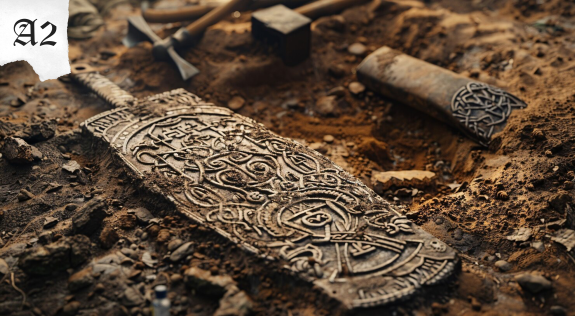
The treasure, made of silver and gold, belonged to a whole community long ago. Today, it belongs to everyone because a museum bought it in 2017. A clue came from old Viking writing on a silver arm ring. The words say: “This is the community’s wealth.”
Dr Martin Goldberg, a museum expert, said this discovery happened while the treasure was sent to Australia for display. “We’re sharing the treasure with the world, just like the writing says,” he explained.
At first, experts couldn’t read the strange words on the arm ring: “DIS IS ЇIGNA F.” Later, they learned “F” meant “wealth” in Old English, and “ЇIGNA” meant “community.” The word “DIS” was likely a misspelling of “this.”
Dr Goldberg said it’s unusual to see “community” written on jewelry.
Normally, such words were used in official papers about land or money.

Secret of old Viking treasure found in Scotland maybe discovered now (A1)

Readaily / Articles by 🇬🇧 level for every day
Secret of old Viking treasure found in Scotland maybe discovered now (A1).mp3
0:00
2:06
In 2014, people found very old Viking treasure in a field in Scotland. It is called the Galloway hoard. It is the biggest Viking treasure ever found in Britain or Ireland. Now, after 1,000 years, we might know who owned it.
The treasure has silver and gold things. Today, it belongs to everyone because a museum bought it in 2017. A silver arm ring in the hoard has old writing on it. The writing says: “This is the community’s wealth.”
A museum expert, Dr Martin Goldberg, said this discovery is special. The treasure is now in Australia for people to see. He said, “Everyone owns a little of this treasure, like the writing says.”
Before, experts did not understand the writing on the arm ring. The words did not match old languages. Later, they saw the word “F” could mean “wealth.” Another word, “higna,” means “community” in old English. The first word might be a mistake for “this.”
Dr Goldberg said it is interesting to see “community” written on an arm ring. Usually, this word is in papers about land or money.
Another expert, Dr David Parsons, said the writing is strange. It has mistakes, but people today speak and write differently too. So, the message makes sense.

From Dogecoin to $Trump: The Ins and Outs of the Wild Meme Coin Universe (B2)

Readaily / Articles by 🇬🇧 level for every day
From Dogecoin to $Trump. The Ins and Outs of the Wild Meme Coin Universe (B2).mp3
0:00
4:54
Three days prior to his presidential inauguration, Donald Trump made headlines by launching $Trump, a cryptocurrency dubbed namecoin – a digital asset rooted in internet culture. Market ed to supporters and speculators, the coin’s value surged from 7 to 75 within 24 hours, as reported by CoinMarketCap. However, it plummeted to 40 shortly after, coinciding with Melania Trump’s release of her own token, $Melania, and a promotional push by inauguration pastor Lorenzo Sewell. This frenzy underscores a broader trend: the chaotic rise of meme coins, where virality often overshadows utility.
What Defines a Meme Coin?
Meme coins are cryptocurrencies inspired by internet jokes, viral trends, or pop culture. The pioneer, Dogecoin, emerged in 2013 as a parody of Bitcoin, featuring the Shiba Inu dog meme. Unlike Dogecoin, which operates on its own blockchain (a decentralized ledger system), most modern meme coins exist as tokens on established blockchains like Ethereum. Simon Peters, a crypto analyst at eToro, explains, “Tokens require minimal technical effort to create, which is why millions flood the market – their sole purpose is speculative trading.”
The Allure and Risks of Meme Coins
Investors are drawn to meme coins by the prospect of rapid wealth. Yet, these assets are notoriously volatile and prone to manipulation. Carol Alexander, a finance professor at Sussex University, notes, “Most are ‘pump and dump’ schemes. Creators hoard tokens, artificially inflate demand through social media hype, then sell their holdings, leaving others with worthless coins.” The lack of regulation in crypto markets exacerbates risks, offering little recourse for duped investors.

From Dogecoin to $Trump: Understanding the Wild World of Meme Coins (B1)

Readaily / Articles by 🇬🇧 level for every day
From Dogecoin to $Trump. Understanding the Wild World of Meme Coins (B1).mp3
0:00
4:12
Just three days before his presidential inauguration, Donald Trump made a surprising move: he launched $Trump,a cryptocurrency tied to internet jokes, known as a memecoin. Supporters and investors rushed to buy it, hoping its value would rise. Initially,Trump skyrocketed from 7 to 75 in a single day. However, its price soon dropped to around $40. Around the same time, Melania Trump and even the pastor at Trump’s inauguration ceremony created their own meme coins, jumping on the trend.
What Are Meme Coins?
Meme coins are cryptocurrencies inspired by internet jokes or viral trends. The most famous example is Dogecoin, created in 2013 as a joke based on a popular meme of a Shiba Inu dog. Unlike Dogecoin, which runs on its own blockchain (a decentralized digital ledger), most new meme coins are tokens. This means they are built on existing blockchains, like Ethereum or Solana, making them cheap and easy to create.
Why Do People Invest in Meme Coins?
The main reason is speculation. Buyers hope to get rich quickly if the coin’s value rises. However, experts warn that most meme coins fail. They are highly volatile and often tied to scams like “pump and dump” schemes. In these scams, creators promote a coin to inflate its price, then sell their own holdings, causing the value to crash. “It’s like a game where ordinary people always lose,” says Carol Alexander, a finance professor.
Subscription levels1

One Coffee Price

$2.93 per month
Access to all articles without restrictions
+ article tests
+ audio versions of articles
Go up